
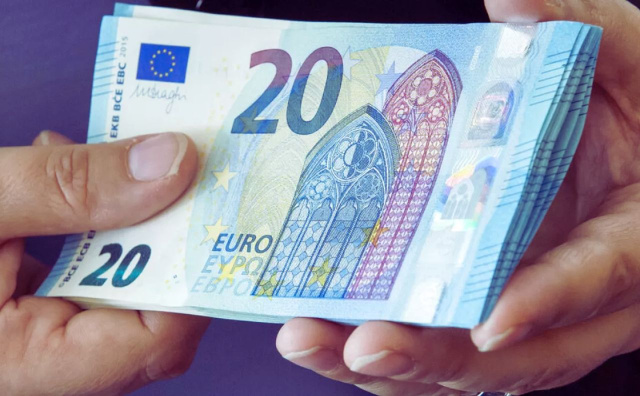
As Bulgaria prepares to enter the eurozone on January 1, 2026, attention is increasingly turning to the security of euro banknotes and coins. Financial authorities stress that while the euro is among the most protected currencies globally, attempts at counterfeiting still occur, making basic knowledge of security features essential for everyday users.
The European Central Bank and the Bulgarian National Bank advise citizens to rely on a simple but effective method for verification, known as “Touch, Look, Tilt”. It allows anyone to check a banknote quickly without special equipment.
The first step is touch. Genuine euro banknotes are printed on special cotton-based paper, not ordinary cellulose. This gives them a firm, crisp feel and a characteristic “rustle” when handled. Several elements on the front are printed in relief, including parts of the main image, inscriptions and the large denomination number. Short raised lines can also be felt along the left and right edges, a feature designed to help visually impaired users.
The next step is look. When held against the light, several security elements become visible. A watermark appears in the blank area, showing the portrait of Europa from Greek mythology together with the value of the banknote. A vertical security thread runs through the paper, displaying the euro symbol and the denomination in tiny lettering. On banknotes of 20 euro and above, a transparent portrait window is integrated into the hologram strip, revealing Europa’s image when viewed against the light.
The final step is tilt. When the banknote is moved, the holographic elements on the silver stripe change, showing the portrait of Europa, the euro symbol and the denomination. Another key feature is the so-called emerald number. Located in the lower corner, it shifts in color from emerald green to dark blue when the banknote is tilted, creating a moving light effect.
Many people wonder whether the country of issuance matters. Each euro banknote carries a serial number beginning with a letter that indicates where it was printed, such as X for Germany, Y for Greece or U for France. Financial experts are clear that this code has no impact on validity or authenticity. All euro banknotes are legal tender throughout the eurozone, regardless of their place of origin.
Euro coins can also be checked visually and by touch. The 1 and 2 euro coins are bimetallic, made from two different metals, which makes counterfeiting particularly difficult. While each country issues coins with its own national design on the reverse side, all coins share a common European side and are accepted everywhere in the euro area. Bulgarian euro coins will feature national symbols, including the Madara Horseman, St Ivan of Rila and Paisius of Hilendar, alongside Cyrillic inscriptions.
If there is any suspicion that a banknote or coin is counterfeit, it should not be used for payment, as knowingly circulating fake money is a criminal offence. The recommended course of action is to compare it with a known genuine banknote and then take it to a commercial bank, the Bulgarian National Bank or, if necessary, report the case to the police for further проверки.