
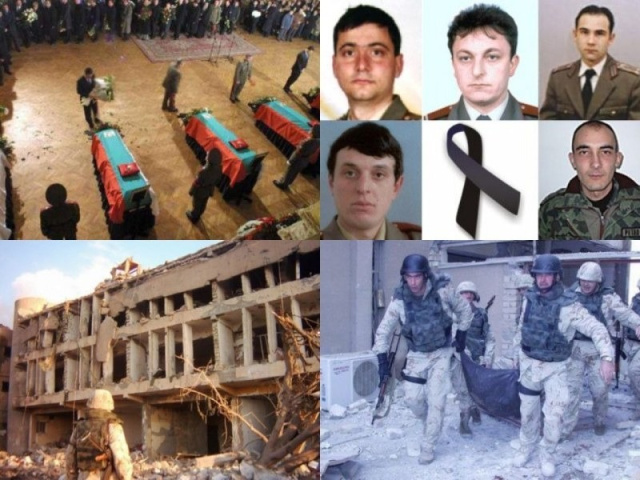
Twenty-two years have passed since the deadly attack in the Iraqi city of Karbala that claimed the lives of five Bulgarian servicemen. A truck bomb rammed into Camp India, where the Bulgarian contingent was stationed, killing Georgi Kachorin, Ivan Indjov, Svilen Kirov, Nikolay Saryev and officer candidate Anton Petrov.
More than two decades later, the memory of the fallen remains alive not only through official commemorations, but also through personal acts of remembrance. For 22 consecutive years, Ivanka Petrova, Anton Petrov’s mother, has funded a scholarship awarded annually to the top student at the Professional High School of River Shipbuilding and Navigation in Ruse. At the same time, former comrades-in-arms continue their efforts to see a national monument erected in Sofia in honor of the soldiers who died.
The scholarship, given in Anton Petrov’s name, is intended to ensure that his sacrifice is not forgotten. According to Ivanka Petrova, each new generation of students learns about her son, about military service, and about the tragedy in Karbala. The school has preserved his memory through donated textbooks he once used and a dedicated corner honoring the Bulgarian Army. Principal Ivelina Georgieva told Bulgarian National Radio that Anton Petrov holds a special place in that space, ensuring that students continue to connect with his story.
One of this year’s scholarship recipients, ninth-grader Adis Petrov, was born after the attack in 2003, often referred to as “Bloody Christmas.” Yet he says receiving a scholarship bearing the name of a fallen soldier has made the event tangible and meaningful for him. In his words, the award represents far more than financial support. It stands as a reminder of duty, courage and devotion to the homeland.
Details of the attack emerged more clearly after an “incident clarification report” was declassified in 2014. The document shows that on December 27, 2003, Camp India functioned as a standard military base, formally prepared to repel hostile action. However, the northern gate leading to the helipad lacked the level of fortification seen at the main entrance. The gate was a corner structure covered with sheet metal, and unlike other sections of the perimeter, no trench had been dug in front of it. The trench was intentionally omitted to allow easier maneuvering of vehicles unloading supplies from American helicopters, but by the day of the attack it still had not been completed.
The report raises additional questions. It remains unclear whether proper shelters had been constructed to protect personnel from mortar fire, and documentation detailing the internal layout of the base such as sleeping quarters, offices, guard rooms and rapid reaction facilities was not presented. Despite this, inspections conducted by senior officers and generals prior to the attack had rated the base’s security and equipment positively.
Autopsies revealed that none of the soldiers had sustained chest injuries, leading investigators to conclude they were wearing protective vests. Fatal injuries were concentrated in the head area, caused by the blast wave, shattered glass and debris from the explosion. The report ultimately states that access to the attacked gate should have been more strictly limited and notes the absence of automated heavy-duty barriers. It also highlights coordination problems between the Polish brigade headquarters and the Bulgarian infantry battalion, which at the time lacked staff officers within the brigade command structure. Additionally, the battalion did not have sufficient trained specialists, financial resources or time to gather adequate intelligence, limiting its ability to counter groups loyal to Iraq’s former regime.
Looking back, Hristo Hristov, who was then deputy commander of a multinational brigade and Bulgaria’s senior national representative, says the price paid in Karbala reflected hard lessons learned under real combat conditions. He notes that Bulgaria’s previous missions in Kosovo and Bosnia and Herzegovina did not prepare troops for the realities they faced in Iraq. According to him, the experience cannot be directly transferred to modern warfare, as the nature of conflict has evolved dramatically, with technology, drones and new forms of combat reshaping battlefields and military training alike.
Despite this, Hristov firmly believes that Bulgaria’s participation in Iraq had lasting significance. He points out that 13 Bulgarian soldiers lost their lives during the mission, but insists their sacrifice was not in vain. In his view, the operation played a key role in Bulgaria’s accession to NATO, demonstrating to allies that Bulgarian troops were capable, disciplined and equal to their counterparts. He says the respect earned during the Karbala deployment remains an important part of the army’s legacy.
For Adis Petrov, the scholarship will be used not for military ambitions, but to support his development as an athlete. He studies forwarding, a field he sees as having strong future prospects, and plans to invest the funds in swimming equipment. A state champion in the 50-meter butterfly, he says he draws inspiration from Anton Petrov’s determination and resolve, even if their paths differ.
This year, as every year, memorial services will take place in the hometowns of the five fallen soldiers, as well as in Karlovo, in front of the 61st Mechanized Brigade. Since 2005, December 27 has been observed there as a day of remembrance at a monument dedicated to servicemen killed in the fight against global terrorism. Efforts to establish a similar site in Sofia continue, though bureaucratic obstacles have delayed the project. According to Hristov, plans exist, but infrastructure projects and administrative hurdles have slowed progress.
He expresses hope that these obstacles will eventually be overcome, allowing the capital to host a monument worthy of the fallen. Addressing younger generations, Hristov urges them to take pride in the soldiers who served in Karbala, emphasizing that they fought side by side and proved the strength and honor of the Bulgarian soldier.