
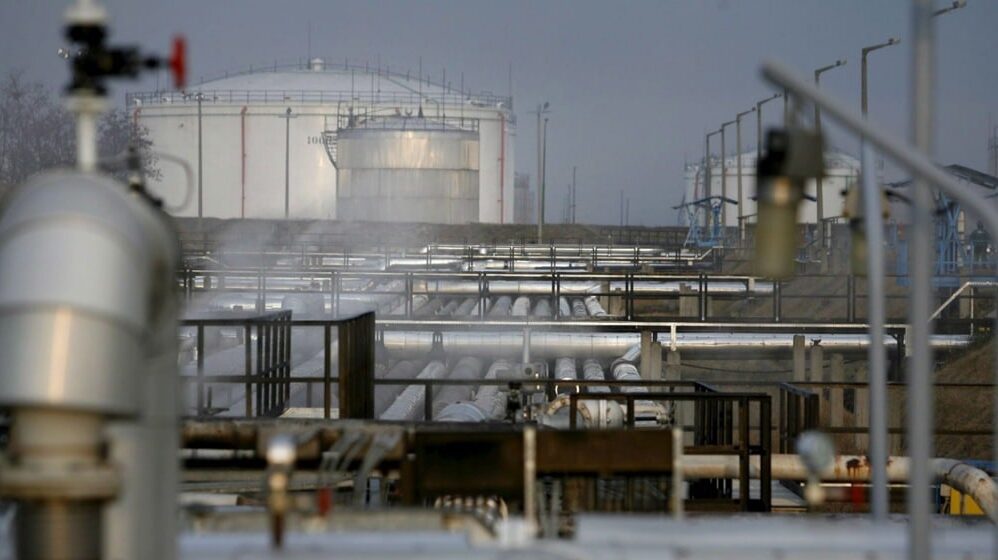
Oil, however, presents a more complex challenge for the two countries.
Hungary and Slovakia rely heavily on Russian crude oil transported via the Druzhba pipeline. Druzhba supplies close to 90 per cent of Hungary’s oil needs and 87 per cent of Slovakia’s.
The latter’s sole refinery, Slovnaft – owned by Hungary’s MOL – produces 5-6 million tonnes of oil products each year, mostly for export. With EU exemptions on Russian oil product exports for Slovnaft now expired, and as the company continues diversifying, it warns that without the Druzhba pipeline it cannot guarantee long-term supply stability or affordable fuel.
But energy analyst Radovan Potocar calls Druzhba “the least reliable” route available to Slovakia, warning that flows could stop at any moment during Russia’s war in Ukraine. He points to alternative options – the Adria pipeline from Croatia, reverse flows from Czechia, or supplies shipped to Ukraine’s port of Odessa and then pumped west through through the Odessa-Brody pipeline, where they would connect to Druzhba.
Austria’s proposal for a new Bratislava–Schwechat oil pipeline was shelved last year, partly over Slovakia’s environmental concerns and partly because Vienna no longer buys Russian crude.
Croatia has been pushing the expansion of the Adria pipeline, which currently supplies Hungary’s MOL with about 1.2 million tonnes of crude oil annually from the Adriatic.
JANAF, the state-controlled operator of Adria, has expressed its willingness to increase the capacity of the pipeline. “Croatia can guarantee today both to Hungary and to Slovakia that it can supply them with more than 12 million tonnes of oil, any blend needed, in order to cater for all the needs for the Szazhalombatta refinery, which is in Hungary, and the Bratislava refinery in Slovakia,” Croatian Prime Minister Andrej Plenkovic said in an interview with CNN on September 15.
“We believe that there is no risk for the supply of oil to two of our neighbouring countries, which we would like to help when it comes to energy security,” he asserted.
To verify Plenkovic’s claims, BIRN asked JANAF whether it had the technical capacity to supply both Hungary and Slovakia with oil. “JANAF is fully technically and organisationally ready to fully meet all the annual needs of MOL’s Central European refineries for crude oil, for which it has given a guarantee to MOL, the Republic of Croatia and the European Union,” JANAF answered unequivocally.
“The tests carried out on the flow of the oil pipeline from Omisalj to the Hungarian border, with a 95 per cent pipeline utilisation and the ability of MOL Group to take over crude oil at the delivery point, guarantee the transport of 12.9 million tonnes per year,” JANAF said, adding that MOL is a long-standing partner of JANAF.
Independent experts, however, continue to raise concerns about capacity issues. “The fact that a pipeline operates at a given capacity for a month is very different from maintaining continuous, long-term operations,” Attila Holoda, a former MOL executive and an ex-deputy state secretary, told the Hungarian investigative news site G7.
The energy analyst Potocar also warns that Slovakia shouldn’t rely solely on the Adria pipeline, noting it has never delivered crude to Slovakia year-round. “If there is a logistical problem, because of limits at the terminal, there may simply not be enough oil,” he told Hospodarske noviny.
In an emailed statement to BIRN, MOL said that last week it and JANAF conducted several joint tests on the pipeline, though the results didn’t yet confirm it is capable of delivering a sufficient quantity of crude oil from the Adriatic Sea to Hungary and Slovakia on a long-term basis. During the tests, the pipeline was not able to operate at the required capacity for more than one to two hours at a time, it said.
“It is important to emphasise that the Adriatic pipeline plays a critical role in supplying Central Europe. However, in order for it to play a greater role beyond its current supplementary function, we must first have a clear understanding of what the Croatian section of the Adriatic pipeline is capable of and what condition it is in. Only then can we determine what is needed for it to reliably transport up to 40,000 tonnes of crude oil per day throughout the year,” the statement said.
Other concerns centre on the political tensions between the two governments and the profits MOL makes from the price differential between Russian Urals crude and Brent oil. Between 2022 and March 2025, Hungary earned close to 900 billion forints (2.3 billion euros) on the price differential between Russian Urals and Brent crude, out of which over 500 billion forints was paid into the Hungarian budget as a windfall tax, while 400 billion remained with MOL, the investigative news site G7 revealed.
Meanwhile, Hungary and Croatia have been at loggerheads since MOL acquired a 49 per cent stake in Croatia’s state energy company INA, including management rights, in 2009. The Croatian government accused MOL’s CEO, Zsolt Hernadi, of bribing the Croatian prime minister at the time, Ivo Sanader, who was sentenced to prison, while an international arrest warrant was issued for Hernadi. The MOL chief executive claims the case against him is politically motivated and denies any wrongdoing, but his international travels have been seriously curtailed by the case. Sanader was released on parole in July after serving 11 years of an 18-year jail sentence.
The energy analyst Pletser concedes “it is a strained relationship” between Hungary and Croatia. “A high-level meeting between the prime ministers would probably help and a long-term contract for yearly 10-12 million tonnes could be signed. The pipeline should be tested gradually, to see whether it can really reliably supply the region with crude oil.”
The Hungarian political expert Kiszelly also sees the problem as more political than practical: “We don’t want to be entirely at Croatia’s mercy, especially when their government regularly votes against Hungary in the EU.”
He also argues that Russian Urals crude is of superior quality to Western variants, providing MOL with a range of valuable byproducts. Moreover, it remains Russia’s last major energy link with an EU member state, preserving Moscow’s hope of eventually returning to the lucrative European market once the war ends.