
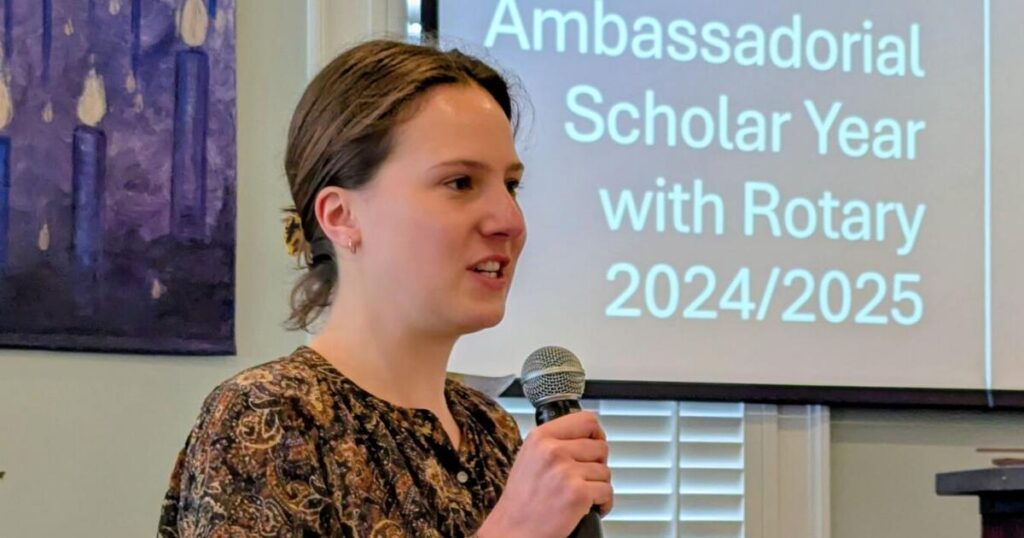
One-time Rotary high school exchange student Lizzie Russler once again represented Rotary International in her latest foreign adventure more than a decade later as a master’s scholar at Imperial College in London, England.
Russler recounted the scope and results of her four terms of study at the Dec. 17 Rotary Club of Mount Pleasant meeting.
Her global excursion saw the climate and human rights advocate take several science, law and environmental classes during the first part of her experience, followed by her analysis of financial mechanisms to manage catastrophic risk.
In studying the impacts of climate adaptation, Russler sought to investigate the funding mechanisms behind actions that help reduce the vulnerability to climate impacts, weather extremes and food insecurity.
From this past May through June, the Ashley Hall product dove in on the local delivery of climate adaptation finance within three “informal” settlements in Freetown, Sierra Leone.
Her time in Africa afforded Russler the opportunity to examine if the local climate-vulnerable communities had sufficient resources for building resilience.
“They are seeing increasingly erratic precipitation, as well as major temperature increase,” she outlined. “And sea level rise is a big part of this as well. You’re seeing intense rainstorms, flooding, coastal erosion … [and] also landslides.”
A 2017 landslide, in fact, resulted in the death of more than 1,000 residents, per the guest speaker.
To that end, the Rotary Global Grant recipient zeroed in on how climate adaptation funding would create pathways to reduce the climate-related risks.
In the process in conducting 30 interviews and attending two community stakeholder engagement sessions, Russler listened to what community members were seeing and what their needs were.
Further, Rotarians were clued in on Sierra Leone’s historical tie-ins with Charleston. Freetown, she mentioned, was the largest exporting port during the transatlantic slave trade, with most of the captives being transported to South Carolina, Georgia and North Carolina. The newcomers introduced the new world to the Gullah Geechee culture, including their local dialects and food staples.