
Türkiye’s energy sector saw significant progress this year, driven by higher domestic oil and natural gas production, rapid expansion of renewable capacity and stronger international cooperation.
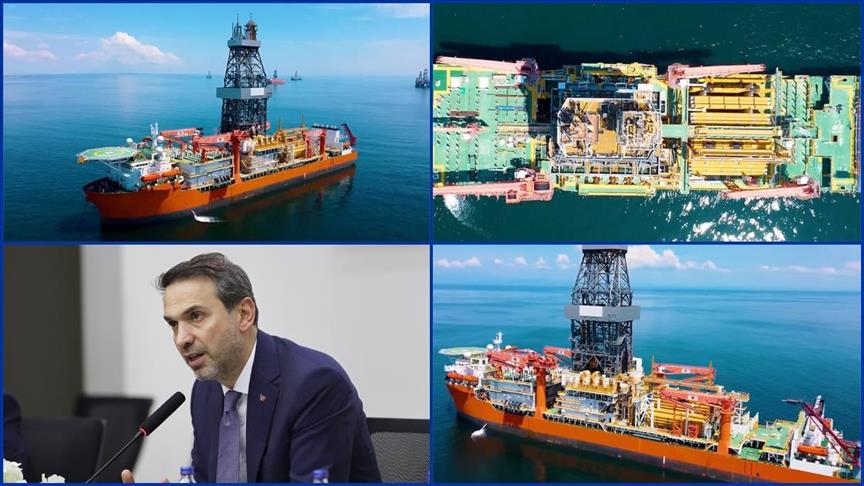
Hydrocarbon exploration and production in the Black Sea accelerated, with daily output from the Sakarya Gas Field reaching 9.5 million cubic meters (mcm), Energy and Natural Resources Minister Alparslan Bayraktar said on April 21. President Recep Tayyip Erdogan later announced the discovery of a new 75 billion cubic meter (bcm) gas reserve in the Black Sea on May 17 and confirmed the successful completion of drilling at the Goktepe-3 well by the drillship Abdulhamid Han.
Another milestone came with the arrival of Türkiye’s first floating gas production platform, Osman Gazi, at Filyos Port on May 31. The facility, with a daily processing capacity of 10.5 mcm, is expected to lift Black Sea gas output to 20 mcm per day.
In addition, regulatory changes approved on Oct. 18 paved the way for exporting Black Sea gas as LNG, following a decision by the Energy Market Regulatory Authority.
– Türkiye expands deep-sea drilling fleet
In 2025, Türkiye advanced its offshore energy ambitions by announcing plans to expand its deep-sea drilling fleet, welcoming a new ultra-deepwater drillship for Mediterranean operations, and deploying a sixth vessel to support subsea pipeline installation in the Sakarya Gas Field.
On July 17, President Erdogan revealed plans to expand Türkiye’s deep-sea drilling fleet from four to six vessels, a move that would place the country fourth globally in terms of fleet size.
On Sept. 30, as part of the expansion, a new ultra-deepwater drillship arrived in the southern province of Mersin and is set to be deployed in Mediterranean operations.
On Dec. 3, a sixth deep-sea vessel reached Mersin and will be used to lay subsea pipelines for Phase 2 of the Sakarya Gas Field, transporting gas to the Osman Gazi Floating Production Unit.
– Domestic oil output gains momentum
Throughout 2025, Türkiye accelerated its energy push by boosting daily oil production, partnering with US firms to develop unconventional resources, discovering new reserves across multiple provinces, and deploying new drilling rigs to strengthen operations in Sirnak.
On March 8, Minister Bayraktar announced that Türkiye’s daily oil production reached 132,000 barrels. On May 19, he noted that output in the Gabar region of Sirnak rose to 81,000 barrels per day.
On March 12, state-owned Turkish Petroleum Corporation signed a joint venture agreement with US companies Continental Resources and TransAtlantic Petroleum to develop unconventional oil and natural gas resources in Diyarbakir.
On July 30, Bayraktar said that Türkiye discovered 57 million barrels of oil reserves worth about $4 billion this year in Diyarbakir, Gabar and Batman.
On Aug. 27, two new drilling rigs, Seyit Onbasi and Naim Suleymanoglu, began operations in oil fields in Sirnak.
– Energy cooperation agreements broaden
Türkiye strengthened its regional and international energy cooperation this year through a series of agreements and projects.
On Feb. 11, Türkiye and Turkmenistan signed an agreement between BOTAS and Turkmengaz to supply Turkmen natural gas to Türkiye, with deliveries starting on March 1 under a swap arrangement.
On March 5, the Igdir–Nakhchivan natural gas pipeline, described as a symbol of Türkiye–Azerbaijan ties, was inaugurated.
In May, Minister Bayraktar said a BOTAS-owned floating storage and regasification unit would operate abroad for the first time under an agreement with Egypt’s state energy company EGAS.
On June 3, Türkiye expanded upstream partnerships, with TPAO acquiring a 30% stake in Azerbaijan’s Shafag-Asiman gas field.
On June 25, the country signed a deal with Libya’s National Oil Corporation for geological and geophysical studies in four offshore areas.
On Aug. 2, natural gas exports from Türkiye to Syria began via the Türkiye–Syria pipeline through Kilis.
On Sept. 27, oil flows through the Iraq–Türkiye pipeline resumed after being halted since the February 2023 earthquakes.
On Dec. 2, Bayraktar said that Türkiye plans to explore for oil and gas in offshore and onshore areas in Pakistan in 2026.
– Türkiye strengthens LNG portfolio
Türkiye expanded its LNG portfolio this year through a series of long- and medium-term agreements with major energy companies.
On Sept. 9, BOTAS signed three-year LNG supply deals with bp, Eni and Shell during the Gastech 2025 forum in Milan, securing a combined 8.7 bcm. A separate strategic cooperation agreement with Oman LNG aims to boost production capacity in Oman and expand cooperation on FSRUs, LNG carriers and future LNG purchases.
On the sidelines of the forum, TPAO subsidiary TP-OTC and Baker Hughes signed an agreement to support Phase 3 output targets at the Sakarya Gas Field, including the supply of subsea systems and well completion equipment to help raise Black Sea production to 40 mcm per day by 2028.
On Sept. 10, Türkiye signed LNG purchase agreements with eight additional companies, securing about 15 bcm of supply for 2026–2028. The deals include supplies from Hartree, Cheniere, SEFE, JERA and Equinor.
On Sept. 24, further strengthening long-term supply, BOTAS signed a 20-year LNG agreement with Mercuria covering around 70 bcm from 2026 to 2045.
On Dec. 3, BOTAS also signed two 10-year LNG contracts with Germany’s SEFE and Italy’s Eni, totaling 11 bcm and set to begin in 2028.
– Renewable capacity grows through YEKA tenders
Introduced in 2016, the Renewable Energy Resource Area (YEKA) tenders have been the main drivers of growth in renewable energy, both in terms of technology development, equipment manufacture, and electricity generation.
The first YEKA wind power tender of the year took place on Jan. 28, followed by a second round on Dec. 9. In the solar segment, the initial YEKA tender was held on Feb. 4, with a second tender conducted on Nov. 19.
Minister Bayraktar said the solar and wind YEKA tenders held this year generated about €530 million in revenue. He noted that the projects are projected to save nearly 1 bcm of natural gas each year, amounting to approximately $8.5 billion in savings over a 25-year period, while supplying electricity to roughly 1.5 million households through investments totaling $1.1 billion.
Separately, President Recep Tayyip Erdogan announced on Nov. 23 that Türkiye is prepared to host the UN Climate Change Conference, COP31, in November 2026. Speaking at the G20 summit in South Africa, Erdogan said the conference would be held in the Mediterranean resort city of Antalya.
– Akkuyu nuclear project reaches key phase
The commissioning process for the first unit of Türkiye’s first nuclear power plant, Akkuyu, began on July 2. Akkuyu Nuclear JSC Chairman Anton Dedusenko said construction of the 1,200-megawatt Unit 1 has been completed and trial operations are underway.
Each of the plant’s four reactors is scheduled to come online at one-year intervals, and once fully operational, Akkuyu is expected to meet about 10% of Türkiye’s electricity demand.
Türkiye also plans to build additional nuclear power plants in Sinop and Thrace.
On Sept. 25, Türkiye and the US signed a memorandum of understanding on strategic civilian nuclear cooperation.
On Nov. 6, Minister Bayraktar also announced the start of technical studies in the field of nuclear energy with Canada-based AtkinsRéalis, including discussions on potential cooperation and the use of CANDU reactor technology.
– Transmission infrastructure investments expand
Türkiye secured $748 million in concessional financing from the World Bank this year to upgrade and expand its electricity transmission network, raising total external concessional funding for 2025 to nearly $7 billion.
On Oct. 6, the financing agreement was signed between the Turkish Electricity Transmission Corporation (TEIAS) and the World Bank.
On Nov. 24, Energy Minister Bayraktar said that an agreement was reached with World Bank Vice President for Europe and Central Asia Antonella Bassani to launch work on a financing package initially valued at $6 billion.
By Ebru Sengul Cevrioglu
Anadolu Agency
energy@aa.com.tr
related news