
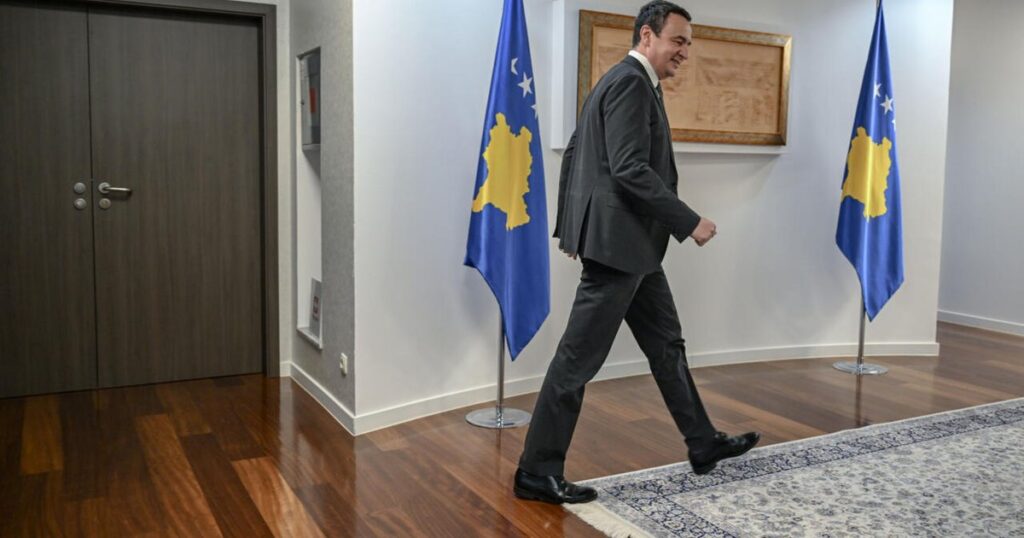
The Balkan country will go to the polls on Sunday, after nearly a year of political deadlock that has caused “colossal damage” to its economy.
Before the first vote is cast in Sunday’s snap elections in Kosovo, experts predict that these elections are unlikely to end the political crisis that has gripped Europe’s newest country for nearly a year.
The Balkan nation has been politically deadlocked since February elections, in which Prime Minister Albin Kurti’s Vetëvendosje (VV) party won but without enough seats to form a government.
After months of debate in a deadlocked parliament, the incumbent prime minister is returning to the electorate in a vote that analysts say will change little.
“I think the December 28 elections will not bring any clarity,” says economist Mehmet Gjata, predicting that Kurti’s party would come out on top again.
Political analyst Fatime Hajdari also agrees that “the chances were high” that VV would secure more votes, but said that few other things were clear.
Albin Kurti’s impossible chances
While experts are not betting on an end to the blockade, if anyone can secure a majority, it is likely to be Kurti.
His party came to power in 2021 in the biggest electoral victory since the country’s independence from Serbia in 2008, taking over 50% of the vote.
From a radical student to a political prisoner – in a past when he was called the “Che Guevara” of Kosovo – Kurti’s long path to prime minister has made him one of the most well-known and influential politicians in Kosovo.
His blend of nationalism and a reform agenda has proven popular in a country whose sovereignty is still contested by Serbia, more than two decades after the end of its war for independence.
However, Gjata says things may have changed since Kurti’s last term.
“I fear that the current political crisis will repeat itself, because VV will not get more than 50% of the votes,” says the economist. “We will no longer have winners.”
The largest opposition parties have refused to join a coalition with Kurti, indicating a fragmented parliament.
The only realistic challenge for the VV would be “cooperation” between the three main opposition parties, says former foreign minister and opposition candidate Enver Hoxhaj. “I think only they can provide stability,” Hoxhaj said.
Bedri Hamza – the challenger
Bedri Hamza, a former central bank governor and newly elected president of the Democratic Party of Kosovo (PDK), is seen as Kurti’s strongest challenger.
Born from a guerrilla movement during the war against Belgrade rule, the PDK dominated Kosovo’s political scene for years, riding the wave of wartime popularity.
However, its influence gradually faded as the country moved beyond the conflict.
Since then, the party has reinvented itself with figures like Hamza, who blend national values ??with liberal economic policies that support free markets, economic growth, a stronger private sector, and social protection.
Lumir Abdixhiku – the rising contender
Lumir Abdixhiku is the youngest candidate for prime minister, but he leads the country’s oldest political party, the Democratic League of Kosovo (LDK).
The 42-year-old economist was an academic focused on tax evasion in transition economies before entering politics and serving as Kosovo’s infrastructure minister.
Abdixhiku also spent several years as a newspaper columnist, writing the well-known column “Letters from Limbo” in the daily newspaper “Koha Ditore”.
He became leader of the LDK in 2021, just a month after the party suffered a crushing parliamentary defeat. Abdixhiku promised reforms and implemented them, replacing most of its leadership with younger activists.
Now the third largest party in parliament, LDK could play a decisive role in these elections, as both the left and the right seek its support for a coalition.
The crisis has caused ‘colossal’ economic damage.
Without a parliament, key international agreements have not been ratified, putting hundreds of millions of euros in aid funds at risk.
Two national elections and one local election have cost one of Europe’s poorest countries at least 30 million euros this year.
Over a dozen government institutions and agencies have also been left without leaders, as the terms of their leaders expired without new people being appointed.
Gjata says “colossal damage” has been caused to the economy by divided lawmakers in recent months. “They have plunged Kosovo into a state of anarchy,” he says.
As lawmakers bickered, the cost of the crisis was being felt by the Balkan country’s citizens, Hajdari warned. “That’s precisely why Kosovo needs a stable and functional government that would focus on development and welfare.” / AFP