
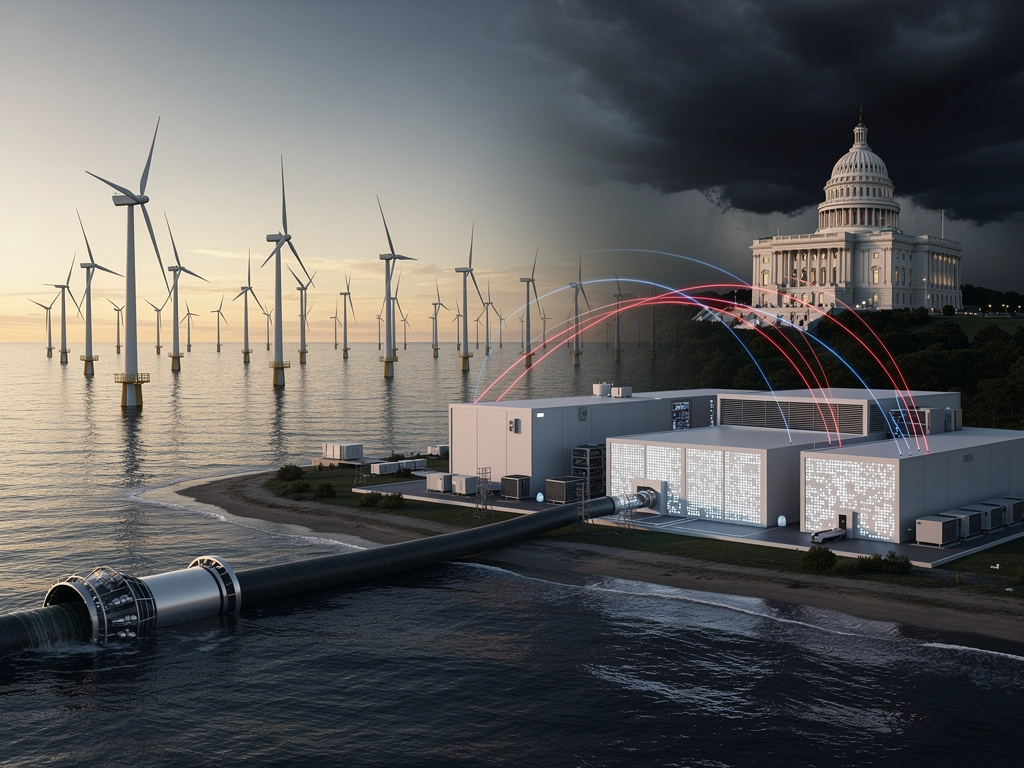
In the waning days of 2025, the intersection of renewable energy ambitions, political maneuvering, and the insatiable power demands of artificial intelligence has ignited a high-stakes legal battle. Dominion Energy, a major utility provider in Virginia, has filed a lawsuit against the Trump administration’s abrupt decision to pause several offshore wind projects, including its flagship Coastal Virginia Offshore Wind (CVOW) initiative. This move, announced just before the holidays, cites nebulous national security concerns but threatens to disrupt a critical source of clean energy for the region’s booming data center sector.
The lawsuit, lodged in federal court, accuses the administration of issuing an “arbitrary and capricious” order that halts construction on CVOW and four other projects. Dominion argues that the pause, imposed by the Interior Department under Secretary Doug Burgum, lacks substantive evidence and could cost the company over $5 million daily in delays. This isn’t merely a spat over turbines; it’s a clash that underscores broader tensions in America’s energy framework, where the push for renewables collides with geopolitical priorities and the explosive growth of AI infrastructure.
At the heart of the dispute is CVOW, a massive 2.6-gigawatt project off Virginia’s coast, designed to power hundreds of thousands of homes and, crucially, the data centers clustered in Northern Virginia—often dubbed “data center alley.” These facilities, operated by tech giants like Amazon, Google, and Microsoft, are voracious consumers of electricity, with AI training and operations driving unprecedented demand. Dominion’s suit highlights how the halt jeopardizes grid reliability at a time when U.S. electricity consumption is surging for the first time in a decade, largely due to AI’s energy-intensive needs.
Escalating Tensions in Renewable Energy Policy
The Trump administration’s rationale for the pause, as detailed in statements from the Interior Department, revolves around Pentagon-identified national security risks. Officials claim that offshore wind farms could interfere with military radar systems, navigation, and training operations in the Atlantic. This echoes long-standing concerns from defense circles, but critics, including Dominion, contend it’s a pretext for broader antagonism toward wind energy—a stance Trump has publicly derided as unreliable and visually unappealing.
Drawing from recent coverage, The Verge reports that the utility’s legal filing emphasizes the project’s role in supporting Virginia’s data centers, which are pivotal to the AI boom. The pause, effective for 90 days but potentially extendable, comes amid a surge in AI-related power demands that have utilities scrambling. Dominion warns that without CVOW’s projected 2026 completion, the grid could face strains, forcing reliance on fossil fuels and delaying carbon reduction goals.
This isn’t the first time offshore wind has faced headwinds under Trump. During his first term, similar projects encountered regulatory hurdles, and his return to office has revived vows to prioritize fossil fuels and nuclear power. Interior Secretary Burgum, a former North Dakota governor with ties to oil interests, has framed the halt as a necessary safeguard, but energy analysts question its timing, especially as AI firms lobby for more reliable, green power sources.
The AI Energy Crunch and Its Ripple Effects
The nexus between offshore wind and AI is particularly poignant in Virginia, home to the world’s largest concentration of data centers. These hubs, processing everything from cloud computing to machine learning algorithms, consume electricity equivalent to millions of households. A Gizmodo analysis notes that stunting renewable development like CVOW could exacerbate energy shortages, potentially slowing AI innovation at a time when the U.S. seeks to lead in this field.
Dominion’s complaint, as covered by AP News, accuses the administration of ignoring prior environmental reviews and economic impact studies that cleared CVOW for construction. The project, in development for over a decade, involves installing 176 turbines capable of generating enough power for 660,000 homes. Its delay not only affects Dominion’s bottom line—evidenced by a 4% stock drop following the announcement, per CNBC—but also ripples through supply chains, from turbine manufacturers to local labor markets.
Industry insiders point out that AI data centers require stable, scalable power, and offshore wind offers a low-carbon solution that’s less vulnerable to weather disruptions than solar. Yet, the administration’s pause aligns with a push toward nuclear and natural gas, as seen in recent announcements of new reactor builds for AI campuses. Posts on X from energy watchers reflect frustration, with users highlighting how the halt contradicts the need for clean energy to fuel tech growth, though such sentiments vary widely and remain speculative.
Legal Precedents and Potential Outcomes
Dominion’s lawsuit seeks an injunction to resume work, arguing that the order violates the Administrative Procedure Act by being unsupported and politically motivated. This echoes prior legal victories for wind developers; for instance, earlier challenges during Trump’s first term led to court rulings favoring project continuations. Fortune quotes Dominion labeling the action as part of “a series of irrational agency actions attacking offshore wind,” suggesting a pattern that courts might scrutinize.
The case is set against a backdrop of evolving energy policies. The Biden era accelerated offshore wind approvals, aiming for 30 gigawatts by 2030, but Trump’s team has signaled a reversal, prioritizing domestic fossil fuel production. For Dominion, which serves millions in the Southeast, CVOW represents a $9.8 billion investment tied to state mandates for renewable energy. Delays could force rate hikes or blackouts, particularly as data centers in Loudoun County alone demand gigawatts of power.
Experts in energy law anticipate a swift judicial response, given the economic stakes. If the court sides with Dominion, it could embolden other developers paused by the order, including projects off New York and New Jersey. Conversely, an upholding of the halt might redirect investments toward alternatives like small modular reactors, which Trump has championed for their reliability in powering AI facilities.
Broader Implications for U.S. Energy Strategy
The dispute illuminates fractures in America’s approach to balancing security, innovation, and sustainability. While the Pentagon’s concerns about radar interference are legitimate—wind turbines can create false echoes—mitigation technologies exist, as demonstrated in European projects. Dominion’s filings reference studies showing minimal risks post-mitigation, challenging the administration’s blanket pause.
From a market perspective, the halt has already jittered investors. Virginia Mercury details how the 90-day freeze could extend indefinitely, straining grid reliability amid AI-driven demand spikes. Data centers, projected to account for 8% of U.S. power use by 2030, need renewables to meet corporate sustainability pledges, making CVOW’s fate a bellwether for the sector.
Political undercurrents are unavoidable. Trump’s longstanding criticism of wind energy, often framing it as a threat to birds and aesthetics, now intersects with his pro-business stance on AI. Yet, halting projects that support tech growth could alienate Silicon Valley allies. Recent X discussions amplify this irony, with posts decrying the pause as counterproductive to national tech leadership, though these reflect diverse opinions rather than consensus.
Industry Responses and Future Pathways
Stakeholders across the energy spectrum are mobilizing. Environmental groups, like the Sierra Club, have condemned the pause as a setback for climate goals, while trade associations urge dialogue between defense and energy officials. Dominion, in its suit, proposes interim measures like phased construction to address security worries without full stoppage.
Looking ahead, the lawsuit could catalyze policy reforms, such as clearer guidelines for military reviews of energy projects. Analysts from firms like BloombergNEF predict that if CVOW prevails, it might accelerate offshore wind to 15 gigawatts by 2030, bolstering AI infrastructure. Conversely, prolonged delays could pivot investments to onshore renewables or imports, altering the domestic energy mix.
For industry insiders, this saga underscores the fragility of large-scale projects in a polarized regulatory environment. Dominion’s aggressive legal stance, backed by over a decade of planning, positions it as a defender of predictable energy development. As the case unfolds in early 2026, it will test the boundaries of executive authority over America’s power future, with AI’s voracious appetite hanging in the balance.
Navigating Security and Innovation Trade-offs
Delving deeper into the national security claims, the Pentagon’s input stems from assessments that wind farms could complicate submarine detection and aviation training. However, internal documents leaked in prior disputes suggest these risks are overstated for well-sited projects like CVOW, which underwent rigorous federal reviews.
Dominion’s economic arguments are compelling: the project promises 1,000 construction jobs and long-term tax revenues for Virginia. ABC News explores how the pause affects not just Dominion but the broader offshore wind supply chain, including U.S.-based manufacturers ramping up for domestic production.
Ultimately, this confrontation may force a reckoning on integrating renewables with defense needs. With AI data centers expanding rapidly—Microsoft alone planning facilities requiring terawatts of power—the resolution could shape how the U.S. reconciles technological advancement with energy security, potentially setting precedents for future administrations.
Strategic Shifts in Power Generation
As the legal drama intensifies, alternative energy strategies are gaining traction. Trump’s administration has floated nuclear expansions, with announcements of gigawatt-scale reactors for AI campuses, as noted in various industry reports. This pivot appeals to those skeptical of wind’s intermittency, yet it overlooks offshore wind’s proven scalability in regions like the North Sea.
Dominion, undeterred, continues preparatory work onshore, betting on a favorable ruling. The company’s filings estimate that full project realization could offset 12 million tons of CO2 annually, aligning with state clean energy laws.
In the end, this lawsuit encapsulates the high-wire act of modern energy policy: fostering innovation while safeguarding national interests. As courts weigh in, the outcome will reverberate through boardrooms and policy halls, influencing the trajectory of America’s power grid for years to come.