What’s driving the decline?
Low birth rates, massive emigration, economic transitions, and — in some cases — war.
WhoAmIEven2 on
Why does Latvia, Lithuania and Bulgaria have wartime numbers?
GustavoistSoldier on
The majority of wealthy Ukrainians have left
A3883 on
Something is wrong with Estonia on this map.
preparing4exams on
Moldovan last census doesn’t include Transnistria, that’s why the numbers look very grim (however the situation is still pretty bad, even if we add 500k~ from Transnistria)
I_Drink_Apple_Juice on
Inb4 “saar we central yurop” brigade arrives
notweirdatallll on
I wonder what happen in ukraine
Drunkensailor1985 on
Why did everyone leave latvia? Didn’t think they were in that bad of a state in 90s and 2000s
WontStopTheFuture on
Poland shouldn’t be green as it’s lost population, and Estonia should have a minus not a plus sign on the number.
But Jesus that’s catastrophic for a lot of these countries.
Sky_Robin on
Russia has closer to 150m when counted with unrecognized lands (Crimea, Donbass, Zaporozhye, Kherson).
sickdanman on
Curious about Czechia, what made their numbers go up like this? Emigration from the east? I would have expected that they would rather go even further west to Germany etc.
genadi_brightside on
My country is the 3rd in terms of percentage loss yet there has been no war here.
Fuck our government and me mentality.
PasicT on
Why has the Czech population increased so much, who is moving there?
Eastern_Labrat on
Since Poland is declining its color should be a very pale yellow, not green.
Mapstr_ on
The collapse of the USSRs effects were disastrous.
Such a mis-managed turning point. Change was necessary to some extent, but Gorbachev really fumbled the ball and then Yeltsin murdered Russian democracy in it’s crib.
Funny_Address_412 on
Glory to neoliberal shock therapy
Mysterious_Quiet_253 on
many died when they changed to market capitalism. capitalism kills.
Fern-ando on
Not even the Black Death reduced the population so much in Ukraine.
AcrobaticKitten on
Isn’t Latvia low due to excluding ethnic Russians from citizenship?
No_Song_3768 on
Well, looking at these statistics, the Czechs could just populate all of Eastern Europe with themselves
pardiripats22 on
1991 is a ridiculous time to use for the Baltic states as immediately after the end of the Soviet occupation, a shitton of the illegal Soviet colonists returned to Russia. Compared to 1989, the number of ethnic Estonians is actually down only 4.5% and Estonia’s population has been in gradual growth for about a decade, bar a few odd years.
Unable-Nectarine1941 on
And again, someone forgot former east Germany.
CopyInfamous9499 on
What happened in Moldova?
BOG_LGuN on
We’re at war here, by the way…
GovernmentBig2749 on

(Laughs in Yugoslavian)
Ready-Fox-3264 on
I was born not long after the fall of communism in Bulgaria and remember that the entire economy collapsed just as I was about to start primary school. It’s estimated that between 40,000 and 60,000 people were leaving the country every year throughout the nineties.
The International Monetary Fund had to bail out the country at the end of the decade on the condition that a new EU-oriented government be elected and that the Bulgarian currency be pegged against the euro indefinitely.
I don’t remember much of how it happened exactly but I’ve been told that organised crime flourished during those first years of experiencing democracy. My family felt like living in the Wild West so we left for the UK in 1999 and my uncle followed us in 2001.
Emigration rates appear to slow down from 2003 onwards – this was the first year when GDP per capita reached the level it was during the communist era, which means that the economy did not develop at all between 1989 and 2003.
I went to school with many children whose parents were eastern European immigrants, including some from Latvia and Estonia and they were almost always ethnically Russian. It sounded like they didn’t feel welcome once the Soviet Union had disappeared and they decided to start over somewhere new.
ravvenzfight on
I have seen a lot of people from ex-Eastern block celebrating the fall of the USSR. Good for them (Poland/Czechia etc.), bad for ex-soviet republics barring the Baltics. Even if the USSR splits a different way (still peacefully), it’s probably better thab ehat happened
Oddisredit on
The EU really is awful in how is just sucks people out of periphery

32 Comments
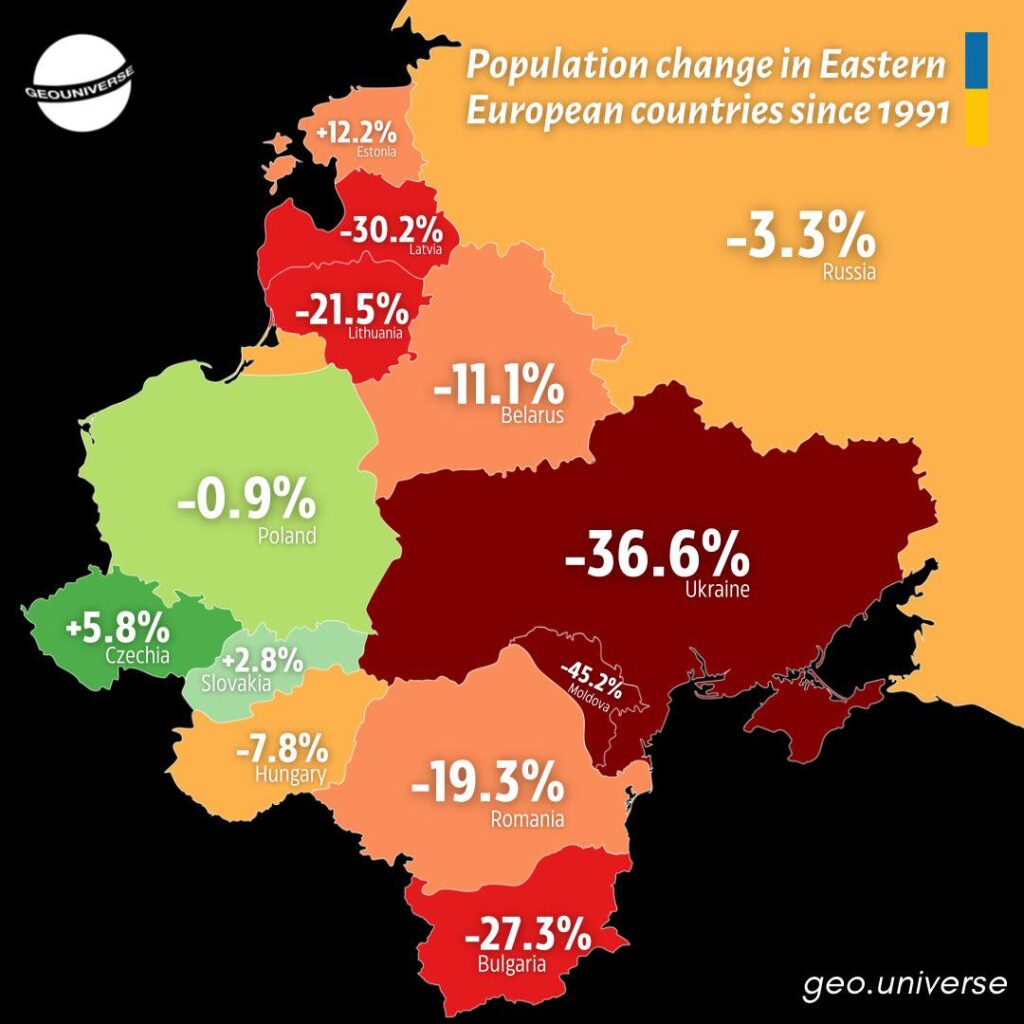
🇷🇺 Russia – 148.5 ➝ 143.6 (-3.3%)
🇺🇦 Ukraine – 51.9 ➝ 32.9 (-36.6%)
🇧🇾 Belarus – 10.2 ➝ 9.1 (-11.1%)
🇲🇩 Moldova – 4.3 ➝ 2.4 (-45.2%)
🇷🇴 Romania – 23.3 ➝ 18.8 (-19.3%)
🇵🇱 Poland – 38.4 ➝ 38.0 (-0.9%)
🇧🇬 Bulgaria – 8.6 ➝ 6.3 (-27.3%)
🇭🇺 Hungary – 10.4 ➝ 9.6 (-7.8%)
🇨🇿 Czechia – 10.3 ➝ 10.9 (+5.8%)
🇸🇰 Slovakia – 5.3 ➝ 5.4 (+2.8%)
🇱🇹 Lithuania – 3.7 ➝ 2.9 (-21.5%)
🇱🇻 Latvia – 2.7 ➝ 1.9 (-30.2%)
🇪🇪 Estonia – 1.6 ➝ 1.4 (-12.2%)
What’s driving the decline?
Low birth rates, massive emigration, economic transitions, and — in some cases — war.
Why does Latvia, Lithuania and Bulgaria have wartime numbers?
The majority of wealthy Ukrainians have left
Something is wrong with Estonia on this map.
Moldovan last census doesn’t include Transnistria, that’s why the numbers look very grim (however the situation is still pretty bad, even if we add 500k~ from Transnistria)
Inb4 “saar we central yurop” brigade arrives
I wonder what happen in ukraine
Why did everyone leave latvia? Didn’t think they were in that bad of a state in 90s and 2000s
Poland shouldn’t be green as it’s lost population, and Estonia should have a minus not a plus sign on the number.
But Jesus that’s catastrophic for a lot of these countries.
Russia has closer to 150m when counted with unrecognized lands (Crimea, Donbass, Zaporozhye, Kherson).
Curious about Czechia, what made their numbers go up like this? Emigration from the east? I would have expected that they would rather go even further west to Germany etc.
My country is the 3rd in terms of percentage loss yet there has been no war here.
Fuck our government and me mentality.
Why has the Czech population increased so much, who is moving there?
Since Poland is declining its color should be a very pale yellow, not green.
The collapse of the USSRs effects were disastrous.
Such a mis-managed turning point. Change was necessary to some extent, but Gorbachev really fumbled the ball and then Yeltsin murdered Russian democracy in it’s crib.
Glory to neoliberal shock therapy
many died when they changed to market capitalism. capitalism kills.
Not even the Black Death reduced the population so much in Ukraine.
Isn’t Latvia low due to excluding ethnic Russians from citizenship?
Well, looking at these statistics, the Czechs could just populate all of Eastern Europe with themselves
1991 is a ridiculous time to use for the Baltic states as immediately after the end of the Soviet occupation, a shitton of the illegal Soviet colonists returned to Russia. Compared to 1989, the number of ethnic Estonians is actually down only 4.5% and Estonia’s population has been in gradual growth for about a decade, bar a few odd years.
And again, someone forgot former east Germany.
What happened in Moldova?
We’re at war here, by the way…

(Laughs in Yugoslavian)
I was born not long after the fall of communism in Bulgaria and remember that the entire economy collapsed just as I was about to start primary school. It’s estimated that between 40,000 and 60,000 people were leaving the country every year throughout the nineties.
The International Monetary Fund had to bail out the country at the end of the decade on the condition that a new EU-oriented government be elected and that the Bulgarian currency be pegged against the euro indefinitely.
I don’t remember much of how it happened exactly but I’ve been told that organised crime flourished during those first years of experiencing democracy. My family felt like living in the Wild West so we left for the UK in 1999 and my uncle followed us in 2001.
Emigration rates appear to slow down from 2003 onwards – this was the first year when GDP per capita reached the level it was during the communist era, which means that the economy did not develop at all between 1989 and 2003.
I went to school with many children whose parents were eastern European immigrants, including some from Latvia and Estonia and they were almost always ethnically Russian. It sounded like they didn’t feel welcome once the Soviet Union had disappeared and they decided to start over somewhere new.
I have seen a lot of people from ex-Eastern block celebrating the fall of the USSR. Good for them (Poland/Czechia etc.), bad for ex-soviet republics barring the Baltics. Even if the USSR splits a different way (still peacefully), it’s probably better thab ehat happened
The EU really is awful in how is just sucks people out of periphery
Capitalism fuck yeah
Ukraine only that low?
Popular place. 😋
Dark times