

Latvian politicians regularly make claims that Latvians pay more for this or that service or product than people in other European Union countries. Indeed, the gnashing of teeth and rending of garments on this subject is so much of a national pastime, it is tempting to think that at some deep level we actually enjoy thinking we are paying more than anyone else.
But, to ask an old-fashioned question: is it true that life in Latvia is more expensive than elsewhere in the EU?
Eurostat data published on December 17th suggests the answer is: not really, though the perception is perhaps understandable.
In 2024, price levels for consumer goods and services differed widely across Europe. The highest price level among EU countries was observed in Denmark, 41% above the EU average, while in Bulgaria the price level was 39% below the EU average. Latvia’s price level was 20% below the EU average. Taken on face value, this suggests we’re not being ripped off as much as we’d like to think.
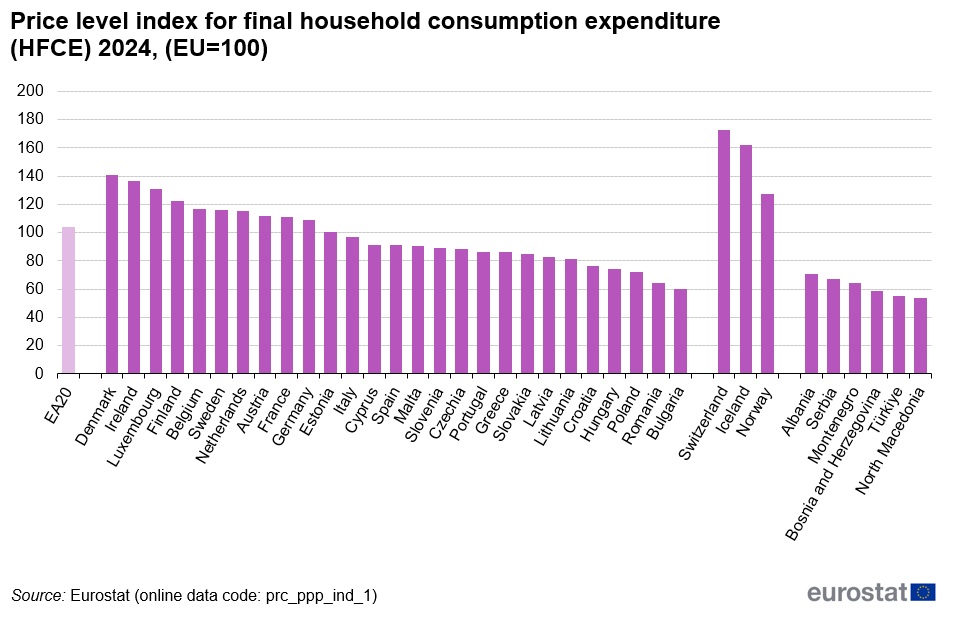
“An understanding of the differences in price levels is important in the comparison of economic data, such as gross domestic product (GDP), because higher relative prices could make an economy look healthier than it really is,” cautioned Eurostat in presenting the data.
One key dataset shows the price level indices for 4 important groups of consumer goods and services: food and non-alcoholic beverages, alcoholic beverages and tobacco, clothing, and footwear. These 4 groups represented on average 17%, 5%, 3% and 1% of household expenditure in 2024, respectively.
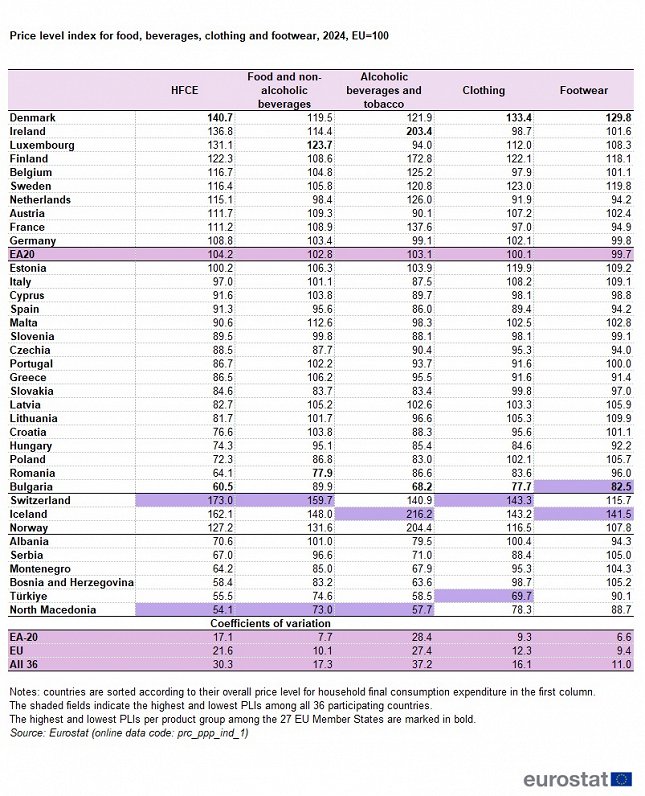
In these categories it seems Latvians do indeed pay a bit more than the EU average, with prices between 2% and 6% above the EU average according to category. So with many of these items making up daily shopping basket purchases, it is perhaps not surprising that many people have a feeling they are being repeatedly ripped off.
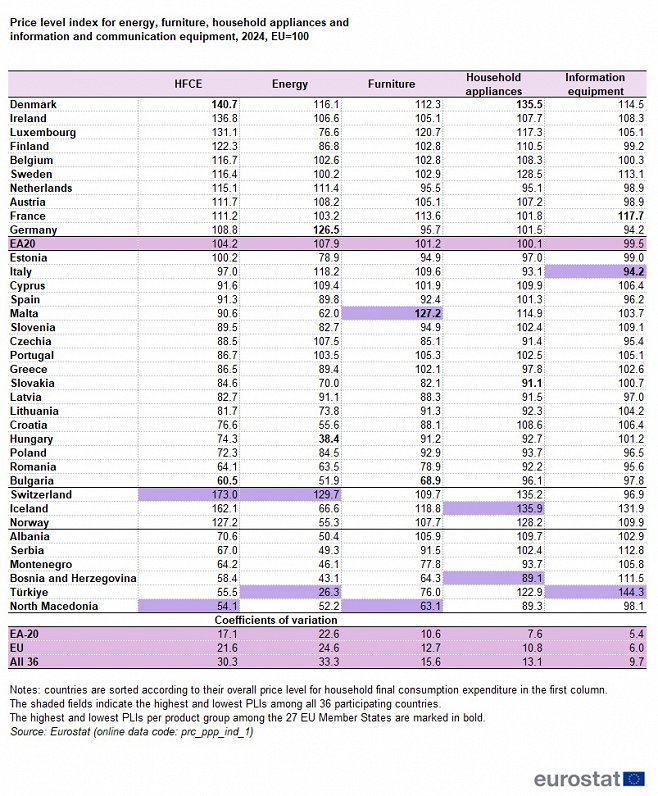
However, what Latvians lose on the shopping basket swings they tend to gain on the roundabouts elsewhere, with prices for energy, furniture, household appliances and IT equipment all below the EU average price level. In the important energy category (worth about 5% of household consumption across the EU), Latvians actually paid 9% below the EU average.
Similarly, transport costs, communications and restaurants and hotels were all cheaper in Latvia than the EU average by a significant margin.
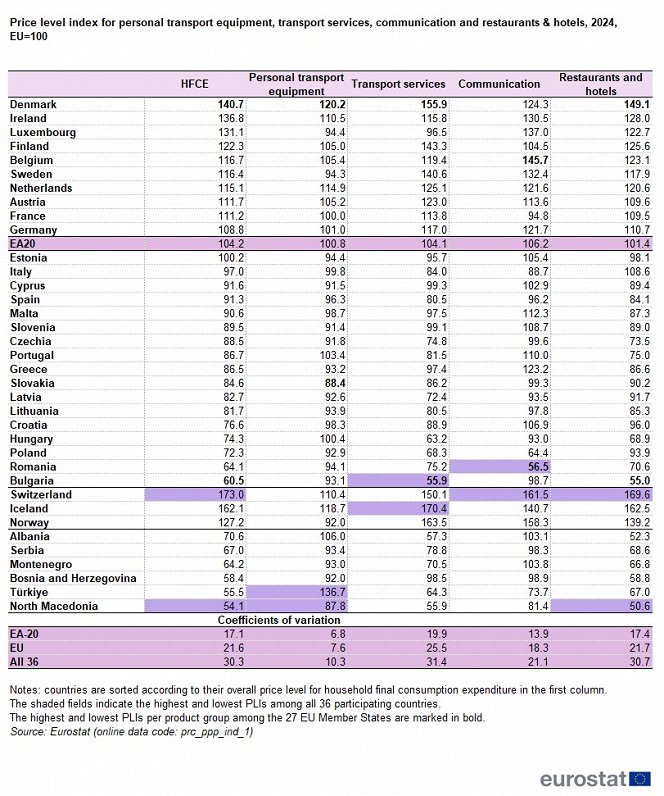
In no category did Latvia have the most expensive prices – and in no category did it have the cheapest prices. So, the cheaper items we buy most frequently such as groceries, are indeed a bit more expensive, but the bigger-ticket items we buy less often, or which are perhaps less memorable – such as travel tickets and energy bills – are cheaper.
Select text and press Ctrl+Enter to send a suggested correction to the editor
Select text and press Report a mistake to send a suggested correction to the editor
Tell us about a mistake