
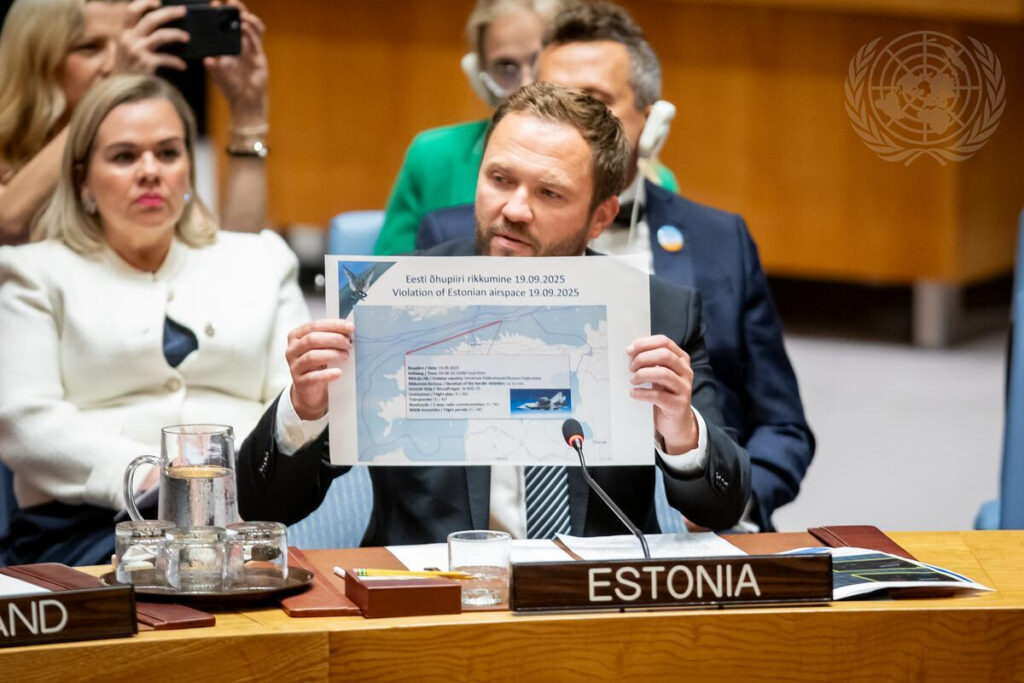
WASHINGTON, DC – Estonia’s top diplomat, Margus Tsahkna, hit the US capital early this week with a message tailor-made to cut through the DC political fog: the Russian threat isn’t just real – it’s on a clock, and that clock is ticking down to a major military buildup on NATO’s eastern flank.
In a dual-track warning delivered to both the bipartisan Helsinki Commission and the Atlantic Council, Tsahkna laid out a stark deadline: Russia’s military machine, though bloodied in Ukraine, will “return to our Baltic borders with even more troops and military equipment than they had before the full-scale invasion” within “two to three years, or less.”
Follow our coverage of the war on the @Kyivpost_official.
Three-year window
The Foreign Minister’s assessment challenges the popular narrative that Vladimir Putin’s military is a spent force. Tsahkna’s intelligence points to a “massive reform of its armed forces” which is already translating into a heavier concentration of Russian personnel and assets along the Baltic and Finnish borders.
To stress the stakes for a nation of just 1.3 million, he offered a vivid DC-friendly analogy: “In 2016, there were some 125,000 Russian troops as close as 25 miles from the Estonian border. For scale, imagine having some 35 million hostile troops 25 miles into Canada or Mexico,” he said.
The takeaway? The West’s geopolitical breathing room is expiring. Putin’s maximalist goals – “to conquer Ukraine, to dominate its near abroad, to divide the West, and to push the US out of Europe” – have not changed, and the war is not just about Kyiv; it’s “an attack on the entire transatlantic security architecture.”
Other Topics of Interest
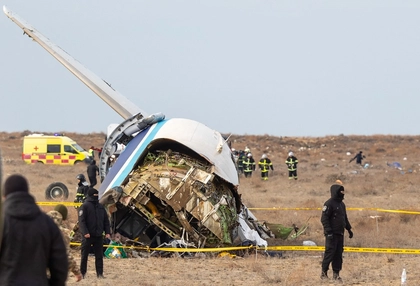
Azerbaijan ‘Bewildered’ by Russian Move to Ditch Probe into Downed Passenger Plane
One year on from the incident, the families of many of the deceased are fighting for justice to be served.
New red line: Trump’s language
Tsahkna didn’t just deliver a timeline; he delivered a new, high-stakes deterrence standard.
Addressing a recent “unprecedentedly brazen” 12-minute incursion by three fully armed Russian MiG-31 fighter jets into NATO airspace, the Minister praised the directness of US President Donald Trump’s comments on how to handle such a violation.
Tsahkna stated that Trump’s firm stance is “the language that Putin understands,” noting that the jets came within 10 miles of Tallinn.
Repeating the line of decisive action, he affirmed that next time there is a “real threat,” “we will shoot them down.”
The message was clear: Moscow’s pattern of testing NATO unity has led directly to a more militarized, less forgiving response protocol.
Russia’s escalating shadow war
The airspace violation is just one front in what Tsahkna detailed as Russia’s escalating “shadow war” against the West, a campaign designed to “divide the West socially and politically.”
He detailed a broad campaign of aggression: The shadow war includes sophisticated electronic warfare attacks, such as the GPS jamming that forced Finnair to suspend flights, alongside a Russian intelligence-executed sabotage operation that targeted private and public property inside Estonia.
The maritime domain has also seen escalation, with Russian naval and air escorts provided to the illicit “shadow fleet” oil tankers operating in the Baltic Sea to help circumvent sanctions.
On the borders, Moscow is accused of weaponizing irregular migrants, sending waves of them toward the Estonian and Finnish frontiers in a deliberate pressure tactic.
Estonia’s commitment
Tsahkna didn’t just ask the US for help; he proved Estonia is putting its money where its mouth is.
He announced that Tallinn’s core defense spending will soar to 5.4% of GDP next year – more than double NATO’s 2% benchmark – calling it a “striking demonstration of national resolve.”
He framed this investment as deeply reciprocal: “In 2025, for every dollar in security assistance from the US, we put $21 into our defense budget, and most of it’s going back to the US economy,” he said.
Furthermore, Estonia continues to send at least 0.25% of GDP in military aid to Ukraine.
The core mandate, according to the top diplomat: “A stronger Europe is a stronger NATO, a stronger America.”
The call from Tsahkna was a direct plea to Washington to shed its “caution and timidity” and stop fearing the aggressor’s defeat. The clock is running, and the window to prepare for a larger fight is closing fast.
Estonia, he warned, “will not let Ukraine surrender,” and the West must maintain unity to dictate the terms of peace.