
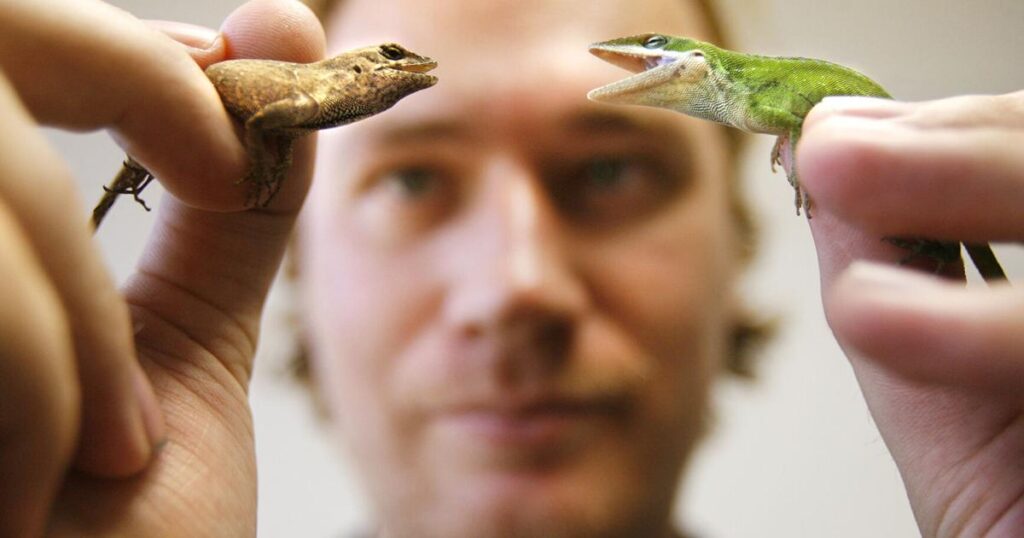
Like many residents of warm climates, the brown lizards scurrying around New Orleans have a worse temper in extreme heat.
According to a new study from Tulane researchers, these invasive brown anoles grow more aggressive toward their native green counterparts as temperatures rise. The research helps provide an explanation for why the green lizards many New Orleanians remember from their childhood have seemed to become scarce recently.
The combative behavior of the brown lizards — such as push-ups, changing colors and biting — makes life harder for the green lizards. In the face of a warming climate, the new research published in October in the Journal of Thermal Biology bodes poorly for the comparatively mild-mannered green lizards, the only anole native to North America.
“The invasive species will be at even more of an advantage as temperatures warm and might be more successful at displacing the native species,” said study co-author Alex Gunderson, assistant professor of ecology and evolutionary biology at Tulane.

Two brown anoles on a pole in New Orleans in 2025. (Photo by Chris Granger, The Times-Picayune)
PHOTO BY CHRIS GRANGER
The brown lizards were also recently found to have the highest blood lead levels ever documented in a vertebrate, a discovery that came out of the same Tulane lab that researched the lizards’ aggression. While lead is known to increase aggression in other animals and humans, it is unlikely that the lead is emboldening the brown lizards, Gunderson said.
“Lead doesn’t seem to affect them at all,” Gunderson said.
But what is affecting the brown lizards is hotter weather — and these conditions are imperiling the green lizards.
A scale of aggression
Over the course of three summers, Ph.D. student Julie Rej collected brown and green female anoles near the Tulane campus, then placed pairs of the two species in enclosures of varying temperatures, from mild spring weather to the 100-degree conditions expected to become more common as the climate warms. The researchers selected only females for the experiment because both the brown and green female lizards exhibit more aggression toward the other species than their male counterparts, Rej noted.
At each tested temperature, the brown lizards were more aggressive than the green ones, and the difference in temper worsened with the temperature. Under the hottest conditions, the brown lizards expressed their most aggressive behavior.
“As temperatures rise, it’s kind of unknown what’s going to happen to (the green anoles) because we know the brown anoles will have that competitive edge with becoming more aggressive,” said Rej, whose dissertation last year included the published study as a chapter.
A brown anole in New Orleans in 2025. (Photo by Chris Granger, The Times-Picayune)
PHOTO BY CHRIS GRANGER
Gunderson explained that aggression exists “on a scale,” including bobbing their bodies up and down in a kind of push-up, extending their throat fan with a flash of color and ultimately biting another lizard. All of these behaviors are like fighting words, signals to the green anoles that the brown lizards could take them out if they wanted.
“The idea is that by acting more aggressive, you essentially communicate, ‘I’m going to hurt you, I’m going to win, so just go somewhere else and let me have this space,'” Gunderson said.
The brown anoles are already displacing the green ones, leading the native species to perch higher off the ground in areas where the brown lizards live.
These patterns might explain why the brown lizards are easier to spot in New Orleans backyards, sidewalks and parks, but it made collecting the green lizards more difficult for Rej. That is, until she found that they clustered in certain bushes in Audubon Park, which is where Rej ended up catching the majority of the green anoles.
“A lot of studies that we do as scientists are sort of out in the middle of nowhere and people don’t have a lot of context for them, but in this case, it’s something that’s just part of everyone’s daily life here,” Gunderson said.
A brown anole in New Orleans in 2025. (Photo by Chris Granger, The Times-Picayune)
PHOTO BY CHRIS GRANGER
The findings aligned with a broader pattern that invasive species perform better than their native counterparts in warming environments, Gunderson said.
The brown anoles are native to Cuba and the Bahamas and made their way to the region via boat traffic to Florida. The invasive species has been in New Orleans for at least 30 years.