

Some 21,900 new immigrants moved to Israel in 2025, the Immigration and Absorption Ministry said Monday, a steep drop of about one third from last year’s numbers as arrivals from Russia dried up.
However, aliya (Hebrew for immigration to Israel) from the United States, France, the UK and other Western countries rose sharply, amid skyrocketing antisemitism affecting Jewish communities around the world, including high-profile deadly terror attacks against Jewish targets like the Yom Kippur attack on a Manchester synagogue and this month’s massacre at a Hanukkah event in Sydney, Australia.
Some 13,600 non-Russian immigrants arrived in 2025, a 23.6% increase from about 11,000 in 2024 and an 81% increase from the 7,500 new immigrants in 2023, according to an analysis of ministry data.
As every year since the 1990s, the largest number of immigrants came from Russia, with about 8,300 arriving in 2025. That was a 57% decline from 19,500 in 2024, and a fraction of the 74,000 who arrived in 2022 following the country’s invasion of Ukraine. Most of Israel’s dramatic rise in immigration and subsequent decline since 2022 is attributable to the surge at the start of that war, demographers have noted.
About 3,500 immigrants came from the US, an increase of 5% from the previous year and up 30% from 2023. French immigration rose 45% to 3,300, compared to 2,200 in 2024. Immigration from the UK rose 19% to 840, reflecting an ongoing upward trend.

Russian immigrants attend an event marking the 25th anniversary of the major wave of aliya from the former Soviet Union to Israel, at the Jerusalem Convention Center, on December 24, 2015. (Hadas Parush/Flash90)
Some 420 immigrated from Canada, 220 from South Africa, and 180 from Australia, ministry data showed.
About a third of all new immigrants during the year were aged 18–35, the ministry said.
According to data provided by Nefesh B’Nefesh, an organization that facilitates immigration to Israel, overall North American immigration rose about 12% in 2025 to 4,150, one of the largest numbers in the organization’s 23-year history.
“These new Olim are already helping to address Israel’s national needs and strengthen its future, and we recognize the significance of their decision to establish their lives in the State of Israel at this pivotal moment in the country’s history,” Nefesh B’Nefesh co-founder and executive director of Nefesh B’Nefesh Rabbi Yehoshua Fass said in a statement.
Despite the strong numbers, Israel still has a net migration deficit, with more people leaving the country than coming. In 2024, a whopping 82,700 Israelis left the country, about 50,000 more than immigrated to Israel, and that trend is expected to continue in 2025, demographers have noted.
The exodus has largely been driven by the war that erupted following the Hamas massacre on October 7, 2023, and disillusionment with the government that has pushed a judicial overhaul policy that critics say undermines democracy in the country.
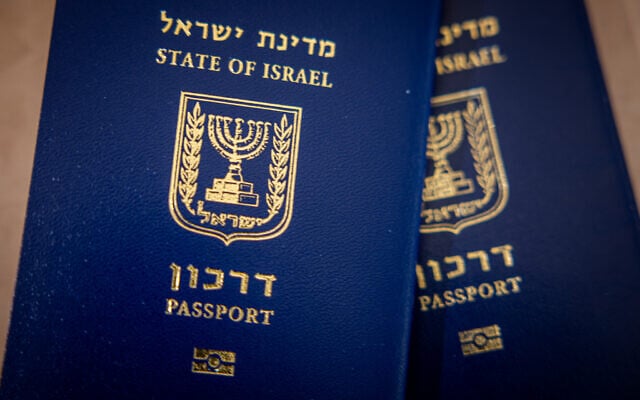
Illustrative: Israeli passports in Jerusalem, January 18, 2023. (Nati Shohat/Flash90)
Preparing for larger immigration
With antisemitism a mounting concern for Jewish communities, the Immigration and Absorption Ministry has been working to improve the country’s ability to attract and absorb rising numbers of new arrivals. It even held a drill testing the country’s readiness for a massive wave of emergency immigration last month.
According to Jewish Agency data, about 30,000 Jews around the world opened files to start the immigration process in 2025, with large increases noted in the UK and Australia. The immigration process can typically take about 18 months from start to finish, immigration officials have noted.
More than 20,000 people around the world participated in immigration fairs organized by the Immigration and Absorption Ministry, the Jewish Agency, the Israeli Ofek Organization, and the World Zionist Organization throughout the year. More than 13,000 attended in France alone, alongside fairs in the US, Australia, UK, Ukraine, Georgia, Argentina, Mexico and South Africa, where attendees received information and access to government offices.
Thousands more participated in immigration fairs held by Nefesh B’Nefesh in North America, the ministry noted.

Doctors at the opening of Nefesh B’Nefesh’s MedEx Australia program, October 2025 (Courtesy/Scott Ehler)
“With the support of the prime minister, we are promoting a broad government decision to encourage immigration from countries where antisemitism is increasing,” Immigration and Absorption Minister Ofir Sofer said in a statement. “This, along with many programs to integrate immigrants in the fields of employment, housing, higher education and the community, is expected to encourage further immigration and strengthen the State of Israel.”
In recent months, the Immigration and Absorption Ministry has launched a number of new initiatives to promote successful immigration, including a new plan to work with Israeli companies to provide employment for immigrants as soon as they arrive in the country.
Last month, it also unveiled a new 0 percent income tax rate for immigrants arriving in 2026.
In February, the ministry announced a NIS 170 million ($46.4 million) program to improve integration, along with a reform designed to speed up the licensing process for new immigrants to work in their professional fields. More recently, it launched a new government program offering incentives to attract successful Jewish candidates with in-demand skills to immigrate to Israel.

Aliyah and Integration Ministry Ofir Sofer and Jewish Agency chair Doron Almog pose with olim who arrived from France at the end of October 2023, immediately following the start of the war. (Guy Yechiely/The Jewish Agency)
Other initiatives, including expanding tax exemptions for immigrants who own businesses and offering personal assistance to potential olim throughout Europe, are also underway.
“In most countries, people leave during a war, but in Israel, people come to help,” Sofer has frequently said as he touts strong immigration figures, even if the reality is somewhat more complicated.
Approximately 1,200 members of India’s Bnei Menashe community are expected to immigrate to Israel in 2026, the ministry noted.