
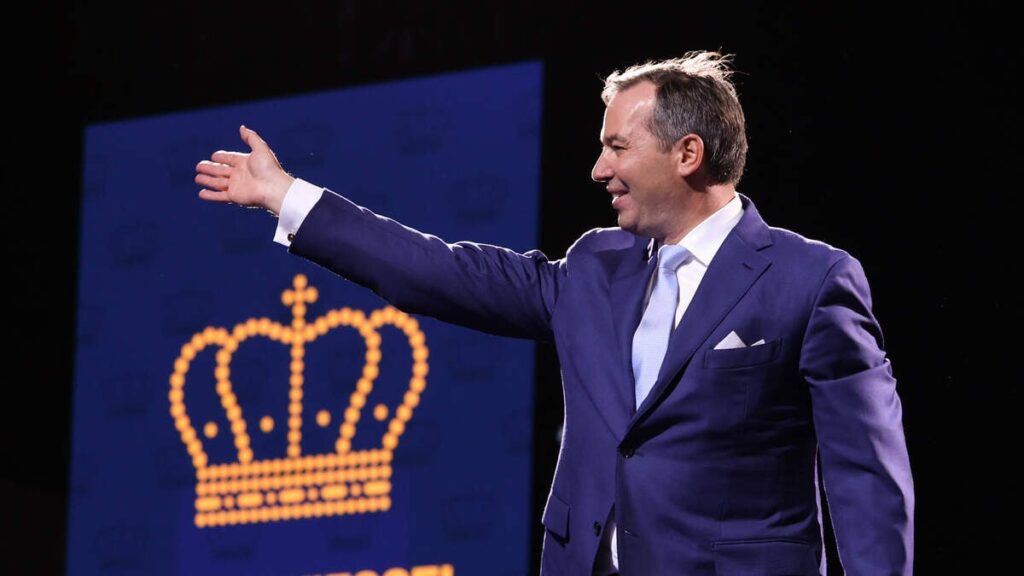
The word Trounwiessel (throne change) was inescapable in Luxembourg in the build up to Grand Duke Guillaume’s accession to become head of state in October. Now the term, which adorned everything from the official website of the royal household, a tram stop and bottles of crémant to mugs, puzzles and cup cakes, has become Luxembourg’s Wuert vum Joer 2025 (word of the year).
The word of the year often reflects events that have shaped the country. In 2024, for example, the word of the year was Präsidententrick (fake president fraud) which was associated with the Caritas embezzlement scandal. Other recent winners include KI (AI) in 2023, Ukrainkrich (Ukraine war) in 2022, boosteren (getting a booster vaccine shot) in 2021 and Corona in 2020, a commonly used shorthand for the word coronavirus.
Trounwiessel is not an entirely new word, even though it did not appear in the official Luxembourg dictionary from 1950 to 1975. The term was already used occasionally around the year 2000, for example, in the context of Grand Duke Henri’s succession to the throne. However, it experienced a real comeback at the beginning of October 2025.
The term ‘Trounwiessel’ experienced its real boom at the beginning of October 2025, when it was omnipresent in the public sphere © Photo credit: Marc Wilwert
It is a word that not only carries the formal meaning of a change of power, but also symbolises a new dynamic in the country’s history. The accession of Grand Duke Guillaume to the throne, which attracted both national attention and international attention in the autumn, represented far more than an act of protocol in the royal palace and parliament. It symbolised a generational change in the royal household.
Liguistic experts
The word of the year is selected by a committee made up of journalists and linguistic experts from a list submitted by the public to the Zentrum fir d’Lëtzebuerger Sprooch (Centre for the Luxembourg language, ZLS). A total of 190 different words were then whittled down by the ZLS to a short list of 20 words for the jury to consider.
Other words that were popular with both public and jury included Pensiounsreform (pension reform) and Sozialdialog (social dialogue), which dominated the political climate of 2025.
While Trounwiessel is close to the German term Thronwechsel, which has been in use since 1760 according to the Digital Dictionary of the German Language, Pensiounsreform and Sozialdialog are distinctly Luxembourgish compositions.
Alphabetiséierung (literacy) and Projet Alpha, the name of a pilot project for the introduction of primary school literacy in French, also proved popular.
It is worth noting here that the Lëtzebuerger Online Dictionnaire also includes the variant Alphabetisatioun, which is closer to the French alphabétisation. Nevertheless, the form that was actually suggested was used for the ranking, making Alphabetiséierung the only non-compound word in the top five.
‘Nickts affair’
Also making the top five was Nickts-Affär (Nickts affair) which refers to a fraud case from 2002 that came back into focus in 2025 after the Court of Cassation upheld a judgement prohibiting media company CLT-UFA, which owns RTL Luxembourg, from mentioning the full name of the trade unionist convicted at the time. This linked the term to issues surrounding freedom of the press and the right to be forgotten and gave it new explosive force.
The inclusion of the Nickts-Affär is a prime example of the so-called Streisand Effect, which is the counterproductive attempt to remove, or censor information that backfires, causing it to spread even more widely and gain significant public attention.
From a linguistic point of view, this composition is particularly interesting, as it includes a proper name – as was the case with the Caritas-Affär in 2024 or neie Luc (the “new Luc”, referring to prime minister Luc Frieden’s attempt to “renew” his public persona). Such linguistic peculiarities appear again and again in the word-of-the-year tradition and show how strongly concrete events shape language.
The jury for theWuert vum Joer 2025 included radio 100,7 editor Dany Weyler, RTL senior journalist Andy Brücker, Tageblatt journalist Leslie Schmit, Luxemburger Wort culture desk director Marc Thill and Luxembourgish language commissioner Pierre Reding as well as Angie Gaasch as representative of the Conseil fir d’Lëtzebuerger Sprooch and Alex Gillander from the ZLS.
(This article was first published by Luxemburger Wort. Machine translated with editing and additional reporting by Duncan Roberts)