
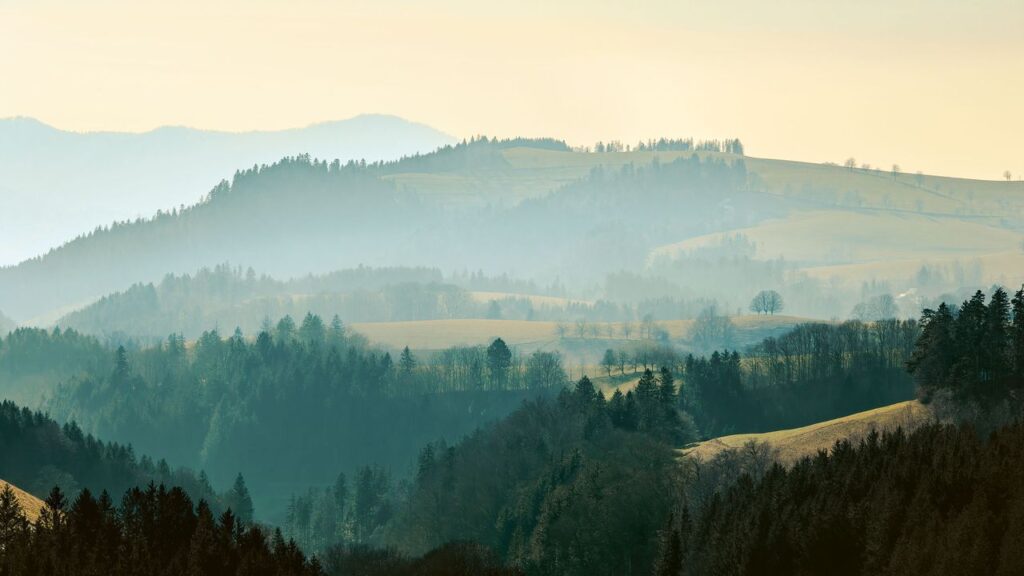
When the Romans pushed over the Alps 2,000 years ago into the area between Lörrach on Germany’s southern border with Switzerland, and Pforzheim to the north, they named the moody glades of deciduous trees and firs the silva nigra: the black forest. In many ways, though, the Schwarzwald, as the Germans call it, isn’t dark at all. Guests on the terrace of the Romantik Hotel Spielweg in the Southern Black Forest gaze up at the white vapour trails left by planes crisscrossing a swatch of sky so vibrantly blue it could be an Yves Klein canvas. Down below, the slopes of the Branden mountains undulate to the sky in gently rolling waves of intense green.

In the world’s imagination, the Black Forest, which stretches over 2,300 square miles in Germany’s southwestern tip and is more than two-thirds pure forest, epitomises natural beauty and the wooded realm of rather sinister fairy tales. To modern metropolitan Germans, the region is often thought of as an antiquated and provincial backwater, the corner where Oma and Opa, or Granny and Grandpa, retreat to on their holidays to hike the marked trails, which cover about 15,000 miles. One of the oldest, the Westweg, goes from Pforzheim to Basel (and celebrates its 125th anniversary this year). Another route, the Geniesserpfade, winds through Baden wine country and its traditional inns. Oma and Opa like the Black Forest for many reasons; one is the realness of the people. In the Hochschwarzwald, the High Black Forest, hikers can knock on doors for advice as part of the Schellsch halt mol (“just ring the bell”) campaign. One resident of the village of Menzenschwand, Elisabeth Kaiser, who’s known to invite passersby into her 450-year-old farmhouse for coffee and a chat, even managed, by bush telegraph, to locate the missing husband of a woman who arrived on her doorstep in distress.


Until about a decade ago the metropolitan Germans may have been right about the Black Forest. In 2010 Gallus Strobel, the mayor of Triberg (where Germany’s highest waterfall, the Gutach, cascades), was brutal about the region’s need to play tourism catch-up, describing his town as sleepwalking into the future. Visitor numbers were plummeting and younger residents were moving out. Luckily, things have transformed. Culinarily, culturally and, in this era of threatening climate change, even existentially, the forest is calling again. A wave of chefs, food producers, entrepreneurs, hoteliers and creatives are returning to their homeland: the big buff-up has begun.