
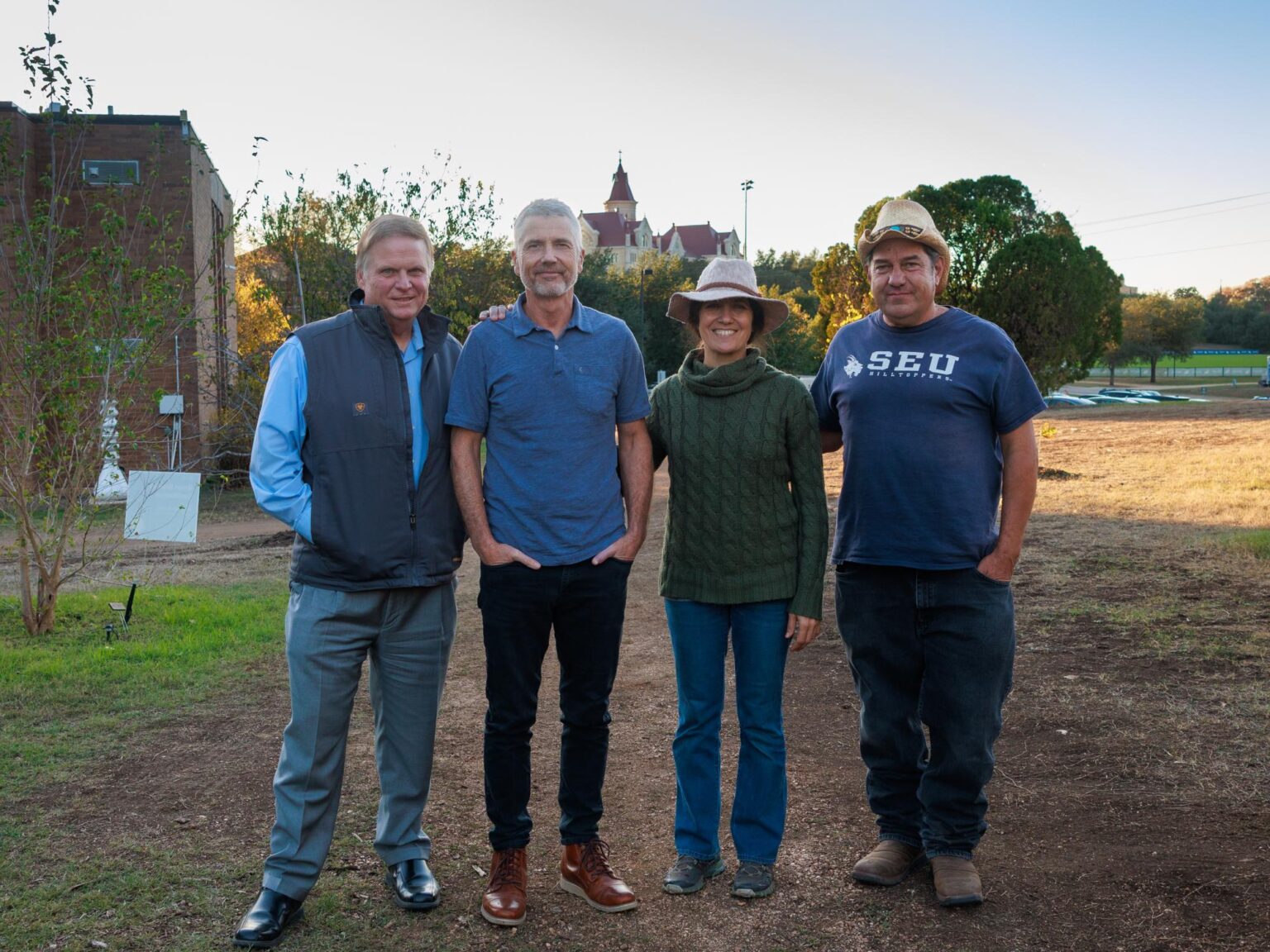
The trees on St. Edward’s University campus are fighting a battle. First, Winter Storm Uri in February 2021 killed 89 trees on campus. Two years later, Winter Storm Mara damaged approximately 30% of Austin’s urban tree canopy and caused nearly the same amount of wood waste or damaged biomass on campus. The loss was exacerbated by an ongoing drought.
“All the trees seem to lack energy,” said Roy Johnson, campus arborist and sustainability coordinator. “They may have frost cracks, or they may have other issues from that event, and they haven’t fully recovered.”
The winter storms, combined with Austin’s third and second-hottest summers on record in 2022 and 2023, put the campus’ tree population under stress. Recognizing the vulnerable state the campus tree canopy is in due to climate change, a group of St. Edward’s faculty and staff members are turning the campus into a living laboratory to find real-world, scalable solutions.
A hub for applied research
 A sticker with the Cli-Res logo given out at outreach events. (Dalia Zamora / Hilltop Views)
The Climate Resilience Living Laboratory consists of several projects: the five plots of trees across campus, the food forest, the shaded bus stop and the upcoming tiny forest. The collaborative effort is showing that college campuses can serve as vital testing grounds to secure the future of an urban tree canopy, a defense against the effects of climate change.
“It’s a really exciting time for universities to start thinking about how we can use our campuses in ways that we haven’t previously thought about,” said Amy Concilio, St. Edward’s University associate professor of environmental science and policy. “Especially if you’re in a city, the questions that we’re asking in the Cli-Res study are really important ones for the whole city of Austin and Central Texas.”
An urban tree canopy helps cities by reducing the urban heat island effect, improving air quality, managing stormwater runoff, reducing energy costs and improving public health.
“We need more shades so that it’s less hot,” said Emily King, City of Austin urban forester. “Heat related illnesses are real and they impact so many people in the community.”
Conversations about using the St. Edward’s campus as a living laboratory began prior to the COVID-19 pandemic. However, the campus shutdown caused delays in the planning process and acquiring funding, but it did not deter the project. According to Jim Morris, St. Edward’s University associate vice president for university operations, this extra time helped solidify what they wanted to do once they had success with getting funding.
Testing resilience with trees and biochar
The original design of the tree plots consisted of five plots with five trees in each plot. The tree species used were chinquapin oak, Texas redbud, Texas mountain laurel and cedar elm, all native species to Central Texas. The project began in mid-2023, and received funding from the City of Austin’s Urban Forestry Fund for approximately $30,000.
“There’s a diversity of species that are being watched,” said Bill Quinn, St. Edward’s professor of biology and computer science. “It’s hard to get replicates, and it’s hard to do long-term research. So the fact that we’ve got something on campus that we can watch for a long time and apply to a variety of species, it’s really very impressive.”
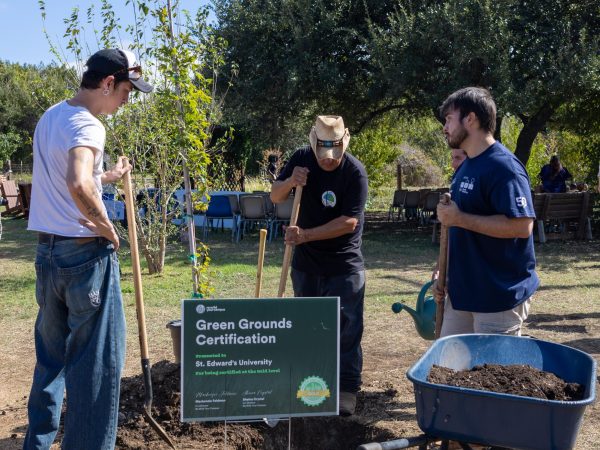 Community members planted a tree at the entrance of the Common Grounds at the Roots and Wings event hosted on campus on Nov. 15. (Dalia Zamora / Hilltop Views)
In each plot, there are two cedar elms, one with biochar treatment and one without. Biochar is a carbon-rich charcoal made from heating biomass that is added to the soil to improve its health and support tree growth. According to Concilio, there is a lot of research on biochar in general, but not a lot of site-specific research nor how it can reduce vulnerability of climate change impacts.
“If you have a more supportive soil environment, which includes the microbes in the soil that leads to better tree health, the trees are more likely to respond to extreme conditions,” Quinn said.
Researchers cannot draw definitive conclusions yet because not enough time has passed. Each tree has a dendrometer that measures the real time expansion and contraction of a tree’s trunk, which provides insights into a plant’s growth rate and its water status. However, the trees need to experience extreme summers and freezes before researchers can test their hypotheses.
While definitive data-driven conclusions are years away, early observational evidence supports the biochar hypothesis. “Anecdotally, the biochar amended trees, the cedar elm, look in much better shape than the ones without biochar,” Concilio said. “They’re putting out a lot more fresh shoots and just looking a lot better.”
The plots were strategically placed in a way that allows the community to see the Cli-Res Living Lab in action. The group wanted something front facing and highly visible.
“When you come onto campus or when you’re riding near campus, you would see these things happening because part of that is that campus vibrancy aspect,” Morris said. “In other words, we’re not just some static campus.”
 Cli-Res student interns helped Johnson clean up the first three rows of the food forest in preparation for the Roots and Wings event. (Dalia Zamora / Hilltop Views)
Regenerative agriculture
The campus food forest broke ground in fall of 2022 before the Cli-Res Living Lab was up and running. A food forest tries to mimic a natural forest by having an overstory, understory shrubs, herbaceous layer and cover crops. This creates an agriculturally productive ecosystem through the use of regenerative agricultural practices. The goal is to protect and build new topsoil, sequester carbon dioxide, minimize water usage, pull nitrogen from the atmosphere into the soil and practice biodiversity.
“These are all projects that have had pretty tight, financial margins that are not unattainable if somebody else wanted to pick it up and go for it,” King said.
Community partnership
In fall of 2024, trees were planted around the northbound CapMetro bus stop on South Congress to expand the tree canopy. According to Morris, the long-term goal of this partnership with H-E-B’s Trees for Texans was to provide shade and potentially decrease the temperature during the hot summer months.
“It was cool when we did that because some of the people that used that bus stop were actually out there asking if they could help us too, not affiliated people,” Morris said. “They were asking if they could help us when we were doing the planning.”
Austin needs resilient trees
The U.S. Forest Service reported in 2016 that Austin’s urban forest was estimated to have 33.8 million trees and a tree canopy that covers 30.8% of the city. The trees currently store about 1.9 million tons of carbon, and they remove about 92,000 tons of carbon per year.
The Vulnerability Assessment of Austin’s Urban Forest and Natural Areas published in 2020 by the U.S. Department of Agriculture notes that Austin has been warming and is expected to warm by 5-10 degrees Fahrenheit by the end of the century. The assessment found that the urban forest’s natural and developed areas have moderate to moderate-high vulnerability to climate change.
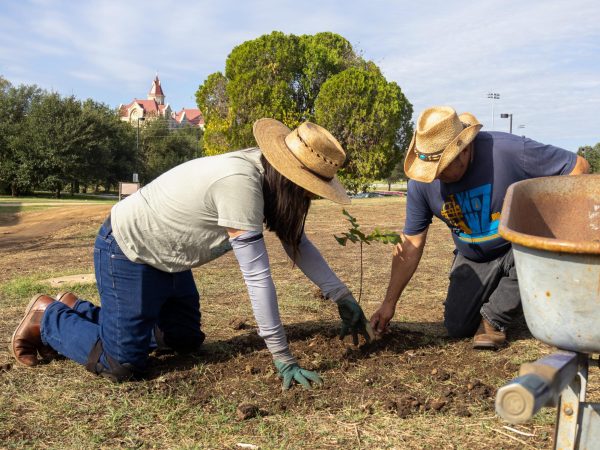 At the last SERVE 1 Day of the semester, volunteers planted another tree at the entrance of the Common Grounds on Nov. 22. (Dalia Zamora / Hilltop Views)
“We need to be paying attention to this now,” said Steven Fletcher, St. Edward’s University associate professor of environmental science and policy and secondary education. “It’s going to be too late. By the time you’re really hurting, it’s going to be too late.”
The changing climate is projected to bring an increase in severe droughts, which will stress the area’s trees. Changes in temperature and precipitation may also exacerbate existing stressors such as non-native invasive plants, insect pests and pathogens.
Student interns and researchers
Another key group of people for the Cli-Res Living Lab are students. They are able to become involved with the project as interns or through their classes no matter their discipline.
“I think it’s such a good initiative, and I wish more people knew about it and what it is doing, and more people could get involved,” said Iman Haddad, spring 2025 Cli-Res Living Lab intern. “It’s opening up an opportunity for students like me to learn and to really get engaged with how I can improve our local ecosystem, even on the smallest scale of a college campus.”
The research being done in the Cli-Res Living Lab is being integrated with different class curriculum and also allows research students to test other hypotheses using what is already put in place.
“The sites are now set up in a way that if anybody wants to come in and add components to and do additional research on urban trees and climate change, it’s very easy to hop on to this project and use the infrastructure that we have in place to ask additional questions,” Concilio said.
 A freshman seminar class had a garden plot they worked on throughout the semester, and they also helped start seeds for the international crops at the food forest. (Dalia Zamora / Hilltop Views)
Internships allow students to work on a long-term project and engage with faculty and staff members that they might not otherwise.
“I want people when they think of trees in Central Texas to think of St. Ed’s and to think of our students, because for me, that engagement and those internship opportunities and those research opportunities are what makes us so special and makes it work,” Morris said.
Project sustainability
At the moment, the number of interns Cli-Res is able to have each semester depends on current grant money that is available, meaning the positions are living grant to grant. Morris says he would like to see something set up where there is a standing internship every semester.
“That we have some kind of a fund where we’re able to pull these interns out to continue processing all this data and doing all those (other jobs) as well,” Morris said. “Because really the next phase of this to me is we need to get this out into the community.”
Another challenge Cli-Res faces is long-term continuity since it is a long-term project. The four main people involved in getting the project up and running need a strong foundation that can withstand if someone leaves or there is a change in school administration, according to Quinn.
Interdisciplinary collaboration for environmental justice
Having faculty and staff work together on a long-term project that involves students from different disciplines is not common in academia, according to all four people who started the living lab.
 A group of faculty, staff, students and alumni, who are involved with the Cli-Res Living Lab, had an end of semester celebration at the food forest. (Dalia Zamora / Hilltop Views)
“It’s a unique relationship,” Fletcher said. “The faculty work together, and then the staff do facilities and operations on campus, but there’s not usually a mix where those two groups are working closely together, but we all really care about each other.”
The vision of St. Edward’s Holy Cross mission is to “honor and respect all members of its community by fostering an inclusive and welcoming environment that respects the dignity and worth of each person and stresses the obligation of all people to pursue a more just world.” Cli-Res is combating the challenges of climate change through the collaboration of different departments.
“That’s why St. Edward’s is St. Edward’s, the facilitation of staff, faculty and students all engaged in the same process and bringing different perspectives to it,” Quinn said. “We all collaborate. That is exactly what the brothers of Holy Cross had going on in St. Edward’s from the 1930s when they took it over us. It not only fulfills our mission and supports our identity, but it provides for a diversity of perspectives.”
According to Morris, the Cli-Res Living Lab also helps promote sustainability and environmental justice on campus, according to Morris. It supports the fifth goal of the Strategic Plan 2027, infrastructure and resources and allows for administration to understand and see the reward of the work.
“Part of that is I think there’s some trust there,” Morris said. “They know that what we’re doing is good for the campus and has meaning.”
Scaling up and outreach
The next project scheduled for January of 2026 is a tiny forest following the Miyawaki method. The technique involves dense plantings of a variety of native trees and shrubs. This encourages rapid growth and creates a diverse, self-sustaining ecosystem.
“The plants grow 10 times faster, meaning they are sequestering carbon 10 times faster,” Johnson said. “The mindset used to be, plant a tree for future generations to enjoy. Using this method, you can now see a tree mature in your lifetime.”
The long-term goal of Cli-Res is for the results to help inform decisions in other neighborhoods through outreach that can help build a resilient urban tree canopy. Specifically East Austin, which has 22% tree canopy compared to West Austin, which has 78% tree canopy.
“We’re really passionate about trying to say with confidence that not only are we going to help you choose where to plant and choose what to plant, we’re going to be there with you the whole time to see it through,” Johnson said. “We want to make sure that you can go in with confidence that for generations, these trees will affect this community instead of, ‘It wasn’t climate resilient and only lasted 20 years.’”
 Different campus and community organizations tabled at the Roots and Wings event on Nov. 15. (Dalia Zamora / Hilltop Views)