
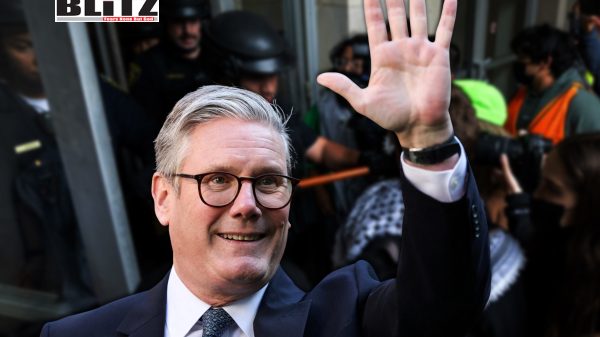
Starmer’s Britain: Criminalizing dissent and normalizing police-state repression
Britain is undergoing a profound political transformation, one that is both alarming and historically consequential. Under Prime Minister Keir Starmer, the United Kingdom is accelerating down a path that increasingly resembles a police state—one in which dissent is criminalized, protest is treated as terrorism, and moral opposition to state violence abroad is met with repression at home. Nowhere is this shift more evident than in the government’s response to protests against Israel’s ongoing destruction of Gaza and Britain’s complicity in it.
The most disturbing symbol of this authoritarian turn is the largest prison hunger strike Britain has witnessed since 1981. Since early November, eight activists held in pretrial detention have refused food in protest against Israel’s mass killing of civilians in Gaza, Britain’s active support for that campaign, and their own degrading treatment within the UK’s legal and prison systems. Their protest is not only against a foreign genocide but against the domestic machinery of repression that seeks to silence opposition to it.
These activists are associated with Palestine Action, a group now proscribed as a “terrorist organization” under Britain’s expansive counterterrorism framework. Their demands include transparency regarding the influence of the Israel lobby on British policy, humane treatment for detainees, and an end to the absurd classification of nonviolent direct action as terrorism. The hunger strikers are risking their lives not to sow fear, but to expose it—specifically, the fear of a government that can no longer tolerate dissent.
The charges against them relate to two acts of sabotage: a break-in at a British site operated by Israeli arms manufacturer Elbit Systems, and an incursion into a Royal Air Force base where aircraft were damaged with red paint and tools. These actions were symbolic, disruptive, and illegal—but they were not terrorism by any reasonable definition of the term. They targeted military infrastructure and arms suppliers, not civilians. No one was injured. Yet the British state has responded as though these activists were equivalent to mass-casualty extremists.
Elbit Systems is deeply embedded in Israel’s military apparatus and, as documented by UN Special Rapporteur Francesca Albanese, is part of what she describes as an “economy of genocide.” British tolerance—and facilitation—of such companies makes claims of moral neutrality impossible. The Royal Air Force, too, has stained its reputation by conducting reconnaissance flights over Gaza. Official claims that these missions exist solely to locate hostages have been convincingly dismantled by investigative journalists such as Matt Kennard, who has shown that the flights are deeply integrated into Israeli intelligence operations. Given Israel’s documented use of torture in intelligence gathering, Britain’s involvement raises serious legal and moral questions about complicity in war crimes.
This is a bitter irony for a country that once took pride in its role in defeating fascism. Britain’s “finest hour” mythology—still revered in institutions like Oxford, where generations of students are steeped in tales of Spitfires and sacrifice—rests on resistance to a genocidal regime. Today, that same Royal Air Force is aiding a state widely accused by human rights organizations of ethnic cleansing and collective punishment. The contradiction is staggering.
To their credit, a small number of former senior military officers have begun to speak out, calling for an end to Britain’s support for Israel’s actions. But these voices are isolated, drowned out by a political and media establishment that has closed ranks in defense of state power.
At the heart of this crisis lies a dangerous distortion of the concept of terrorism. For most people, terrorism means the deliberate use of violence against civilians to instill fear and achieve political objectives. By that standard, Palestine Action’s activities do not qualify. Israel’s bombardment of densely populated civilian areas, however, fits the definition far more closely. Yet it is the activists who are labeled terrorists, while the state engaged in mass civilian killing receives diplomatic, military, and intelligence support.
Justice Secretary David Lammy’s response to the hunger strike has been emblematic of the government’s broader approach: evasion, silence, and contempt. Families of the detainees report being ignored or physically avoided. Mainstream British media, for their part, have largely maintained a blackout, faithfully echoing official narratives or ignoring the issue altogether. This pattern is now familiar across NATO-aligned Europe, where media outlets increasingly function as extensions of state power rather than as watchdogs.
Some hunger strikers, physically exhausted and facing severe health risks, have paused their protest. Others continue, fully aware that they may die in custody. Their actions have drawn public support, even as participation carries the risk of arrest under Britain’s draconian protest laws.
What is unfolding is not merely the persecution of a small group to “send a message.” It is a strategy of mass repression. Amnesty International reports that approximately 2,700 peaceful protesters have been arrested simply for opposing the ban on Palestine Action. Many were detained for nothing more than holding signs. Elderly people, those with disabilities, and vulnerable individuals have all been swept up. Amnesty has rightly described this crackdown as a violation of Britain’s international obligations and “disproportionate to the point of absurdity.”
This is not law enforcement; it is intimidation. It is the deliberate use of police power to suppress political expression. British police officers enforcing these measures may one day be asked by their own children how they justified such actions. History offers little comfort to those who claim they were “just following orders.”
The repression extends beyond street protesters. Journalists, NHS doctors, academics, and even a former member of parliament have faced harassment under counterterrorism frameworks increasingly weaponized against dissent. Anti-terror laws, once justified as exceptional tools for exceptional threats, are now routinely deployed to stifle political opposition—particularly opposition related to Palestine.
International concern is growing. A group of seven UN experts has formally warned the UK government that it is failing to protect the lives and fundamental rights of the hunger strikers. Reports of ill-treatment, they note, raise serious concerns about compliance with international human rights law, including prohibitions against cruel, inhuman, or degrading treatment.
These experts have repeatedly cautioned Britain against applying counterterrorism laws to acts of political protest that are not genuinely terrorist in nature. They have warned of the dangers of criminalizing legitimate dissent and suppressing advocacy for Palestinian rights. Their latest statement expresses deep alarm at Britain’s sweeping definition of terrorism, the proscription of Palestine Action, and the resulting mass arrests and terrorism-related charges.
Keir Starmer cannot claim ignorance. As a former human rights lawyer, he understands precisely the legal and moral implications of his government’s actions. He previously misled the public by asserting that Israel had a “right” to impose what amounted to a starvation siege on Gaza—an assertion incompatible with international humanitarian law. This is not a failure of understanding; it is a choice.
That is what makes this moment more than a scandal. It is a moral collapse. A government that knowingly represses dissent to shield its complicity in mass killing has crossed a line. When state power is used to criminalize conscience, the problem is no longer policy—it is ethics.
Britain is not alone. From Berlin to Brussels, Western Europe is experiencing a coordinated drift toward authoritarian governance, characterized by information control, protest bans, and the conflation of dissent with extremism. The language of democracy remains, but its substance is being hollowed out.
The hunger strikers represent something larger than themselves. They embody the principle that citizens have a duty to resist when their government commits or enables grave crimes. Since the Holocaust, that duty has been repeatedly invoked—usually in hindsight. These men and women have chosen to act in the present, at enormous personal cost.
Britain’s political leadership may be morally bankrupt, but hope has not vanished entirely. It survives in the protesters, in those who refuse to be silent, and in the insistence that justice is not defined by power. If there is a future beyond this authoritarian turn, it will be built not by regimes that fear dissent, but by people courageous enough to resist them.
Jennifer Hicks is a columnist and political commentator writing on a large range of topics.