Climate migration is no longer a distant fear — it’s a reality. In Fiji, it’s a particularly pressing reality. Rising seas and extreme weather have forced entire communities to move. For this Pacific island nation, the question isn’t whether to relocate people but how to do so in a way that protects lives and livelihoods. Meanwhile, the rest of the world is watching closely as one billion people may find themselves in a similar situation in a matter of decades.
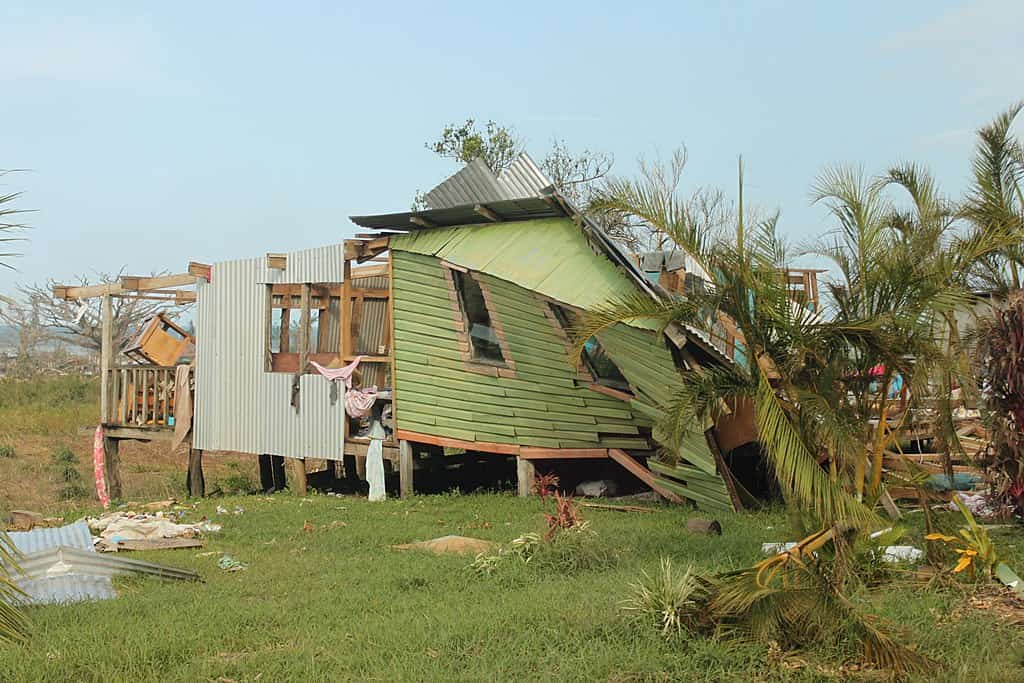 A house destroyed by Cyclone Winston in 2016. Image credit. Wikipedia Commons.
Fiji, an archipelago of over 300 islands, is on the front lines of the climate crisis: nearly two-thirds of its population lives within five kilometers of the shoreline. The country is vulnerable to rising seas and powerful cyclones and is already feeling the devastating effects of climate change. In 2016, Cyclone Winston claimed 44 lives and caused $1.4 billion in damages.
Now, Fiji faces another challenge: relocating communities at risk of inundation. The scale of the challenge has exploded in recent years. By August 2025, updated assessments suggested that up to 676 communities could eventually require relocation—not just from rising seas, but from worsening landslides and flash floods, all linked to climate change. Currently, 17 of these villages are on a ‘red list’ for urgent intervention.
But moving an entire community is far more complex than it sounds. It requires not just logistics but also money, cultural sensitivity, and long-term planning.
To tackle this, Fiji’s government has developed the Standard Operating Procedures for Planned Relocations, a framework designed to streamline and standardize the process. The goal? Ensure that every village relocation is consensual, equitable, and sustainable.
But it won’t be easy.
Lessons From the First Relocations
Narikoso, a village on Ono Island, provides a stark lesson in the complexities of relocation.
For a decade, the residents of Narikoso watched sea levels rise and threaten their homes. The village was in dire need of relocation to higher ground, but discussions started in 2011, and it took almost a decade for any tangible move to happen.
The community was partially moved to higher ground in 2020, but challenges soon emerged. Some villagers chose to remain in their original homes, dividing the community. Funding was also unclear: where should the money come from, and how should it be divided based on the community needs?
The Fiji government has developed a new plan which it hopes will resolve the many uncertainties of the relocation process. Until now, whether a village was eligible to move depended a lot on the influence of village leaders. Under the new plan, the process will be standardized. The first step will be obtaining consensus from the community.
Leaders must first engage with villagers to gain their agreement. This process ensures that relocations are not forced but collaborative. Yet, as the experience in Narikoso shows, even consensual relocations can disrupt social structures and livelihoods.
A study published in 2024 revealed that relocation affected various aspects of the community’s well-being, from financial stability to social cohesion. Researchers concluded that relocations must do more than mitigate immediate risks; they must also sustain livelihoods, preserve cultural traditions, and respect the spiritual connections people have with their land.
Climate Migrants and Relocations
 Image credits: Ted McGrath.
Fiji’s experience reflects a broader, global problem. Climate migration is accelerating as extreme weather events displace millions each year. According to the UN International Organization for Migration, up to one billion people could be forced to move by 2050. Low-lying nations like Fiji are among the first to grapple with these realities, but others will soon follow, and their lessons are important for the entire world.
Relocation is not a one-size-fits-all solution. The Fijian government has committed to exploring all adaptation options before moving communities. These include raising houses on stilts, building seawalls, and reclaiming land from rising seas. Only when these measures prove insufficient does relocation become the final option.
However, even with a clear plan, relocations are fraught with challenges.
The Nabavatu Test Case
While Narikoso provided early lessons, the relocation of Nabavatu village in Vanua Levu became the defining project of 2025. Rendered uninhabitable by saltwater intrusion and cracking land, the community spent years in temporary tent shelters before construction on their new site began in earnest in mid-2025.
The project struggled for lack of resources but a breakthrough occurred in December 2025 when New Zealand injected an additional $5 million into Fiji’s Climate Relocation of Communities Trust Fund. This funding is critical, proving that while the blueprint for survival exists, it requires international capital to function.
Fiji is actively trying to solve the funding puzzle. In November 2025, the government launched a new Sustainable Finance Roadmap, designed to align the nation’s entire financial system with climate goals. It is a bold attempt to secure the money needed to save its citizens before the next major storm, like Cyclone Rae which brushed the islands in February 2025, strikes again.
As more communities are forced to move, Fiji’s experiences may provide a blueprint for resilience and adaptation. The world would do well to pay attention—not just to the challenges but to the solutions and the efforts required to address the damage caused by the changing climate.
This article was originally published in December 2024 and has been reedited to include more recent information.