
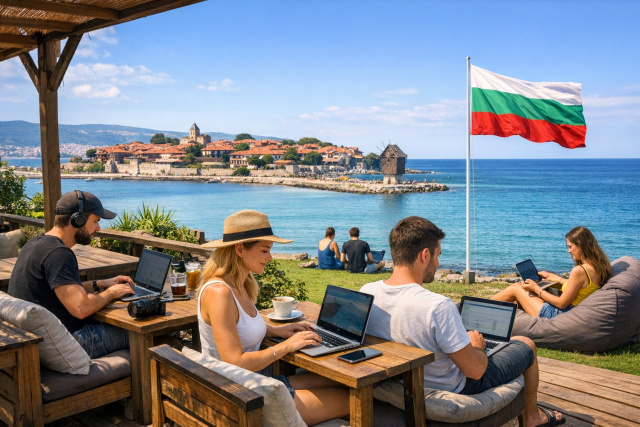
Remote work has become part of normal working life in Britain, with analysis of official surveys showing around 36 – 41% of UK workers now doing their jobs from home at least some of the week in 2024. At the same time, the average monthly cost of living for one person in Bulgaria is estimated at 961 USD, compared with 2,423 USD in the UK, a difference of about 60%. When you combine that cost gap with Bulgaria’s flat 10% tax rates, the bitcoin price usd, solid internet and the growing crypto undertaking, you start to see why more digital nomads are giving this corner of the EU a serious look.
Pounds In, Leva Out, Crypto On Top
If you earn in pounds but spend in leva, Bulgaria changes the maths of your day‑to‑day life. According to cost comparison site Livingcost.org, a single person needs around 961 USD per month in Bulgaria versus 2,423 USD (or equivalent GBP) in the UK, with big differences in rent, transport and eating out. That gap means you can cover your essentials comfortably and still have money left for travel, savings, or putting more into your crypto portfolio.
Tax policy adds another layer. Bulgaria applies a flat 10% personal income tax and a 10% corporate tax rate, which is among the lowest headline rates in the European Union. For a freelancer or small business owner who becomes tax resident, that predictability and simplicity can feel refreshing compared with more complex progressive systems.
Crucially, the practical side of remote work is supported by decent infrastructure. Data compiled by Statista from Ookla’s Speedtest Global Index shows Bulgaria’s median fixed broadband speed at about 77.6 Mbps in 2023. City‑level figures are even stronger, with Speedgeo estimating Sofia’s average fixed broadband around 105 Mbps download, 76 Mbps upload and roughly 20 ms latency, which is more than enough for video calls, cloud tools and crypto trading platforms.
Put those pieces together and Bulgaria starts to look like a place where your income does more work for you. You’re not only shaving pounds off each monthly bill, you’re also buying the freedom to experiment more with investments, whether that means holding blue‑chip coins like Bitcoin and Ethereum or using DeFi lending protocols that saw total value locked grow around 72% this year. In that sense, relocation can double as an upgrade to your financial strategy, not just a change of scenery.
Here’s how the money side lines up in simple terms: Much lower typical living costs than the UK, flat 10% income and corporate tax, and fast, affordable internet combine to stretch your GBP income while keeping your crypto activity practical and accessible from Bulgaria.
The Crypto‑Curious Hub
Sofia doesn’t always feature in glossy “best nomad city” lists, yet the ecosystem on the ground has real substance. Regional tech analysis highlights more than 300 startups in the Bulgarian capital, with over 150 fintech companies nationwide and success stories such as Payhawk reaching unicorn status, alongside crypto‑adjacent firms like Nexo. That density of finance and tech talent naturally spills over into meetups, conferences and co‑working spaces where people openly discuss Web3, DeFi and digital assets.
On the regulatory side, Bulgaria has taken a clear stance: cryptocurrency trading and mining are legal, and specialist commentary notes that recent tax rules aim to bring mining income into the formal system instead of shutting it down. Because Bulgaria is part of the EU, it’s also in the process of applying bloc‑wide frameworks such as the Markets in Crypto‑Assets (MiCA) regulation, which is designed to standardise licensing and consumer protections across member states. For a UK national still getting used to life outside the EU, that can provide a reassuring sense of structure.
Global market data from Binance Research adds useful context. Its reports show that DeFi lending protocols grew total value locked by about 72% in 2025, with Aave alone accounting for roughly 54% of that segment. That level of adoption suggests crypto‑based tools are becoming part of regular financial habits for many users, including digital nomads who rely on lending, stablecoins and on‑chain yield products regardless of where they’re physically based.
If you see Sofia not as a hype‑driven hotspot but as a compact city where you can actually meet founders, tax advisers and developers, the appeal looks different. You get room to participate in Web3 in a more grounded way, from joining meetups to helping early‑stage projects, instead of standing on the sidelines in a crowded, over‑marketed hub. That practical energy can suit people who care more about building and long‑term holding than chasing noise. As Yi He, from Binance, notes, “Crypto isn’t just the future of finance – it’s already reshaping the system, one day at a time.”
Visas, Schengen Freedom And Your Next Base
For non‑EU nationals, the visa question is always close to the top of the list. Bulgaria has used its Aliens Act to create a Type D long‑term visa route aimed at freelancers and remote workers, commonly described by relocation experts as a digital‑nomad or freelancer programme. Guides explain that applicants can obtain a freelance permit through the Employment Agency and then apply for a Type D visa, typically starting at six to twelve months with renewal options. It’s not the simplest process, and some legal firms point out that Bulgaria doesn’t yet have a single, branded “Digital Nomad Visa”, but in practice this framework provides a clear path for many remote workers to stay longer term.
The travel picture improved significantly at the beginning of this year. Following a Council decision in early 2024, Bulgaria and Romania fully joined the Schengen Area, with air and sea borders integrated from 1 January 2025 and land borders following afterwards. For anyone holding a Bulgarian residence permit or long‑term visa, this means easier movement to other Schengen countries without routine internal border checks, which is a big plus if your work or personal life involves regular trips around Europe.
Crypto fits into that legal and geographic puzzle in a relatively straightforward way. As mentioned earlier, crypto trading and mining are legal in Bulgaria, and the country is aligning with EU‑wide rules that aim to clarify how exchanges and wallet providers should operate. That combination of residence options, Schengen access and a regulated crypto environment gives you a solid base from which to run a cross‑border life, whether you’re invoicing UK clients, collaborating with EU teams or attending events across the continent.
So if you’re already moving between European cities with your laptop and a hardware wallet, how different could your year look if you locked in a Bulgarian home base, rather than stitching together a string of short, expensive stays elsewhere?
Turning Advantages Into Your Edge
When you zoom out, the pattern is fairly clear. Remote work is now a normal option for a large share of the UK workforce, with multiple analyses putting home or hybrid working around a third or more of employees in 2024. Bulgaria offers a cost of living that’s roughly 60% lower than the UK on average, flat 10% income and corporate tax, capable internet infrastructure and a tech scene where fintech and crypto companies are part of the mainstream business story rather than a niche curiosity.
Add to that a freelancer‑friendly Type D visa route, full Schengen membership, and a legal environment where crypto is allowed and increasingly structured by EU rules, and you get a place that supports both your professional life and your interest in digital assets. On the financial side, lower monthly outgoings and clear tax rules open up more room for saving and investing, including using DeFi and other on‑chain tools that continue to gain traction globally.
If you’re a British remote worker who already thinks in terms of flexibility, multiple income streams and border‑agnostic money, Bulgaria won’t feel like a wild gamble. It feels more like an under‑discussed option that lines up neatly with the way you’re already working and living, which raises a simple question: when you next review your plans for the year, will Bulgaria and its crypto‑friendly advantages be part of the conversation you have with yourself?