
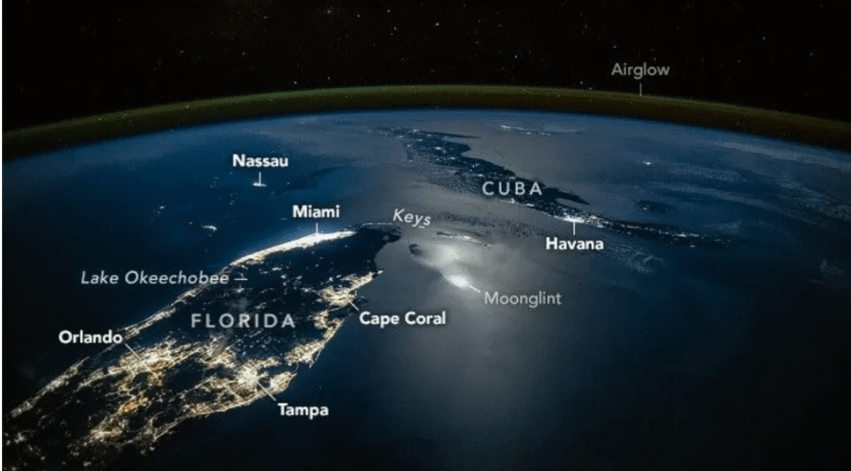
Airglow and city lights come together in this image. (Image credit: NASA/Expedition 72 crew)
The image offers a rare look at how Earth's surface and atmosphere interact after sunset.
At 2:23 am Eastern time on March 19, 2025, an astronaut aboard the International Space station (ISS) captured a striking nighttime view of Earth, where shimmering moonlight dances across dark ocean waters while clusters of city lights outline the Florida Peninsula, the Caribbean, and parts of Central America.
Dense clusters of illumination trace major population centers, including the bright corridor from Miami to Fort Lauderdale along Florida's southeastern coast, the Tampa–St. Petersburg area on the Gulf Coast, and the Orlando metropolitan region near the center of the peninsula. Smaller but still discernible patterns of light mark the Florida Keys, Nassau in the Bahamas, and Havana and other cities across Cuba.
What is it?
Besides the stunning city lights, what sets this image apart is the presence of moonglint, the nighttime counterpart to sunglint. Much like sunlight reflecting off the ocean's surface during the day, moonglint occurs when moonlight reflects off water at just the right angle to reach the observer.
https://i.redd.it/hms47wame9ag1.png
6 Comments
I can see my house from there
So the letters and names are there!
As an American, Cuba seems so far away, and different. This picture makes me realize how untrue that is, as far as the natural world is concerned. The only thing that different is man-made cultural and political distinctions. At the end of the day we all want and strive for the same things, and have more in common than we realize.
What’s cool is the atmosphere.
I’m not sure it ever occurred to me that astronauts in space can see moonlight reflected on the oceans at night.
The more white LED lights of Miami really contrast with the more yellow (but not sodium orange of old, sadly) lights of the rest of Florida, interesting to see that contrast.