
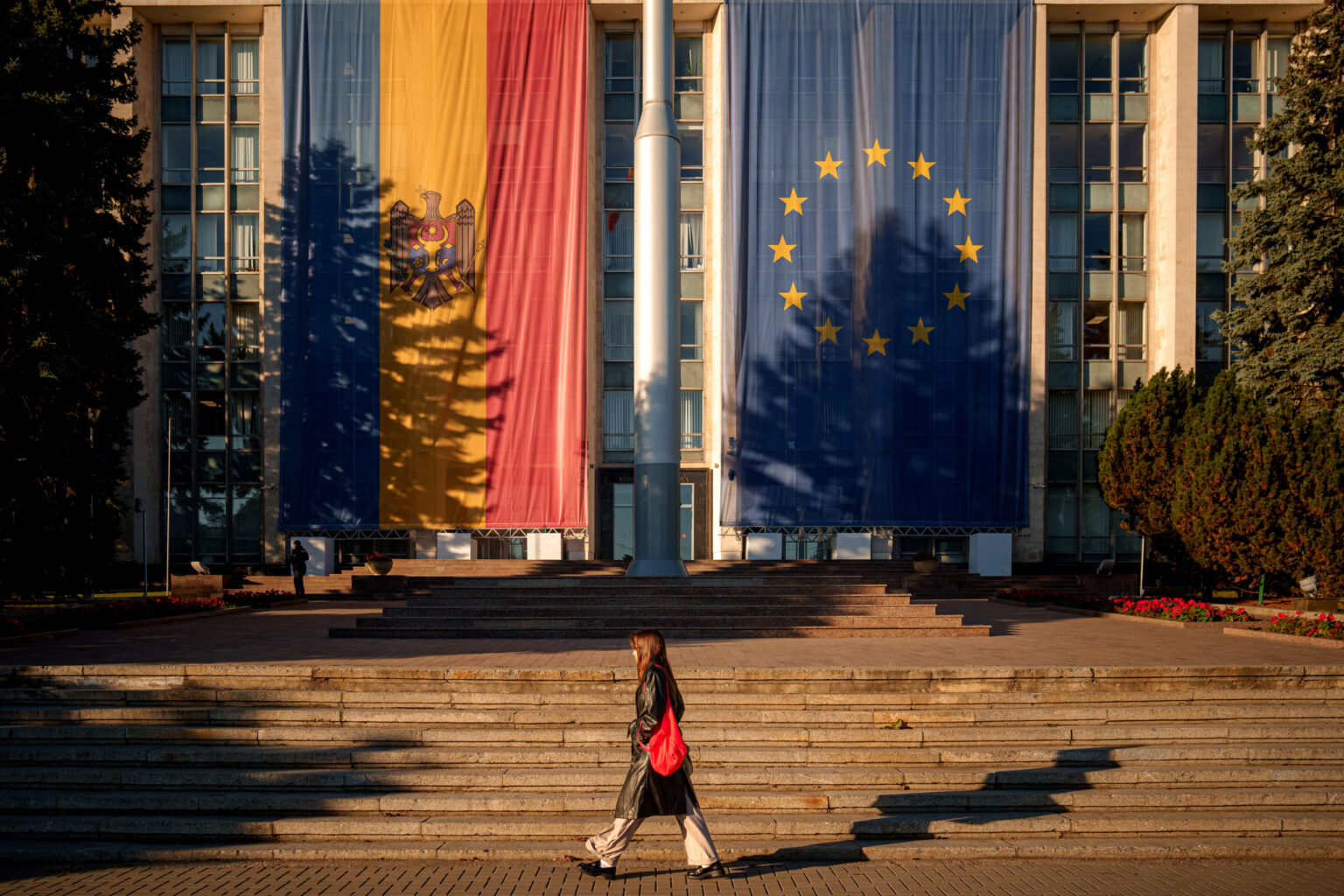
Priests are preaching pro-Kremlin propaganda from their altars, Russia is recruiting teenagers to stir unrest, and millions of euros are being funnelled through cryptocurrencies for influence campaigns and vote buying. This is the political reality in Moldova ahead of the parliamentary election on September 28th. Moscow is relentless in its bid to weaken the country’s pro-EU camp, led by incumbent president Maia Sandu’s Party of Action and Solidarity (PAS), and block it from securing a majority.
A Kremlin-loyal government in Chisinau would serve Russia well. Empowered Kremlin-linked parties or blocs would create a direct security risk on Ukraine’s southwest border and provide a central base from which Russia can operate against EU countries. Moscow’s influence in Chisinau would almost certainly derail Moldova’s EU accession bid, an opportunity which opened in 2023 and—given the amplified voice of enlargement sceptics—could close with the EU’s next election cycle. Moldova’s election result has profound implications for the eastern neighbourhood, and for Europe overall.
Europe should view Moldova as a testing ground for its own resilience, with the election offering Brussels valuable insight into the tactics, tools and impact of Moscow’s operations
Yet it also gives Europe a chance to study—and even counter—Russia’s disinformation and hybrid-war playbook. Europe should view Moldova as a testing ground for its own resilience, with Sunday’s election offering Brussels valuable insight into the tactics, tools and impact of Moscow’s operations. By learning from the election campaign, and its outcome, the EU can better anticipate, prepare for, and build resilience against similar threats among member states such as Romania. By the same token, Chisinau’s western European partners need to safeguard Moldova’s democracy and mitigate the risks of Russian meddling now and in the future.
Putin’s disinformation playbook
This is not Vladimir Putin’s first rodeo. He has attempted to derail democracy in Moldova in the past, with large-scale Russian meddling characterising both the country’s 2024 presidential election and its simultaneous referendum on Moldova’s future EU membership. Indeed, Moldovan authorities (confirmed by an independent investigation) documented 135,000 cases of vote-buying through various phone-based apps.
Now, throughout 2025, Russia is adapting its gameplan, resulting in brutal and often overt campaign meddling such as illicit funding and financing pro-Russian parties and candidate. Officials close to Moldova’s ruling PAS party complain that, instead of competing with the opposition, they are competing with Russia.[1] Economic hardship, combined with PAS being unable to deliver fully on its previous election promises, is fertile ground for Russia’s malign influence to sow division among the population: over attitudes towards the war in Ukraine, over views on Moldova’s strategy towards Russia, and due to growing discontent toward the welfare state. Moscow is also intent on portraying the West as a threat to Moldova, warning that Chisinau’s pro-EU course will strip the country of its sovereignty, undermine traditional values, and risk turning it into a Ukraine-like battlefield.
The scale at which Russia is pumping resources into Moldova is also overwhelming the country’s law enforcement: the Kremlin has already spent an estimated $100m on voter manipulation. For example, Moscow has invested in pro-Russian narratives and parties, and in fake pro-EU and pro-Romanian entities (including “Partidul Nostru” and “Alternativa”), which are designed to split and confuse pro-European and pro-Romanian voters. Moldova’s potential inability to form a government, combined with Russian meddling and the Kremlin’s efforts to label the elections as fraudulent, could create fertile ground for engineered unrest (for example, by planting provocateurs to stage violent demonstrations). It might also lead to a fragmented parliament stuck in a deadlock, through which Russia could move to discredit the incumbent government and sow distrust among the population.
Furthermore, if the election result does not create a straightforward, pro-reform and pro-EU government, Moldova’s parliamentary parties will have to form a coalition. In this scenario, Russia will exploit any possibility to discredit Moldova’s pro-EU camp. It would erode public trust, force early elections to secure a pro-Russian majority government, and derail Moldova’s EU accession. If it succeeds, the Kremlin could use Moldova as a platform for hybrid operations against EU member states such as Romania and France (the latter being a staunch supporter of Moldova among the G7 countries). However, its main focus is Ukraine: Russia installing a hostile regime along the 1,222 km border and fortifying the contested Transnistria region would directly weaken Ukraine’s defence. Moldova’s election is therefore vital to protect Europe from Russian meddling or continued military escalation.
Europe’s democratic endeavour
But the EU has the instruments and the power to support Moldova’s pro-reform and pro-EU parliamentary course. The EU should offer financial incentives that facilitate the forming of a coalition government committed to preserving stability and carrying out the government’s promised reforms: for example, a funding programme for new energy production facilities or renewable reserves would drive energy prices down and help alleviate some economic hardships. At the same time, the EU needs to underline what Moldova can lose should Russia assume proxy control. This includes depriving the country of its ability to shape its own future, undermining its pro-reform and pro-EU trajectory, and subordinating Chisinau to Kremlin interests—including being dragged into its war against Ukraine.
Regardless of the election’s outcome, sustained capacity-building to counter Russian influence operations remains a top priority. Russia is unlikely to cease its attempts to undermine the government; European partners need to help Moldova curb illicit funding and provide robust cyber support to tackle ongoing disinformation. This could include the EU allocating resources towards improving anti-money-laundering instruments, for example by tracking the conversion of Russian money into crypto and then back into the cash being pumped around Moldova. The EU could also improve cyber-security by ensuring that social media platforms become more responsive to the Moldovan government’s requests to take down fake news and AI-generated content.
Such initiatives are vital since, if Sandu’s party wins, Russia is likely to portray the election as fraudulent. Putin could then activate pro-Russia networks to orchestrate unrest and create instability across the country. In this scenario, Moldovan law enforcement will have to protect the election result and maintain order: given Russia’s past actions, the country needs a contingency plans—support by the EU—for the post-election period. However, EU member states need to provide long-term sustained political and diplomatic support, communication and intelligence sharing, and cyber assistance and rapid response mechanisms. Especially in the likely scenario that US governmental support for, and cooperation with, Moldova continues to decrease, Moldova alone cannot manage Russia’s destabilisation attempts.
*
Russian interference in Moldova risks stripping the country of its ability to decide its own future, derailing its EU path, and turning Chisinau into a Kremlin outpost. For Ukraine, this means a new security threat along its southwestern border; for Europe, anything that weakens Ukraine also undermines European security. On top of this, a Kremlin-loyal Moldova could serve as a launchpad for Russian hybrid operations against the EU itself.
The EU cannot afford to stand idly by. It needs to push back against Moscow’s influence and prevent further destabilisation in its eastern neighbourhood, whatever the election outcome. The lesson from Putin’s playbook in Moldova is clear: Russia will not hesitate to flood Europe and its neighbours with political, social, financial and economic manipulation, and create an atmosphere where “nothing is true and everything is possible”. If Europeans are not ready to defend their democracy now, others stand ready to take it.
[1] During private conversations with the authors.
The European Council on Foreign Relations does not take collective positions. ECFR publications only represent the views of their individual authors.