
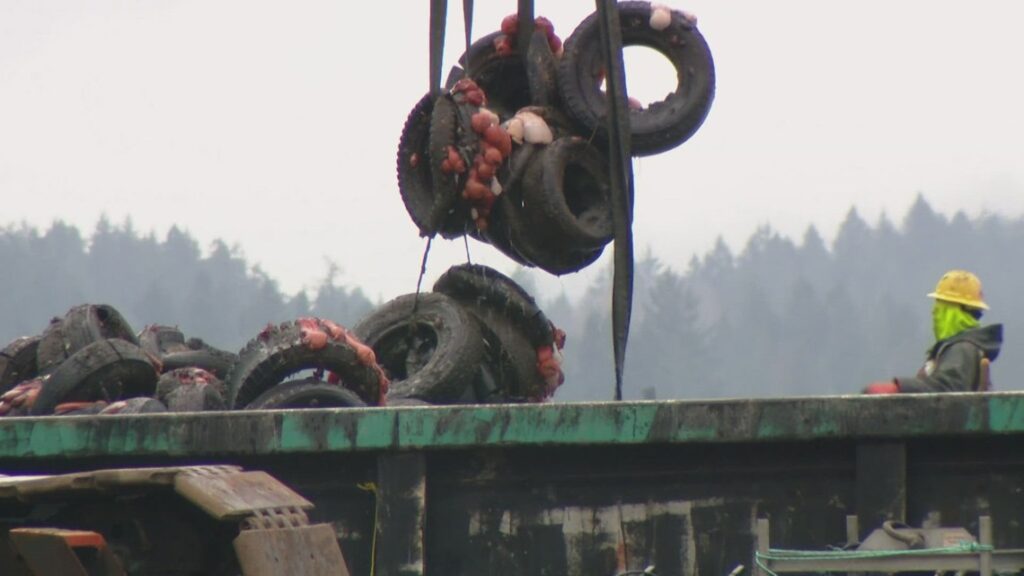
In this KING 5 update, the Environment Northwest team gets exclusive access to Washington state’s cleanup. This reverses a failed plan to submerge artificial reefs.
OLYMPIA, Wash. — Vernon Stoner has grown accustomed to the rhythmic industrial symphony outside his Olympia waterfront home.
The noise recently heard on Puget Sound is the groan of hydraulics, the splash of chains, and the thud of rubber against metal.
Day after day, a massive cleanup barge glides along Puget Sound, its deck piled high with an unusual cargo — thousands upon thousands of old tires.
“The barge is a little bit noisy, but we can live with that for several weeks,” Stoner said, watching from his deck as another load passed by. “It’s just great that they now recognize that wasn’t a good idea.”
What Stoner is witnessing is environmental history being reversed, one tire at a time.
Undoing an environmental error
In the 1960s, the Washington State Department of Natural Resources made what seemed like an innovative decision.
A plan to create artificial reefs in Puget Sound using truck and car tires was created by Washington’s Department of Natural Resources (DNR) to attract native reef fish to bolster recreational fishing opportunities across the state.
Over the span of two decades, more than 100,000 tires were scattered across the seafloor from Olympia to Port Townsend.
The science seemed sound at the time.
But decades later, researchers discovered the initiation had backfired.
Rather than nurturing ecosystems, the tires separated and began migrating to other areas. Local marine biologists KING 5 spoke to this year worry that tire particles have degraded in the saltwater, potentially leaching toxic chemicals and at times, creating hazards for marine life.
The hoped-for reefs became underwater junkyards.
Throughout 2025, the state agency is undertaking one of the most ambitious environmental cleanup projects in the Pacific Northwest’s history, working to extract as many tires as possible before the new year.
In KING 5’s report earlier this year – DNR said it was facing a major challenge.
It does not know exactly how many tires are in Puget Sound.
A few thousand tires were lugged out of Puget Sound in late fall 2024 during a pilot program. An area estimated to house about 3,000 tires ended up having 5,000.
It’s possible there are 30% more tires in the water than originally projected.
A fresh start for Puget Sound’s salt water
The scale of the operation is staggering. Stoner, who has lived on the waterfront since 2004, said he’s watched barge after barge lumber past his home. “I see hundreds of tires on the barge,” he said. “I’m surprised how many there are.”
For residents like Stoner, who cherish the region’s natural beauty — the eagles soaring overhead, the salmon runs, the crystalline waters — the cleanup represents more than just waste removal. It’s an acknowledgment that even well-intentioned environmental interventions can go wrong, and a commitment to making things right.
“We really do enjoy the life here, the eagles, the hawks, doing the fishing in the sound,” Stoner said. “We care a lot about the sound, we care a lot about the environment.”
The contrast between the dumping that happened nearly 60 years ago and today’s meticulous cleanup underscores how far environmental science has advanced.
What was once considered habitat enhancement is now recognized as pollution that must be remediated.
Where are the removed tires headed?
DNR officials say the extracted tires are being sent to specialized facilities that accept only tire waste, ensuring they’re either recycled or disposed of properly — preventing any further environmental damage from the decades-old mistake.
When the barges finally stop their daily rounds and silence returns to Stoner’s waterfront, Puget Sound will be tens of thousands of tires cleaner. And a well-meaning error from the past will, at last, be corrected.
To read and watch KING 5’S Environment Northwest report that aired in March of this year, click here.