
MANSFIELD — Three weeks after immigration officers detained Maher Tarabishi, his son was rushed to the emergency room with life-threatening sepsis and pneumonia.
One month later on Dec. 24, his son, Wael, was again admitted to Methodist Mansfield Medical Center, this time after his feeding tube was displaced, causing excruciating pain and his stomach to leak.
Wael, 30, who has a rare genetic disorder called Pompe disease, remains hospitalized. His father, who is his longtime primary caretaker, is being held at the Bluebonnet Detention Center in Anson, about 200 miles west of Dallas.
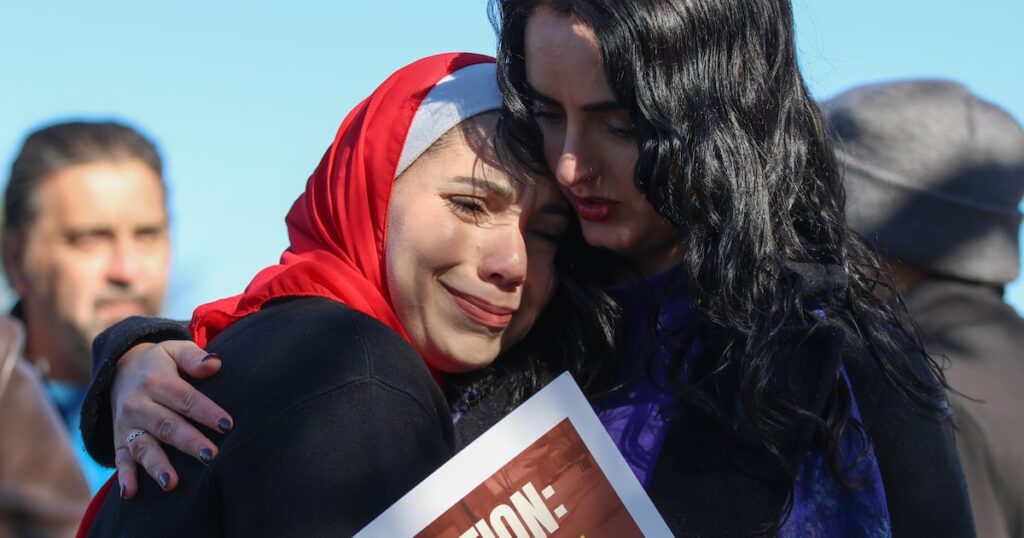
On Tuesday, family members pleaded for the humanitarian release of Tarabishi, a native of Jordan who has lived in the United States since arriving on a tourist visa in 1994. At a news conference outside the hospital, friends and family frequently appealed directly to President Donald Trump.
“I’m not here to talk about immigration policy. I’m not talking about politics …” said Dr. Bilal Piracha, an emergency medicine physician in Coppell and medical advocate for the family. “We are talking about mercy. We are talking about humanity.”

Ammar Jumaa, Wael Tarabishi’s uncle, (center) holds signs calling for Maher Tarabishi’s return during a news conference outside of Methodist Mansfield Medical Center on Tuesday, Dec. 30, 2025, in Mansfield. Wael, who lives with Pompe disease, has been hospitalized at least twice since his father was detained.
Christine Vo / Staff Photographer
Tarabishi, 62, who lives in Arlington, was detained Oct. 28 during a routine check-in with immigration officers in Dallas. His family said he had applied for asylum. A spokesperson for Immigration and Customs Enforcement did not respond to emails Tuesday from The Dallas Morning News seeking additional details.
The agency has previously said that Tarabishi is a member of the Palestine Liberation Organization, the internationally recognized representative of Palestinians, which his family denies.
Family members described Tarabishi as a devoted father and grandfather, a rule follower who never missed an immigration check-in or even got a speeding ticket.
When Wael was diagnosed with Pompe disease at a young age, doctors estimated he would not live past age 10. The condition causes progressive muscle weakness, enlarged organs and difficulty breathing. To care for his son, Tarabishi, an electrical engineer, developed an encyclopedic knowledge of the condition.
In a statement read by his cousin, Loui Tarabishi, Wael said he is alive because of his father, who he called his hero and best friend.
“He has never left my side,” Wael said. “Without him, I am nothing. Without him, I cannot survive. He is my arms, my legs, my lungs, my voice when I cannot speak.”
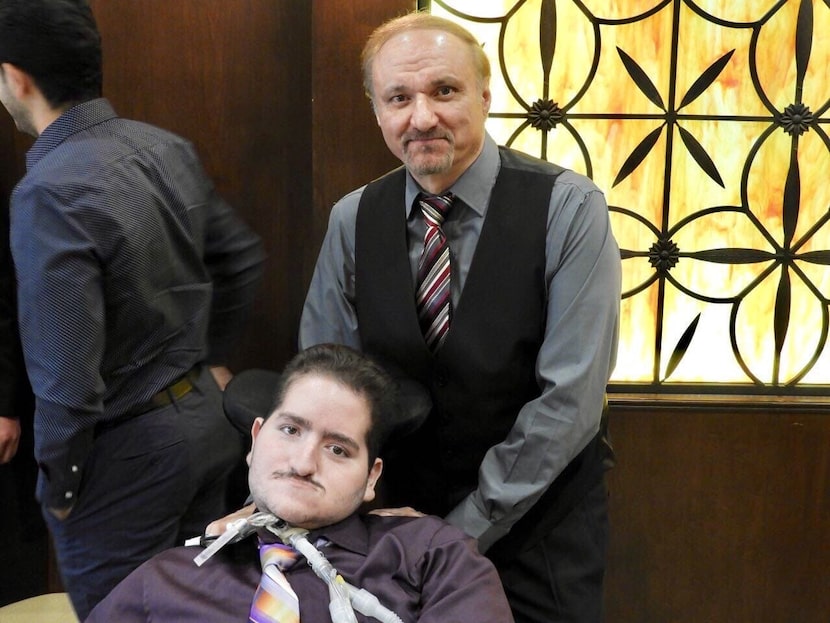
Maher Tarabishi and his son, Wael.
Family of Maher Tarabishi
Tarabishi is among the tens of thousands of immigrants targeted by the Trump administration’s sweeping mass deportation program. Since taking office in January, Trump has aimed for 3,000 arrests a day. An estimated 70,000 people are in ICE custody.
Last month, federal agents detained Donovan Hinda, a popular Bishop Arts bartender, and Chih-Ming Feng, known as Petey, a longtime Dallas line cook who has worked at numerous fine-dining restaurants in the city. In October, the Rev. James Eliud Ngahu Mwangi, an Episcopal priest, was detained in Huntsville.
Days after his arrest, relatives of Tarabishi said they struggled to find any information about their family’s patriarch. Eventually, they learned he spent four days at a Dallas ICE office, in a space with about 30 people and access to only one bathroom. Tarabishi was then transferred to the Bluebonnet Detention Center, where his daughter-in-law Shahd Arnaout called the conditions “inhumane.”
In the past several weeks, they have spoken with him frequently, and he begins each phone call asking about Wael’s health, Arnaout said through tears.
“This is not a man who should be behind bars,” Arnaout said. “This is a man who should be beside his child. … Bring him home. Bring him back to his son. Do not wait until it’s too late.”