
Azerbaijan’s first large-scale seawater desalination plant is set to be built by Saudi-based ACWA Power, under a recently signed $400-million public-private partnership agreement. It is a rare Caspian Sea project for the water and power contractor and a milestone for the country’s water sector.
ACWA Power announced Dec. 26 that it executed a design-build-finance-own-operate-maintain concession with Azerbaijan’s state water authority, the Azerbaijan State Water Resources Agency, under a 27.5-year term. The project company will be wholly owned by ACWA Power at signing, with additional details to be announced at financial close.
]]>
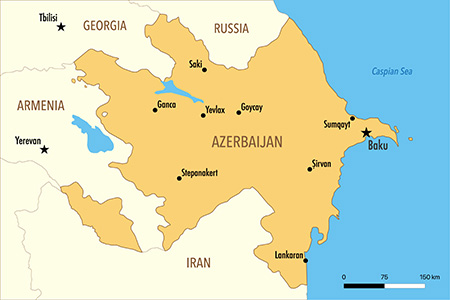
ACWA Power plans to develop the country’s first large-scale seawater desalination plant at Sumgayit, located near the capitol of Baku, under a $400-million P3 deal.
Map courtesy of Adobe
The planned facility would be located at Sumgayit Industrial Park, about 19 miles northwest of the capital, Baku, along the Caspian coast.
The site places the project within Azerbaijan’s primary coastal industrial and population corridor, serving the Baku metropolitan area—including the Absheron Peninsula—which has a population of about 3.2–3.3 million, according to Azerbaijan’s state statistics and United Nations urban data. Azerbaijan’s total population is roughly 10.2 million, according to official national statistics and World Bank data.
Azerbaijani government-linked reporting, citing ACWA Power and water-agency officials, has indicated a planned capacity of about 300,000 cu m per day. At full output, the plant could supply roughly 2 million people at typical urban consumption levels, underscoring its potential role as a stabilizing water source for the Baku–Absheron corridor rather than a marginal supplement.
]]>RELATED
ENR 2024 Water Report: Managers Look to Potable Water Reuse
The project is advancing as independent scientific assessments have flagged long-term water-supply risks in the Caspian region. The Intergovernmental Panel on Climate Change and NASA have identified rising temperatures and evaporation—not short-term hydrology—as the dominant drivers of sustained water-level declines in the world’s largest enclosed inland sea.
]]>
A peer-reviewed study published in Nature Communications projects continued declines under most warming scenarios, while World Bank water-sector reviews for Azerbaijan have cited the trend as a growing constraint on coastal infrastructure and municipal supply planning.
The next key milestones for the desalination project will be the financial close and EPC disclosure, which will clarify whether the project is delivered under a single EPC wrap or multiple construction packages.
Intake and outfall design, power sourcing and energy intensity will be among the most consequential technical decisions, given the Caspian Sea’s shallow coastal conditions and the facility’s scale. Those elements are typically finalized shortly before a notice to proceed on comparable desalination P3s.
Power-supply arrangements, including grid connection and energy-intensity assumptions, have not been disclosed, nor have financing arrangements, lenders or a construction notice-to-proceed date. ACWA Power said those details will be provided after financial close.
RELATED
Competition Offers $119M to Advance Desalination Technologies
Azerbaijani officials have previously indicated that multiple agreements tied to the desalination program were executed in 2025, including land-use and state-support instruments, positioning the plant as a flagship water-security investment. The facility is expected to be transferred to the state water agency at the end of the concession term, according to Azerbaijan-based reporting.