
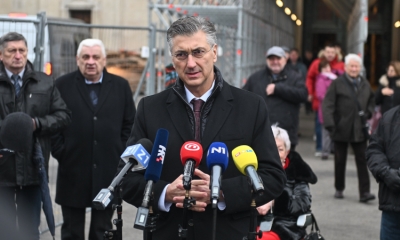
Croatian Prime Minister Andrej Plenković said on Tuesday that Croatia is closing the gap with older EU member states, highlighting continued economic growth, stable public finances and strong development of the capital market as key achievements in 2025.
Speaking at the final government session of the year, Plenković said the Croatian economy has now recorded 19 consecutive quarters of growth, with GDP per capita reaching 78 percent of the EU average—an increase of 16 percentage points over the past nine years. The government’s goal, he added, is to push Croatia beyond 80 percent of the EU average.
He also pointed to confirmation from all three leading credit rating agencies, which continue to assign Croatia an A-level investment-grade rating, describing it as a clear signal of confidence in the country’s fiscal stability, responsible public finance management and overall political stability.
Plenković placed special emphasis on the strengthening of the capital market, noting that the state has issued 18 government bond offerings in recent years. Croatian citizens have invested €4.6 billion in these instruments and now hold around nine percent of the country’s public debt.
Addressing inflation, the prime minister acknowledged that rising prices have had the greatest impact on the most vulnerable groups. He said the government has therefore continued with support measures throughout the year, introducing nine aid packages worth a total of €8.5 billion. These measures included energy subsidies, price caps on 170 products, reduced VAT rates, increased price transparency, and 11 one-off payments to pensioners.
According to projections from the Ministry of Finance, inflation is expected to fall to around 2.8 percent in 2026. Plenković called on all market participants to act responsibly, stressing that the state had provided significant support during recent crises.
“We are entering 2026 with positive trends, optimism, and a necessary level of caution given the economic slowdown in Europe and globally,” he said.
Plenković also confirmed that the 2026 state budget has been adopted, with a focus on continued growth in wages, pensions and social benefits. One of Croatia’s key strategic economic objectives, he reiterated, remains membership in the OECD.
Looking ahead, the prime minister announced plans to adopt a National Development Strategy through 2030, a new Crafts Act, and an updated industrial strategy, alongside accelerated energy and climate transition and further development of agriculture towards safe and sustainable food production.
Plenković also reported that Croatia is expected to receive the seventh payment of €1.07 billion from the National Recovery and Resilience Plan (NRRP), marking the largest single transfer from the EU budget to Croatia since joining the EU more than 12 years ago. With this payment, total funds received under the plan will reach €6.4 billion, reinforcing Croatia’s position among the most successful EU member states in implementing recovery funding.