
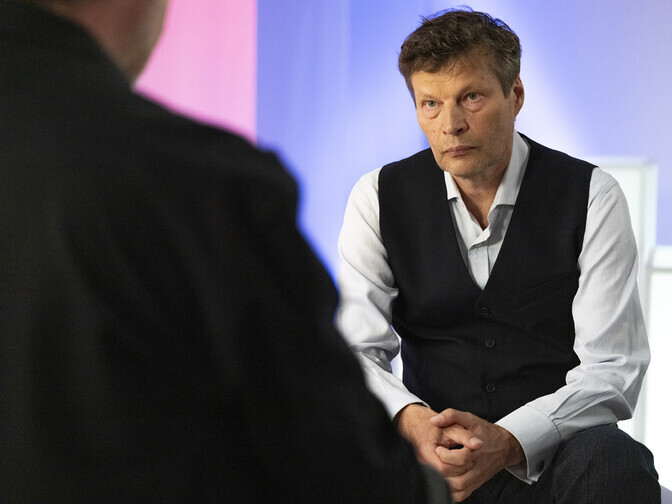
The end of the year is a time for taking stock and this has, without a doubt, been Donald Trump’s year. What does Donald Trump’s world look like from your perspective — how would you describe it?
Well, it’s an absolutely insane world that no longer lends itself to any kind of analytical approach. At times, it feels like what’s really needed isn’t a historian’s or political scientist’s education, but a psychiatrist’s training to make any sense of it. Just recently, the United States released its National Security Strategy and even reading that document is completely surreal. Literally, in the introduction and throughout the text, there are repeated praises of the current president. I’ve never seen anything like that in such high-level documents — just outright glorification of the sitting president.
And it seems that we here in Europe, in the old world, are being forced to go along with this game. From my point of view, the problem isn’t so much Donald Trump himself, but rather what we, as Europeans, have done to ourselves.
If we look around Estonia, the vast majority of our top politicians, senior officials and security experts have built their entire careers on two pillars. The first is the assumption that America will always be our friend. The second is that NATO’s Article 5 will hold under any and all circumstances. And now, as the situation begins to shift — when there is real reason to deeply question the permanence of those two pillars — these people suddenly have nothing to say. And that’s understandable because if they were to admit that these things no longer hold true, they’d essentially be discrediting their entire life’s work. They would be forced to acknowledge that they’ve been wrong for quite some time about something fundamental.
There’s one case I find particularly interesting, looking back a bit in history: 2018, Trump’s first year in office, when the presidents of the Baltic states all went together to the White House. That was in April 2018. We remember the optimistic reports that came out of that meeting — how Trump even thanked the Baltic countries for increasing their defense spending and all the usual talking points were covered. But then, in November 2018, French journalists from Le Monde uncovered what had actually happened during that meeting. Apparently, Trump began scolding the Baltic presidents, mistakenly believing they were the presidents of Balkan states and he berated them for having started the Yugoslav wars. What’s remarkable is that here in Estonia, no one said a word about this. I followed it closely at the time. Kersti Kaljulaid, who was our president then, didn’t feel the need to explain what had really gone on in the White House. And the Estonian press didn’t pick up the story either.
What I’m saying is that when I talk about how our top politicians, officials and security experts have always tried to leave certain things unsaid, the Estonian media has also played a part in that same game. We, too, have chosen not to notice certain things, not to talk about them because there’s something very, very dangerous lurking underneath it all, something existentially frightening. And that’s the situation we find ourselves in at the end of this year.
Is NATO still functioning?
I don’t know, I can’t say. If Trump says it’s not, then it’s not because what we’re seeing right now is a moment shaped by that U.S. worldview I mentioned earlier, and from that perspective, Europe is seen more as a problem. Yes, it’s true that Europe is important to the United States, but not in the form it currently exists. The United States, or rather Donald Trump and his administration, would like to reshape Europe or, more precisely, not even reshape it but revert it to how it was at the beginning of the 20th century or the end of the 19th: no European Union, no globalization, just nation-states pursuing only their own narrow national interests. And with those kinds of countries — countries focused solely on their own self-interest — the United States would be willing to engage as a cooperative partner. That’s the concept.
One thing that stands out in this national strategy document is that universal values like defending democracy, international law and human rights have been pushed to the margins, while “America First” and American interests are at the center. How significant or transformative is this shift or, if we look at the longer arc of history, could it be that we simply happened to live our years of independence during a particularly idealistic period and that’s why it felt like those values were fundamental and permanent? Maybe the talk of universal values was always more of an exception?
Well, I wouldn’t call it accidental — reaching those universal values was certainly part of a natural progression. But now their being called into question, this return to something like the 19th century, shouldn’t really surprise us either. History has always had these kinds of setbacks.
What is surprising is that we’re surprised by it. There’s a kind of hypocrisy in that. I still remember the excitement of the early 1990s when Francis Fukuyama came out with his theory about the “end of history” — that liberal democracy had triumphed globally and that there were no longer any competing ideologies. From that point on, the rest of world history would supposedly unfold within the framework of liberal democracy.
I remember how, here in Estonia, from top politicians to security scholars, we laughed at Fukuyama — what a naive American, we thought. And yet, at the same time, we began acting as if that was exactly what had happened, that history really had ended. Especially after we joined NATO, suddenly, we felt like we were under God’s own protection, that nothing bad could ever happen to us again. And that attitude started to shape our behavior, even to the point where we had, for a long time, a minister of defense who advocated for abolishing conscription and turning the Defense Forces into something the size of a paid orchestra and ceremonial guard company. That person is still active in top-level politics today, they haven’t disappeared anywhere.
All these people who once said completely absurd things are still around. Every time the Lennart Meri Conference starts, I go there and look around and they’re all there. They’re doing just fine, feeling great, telling us how to think and how to live. These are the same people who once spoke in wishful fantasies that, as we now see, had very little to do with reality.
If we continue looking at this through a historical lens, Trump’s worldview is highly confrontational, competitive, all about who holds the cards and who doesn’t, who’s the stronger player. But history has also shown us that cooperation can be deeply valued. Couldn’t cooperation, then, still be one of Europe’s trump cards in this game, something we should recognize and appreciate?
Yes, yes — cooperation is mentioned in that document too. But the question is: under whose terms does this cooperation take place? Some malicious jokers have said that to truly understand the strategy document, you should read it in its original language — Russian. Now, that might be a bit of a cruel joke, but it does capture something real: the document clearly implies that cooperation is fine, yes, but it’s dictated by the stronger party. And that stronger party is not Europe.
It’s definitely the United States. But reading between the lines, you also get the sense that in some contexts, it could even be Russia.
In that document, Russia is referred to as a desired partner, a strategic partner.
Well, at the very least, it’s not portrayed as an adversary or an enemy. And that all stems from something stated very clearly right at the beginning of the document, the part you also referenced. It explicitly says that the United States’ relationships with other countries will no longer be based on those countries’ domestic policies or ideologies. All that emphasis on democratic and liberal values that used to form the basis of U.S. foreign relations — it’s been cast aside. Now, it’s all about pragmatic interests.
Basically, the United States is prepared to work equally with countries led by vegetarians or by cannibals. If there’s a strategic interest, if there are economic considerations — so be it. Cannibals aren’t considered any worse than vegetarians.
What should Europeans and Estonia do in this new world? How should we act to defend our interests?
Now, I’ll allow myself a few literary flourishes here. And what I’m about to say, everyone can decide for themselves whether I’m being ironic. But maybe I’m not.
In any case, what Estonia could do now is reach an agreement with Latvia to start a major conflict over the island of Ruhnu. We’d gather our Viking fleets beneath Ruhnu, string up our crossbows and fire off catapults — and after two or three days of intense warfare, we’d turn to the White House and ask for mediation. Donald Trump, of course, would quickly and efficiently broker a peace deal, after which the Estonian and Latvian governments would issue a joint statement saying that Donald Trump should receive the Nobel Peace Prize for ending his ninth, tenth or eleventh war.
At the same time, Estonia’s military historians should put together a thorough academic study proving that if Donald Trump had been president in 1939, World War II would never have broken out. If he’d been president in 1914, there’d have been no World War I. And had he ruled instead of Edward III in the 14th century, there’d have been no Hundred Years’ War either. The whole thing should be printed on parchment and presented to Donald Trump.
After that, Trump would surely understand that Estonians are a great people — a friendly people, a people who get it, who speak his language. A people worth befriending. A people worth protecting if trouble arises.
The most horrifying part is that as I’m saying this, I’m not entirely sure it’s a joke. This kind of approach might actually work on Donald Trump.
Well, Estonian politicians probably aren’t going to do that, but what would be option two?
Right, because Estonian politicians are very much boxed in. And the boundaries of that box were drawn 25–30 years ago — NATO with its Article 5, transatlantic values, the European Union and the notion that Russia is not to be trusted. That’s the framework in which all thinking still takes place. So our options are extremely limited.
If I shift back into writer mode, I could immediately suggest three different scenarios for acting outside that box, but they would probably exceed our collective pain threshold.
For example?
Well, the first is a classic: the 1939 bases agreement scenario. If, especially among the younger generation, there’s now this sudden fear that we might actually have to go to war with Russia, then that’s not necessarily inevitable. We could leave NATO, allow Russian bases onto our territory, become some kind of oblast, province or vassal state of Russia. Then we wouldn’t have to fight and everything would be “fine.” Foreign investment would rise, the birthrate would suddenly spike because there’d be no more threat of war. That’s one option.
The second option: we turn to the Chinese. We invite 10,000 Chinese language teachers here via the Confucius Institute and 100,000 Chinese soldiers to protect them. In return, we hand over our forests and mineral resources, let them do as they please. The economy would start booming and maybe the birthrate would go up too.
The third option: we finally fulfill the heartfelt wishes of our friends who support Gaza. We bring the population of Gaza here as refugees, along with everything that comes with them. Then Hamas would build hundreds of kilometers of tunnels here, fill them with Iranian weapons and who knows what else and after that, all our neighbors would be terrified of us. No one would dare attack. Again, maybe not foreign investment, but it would feel secure and we wouldn’t need to go to war.
You can come up with all sorts of scenarios and, again, I’m not entirely sure I’m joking. Because there are political forces and highly respected individuals in Estonia — some of them even in the Riigikogu — who have said things like: does it really matter what color the flag flying atop Tall Hermann [tower] is? These people are still respected, they’re still among us and nothing has changed for them.
So all sorts of opinions can be expressed in this country. And I believe that tens of thousands — maybe even hundreds of thousands — of people could, at this point, be thinking: well… why not?
Let me ask about a more modest scenario. If we feel that the alliance with the Americans is unreliable — some days it’s there, some days it’s not — and we also can’t fully count on Southern Europeans, maybe we should focus more on regional cooperation: the Nordics, Poland, Germany. Perhaps we still share a common sense of threat in this part of the world?
That kind of regional cooperation is already happening, in fact. Those ties are likely to grow stronger.
You’d have to ask a Scandinavian studies expert or someone who knows more specifically what’s going on in Sweden, but there have been rumors that Sweden is considering acquiring nuclear weapons and they certainly have the capability to do so.
And the Finns are just impressive. Unlike us, they haven’t spent the last 30 years living in some kind of wishful fantasy world. They didn’t build castles in the sand — they’ve consistently developed their defense capabilities. They have never lost sight of who their neighbor is. So yes, regional cooperation.
The downside is that the strongest countries in this region — Germany and Poland — often have a fragile relationship. That’s partly due to history: at times, Polish rhetoric toward Germany has included demands or outbursts rooted in past conflicts. On the other hand, Germany is a very weak country — militarily, not economically.
Since the fall of the Berlin Wall, the Germans have managed to disarm themselves so thoroughly that their military capacity is… I don’t even know how to put it. Analysts seem to be in competition over who can describe it in harsher terms. But the bottom line is, Germany is disarmed. And all efforts to reverse that — to bring back the kind of defense posture they had during the Cold War, when the Bundeswehr was one of Europe’s most powerful armies — have failed. Back then, they didn’t have nuclear weapons, but they did have 600,000 troops under arms at all times, a massive trained reserve and countless tanks and hardware — all the things Ukraine could use now. But the Germans scrapped it all and they haven’t managed to replace it with anything meaningful.
The war in Ukraine has been going on for nearly four years now and those four years have been wasted in Europe — spent in the hope that maybe it would all just blow over, that the good old days would come back, that this nightmare would simply vanish. It hasn’t vanished. The good old days are not coming back. And Donald Trump is extremely unhappy with us, which is something we really do need to worry about.
And Russia, in turn, only seems to be raising the stakes. It feels like war itself is the societal glue holding things together there — that without it, the whole domino house would collapse.
Yes, the current regime in Russia is a wartime regime. At this point, war has become an essential component for its survival.
You can sense it from how eager Donald Trump is to make peace in Ukraine — it’s something he’s genuinely committed to. But Putin doesn’t want peace. He clearly believes he can keep fighting and fighting and fighting. It suits him.
So what do we do with that knowledge? We can reasonably assume that once the war in Ukraine ends, Putin will start something similar somewhere else along the perimeter of the Russian Federation — some new campaign, which might again be called a “special military operation” or maybe they’ll come up with a new term for it. Because the regime simply needs it. The Russian regime is no longer capable of functioning without war.
—