
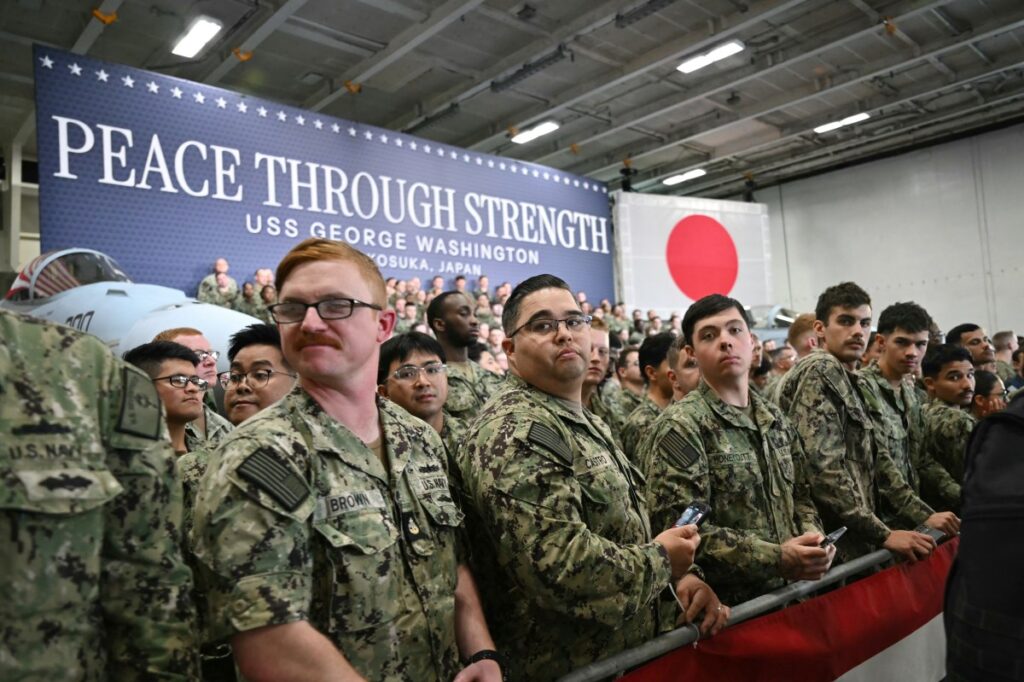
A senior Japanese official’s suggestion that Japan should possess nuclear weapons has reignited debate over whether the country could—or would—break with a decades-old taboo in response to an increasingly tense security environment.
Why It Matters
Such a move would mark a dramatic departure for Japan, the world’s only nation to have suffered atomic bombings and a country that, after World War II, adopted a pacifist constitution. For decades, the U.S. has pledged to protect Japan, South Korea, and Australia under its nuclear umbrella.
The statement comes amid heightened tensions with China, which has, since last month, waged a public-relations campaign portraying Japan’s recent actions as a return to pre-World War II militarism. The rhetoric escalated after Prime Minister Sanae Takaichi said that a Chinese blockade of Beijing-claimed Taiwan would justify a joint intervention with U.S. forces.
Newsweek has reached out to Takaichi’s office by email with a request for comment.
A Changing Security Environment
An unnamed Cabinet official who advises Takaichi on national security matters told reporters earlier this month that it was time to begin discussions about acquiring a nuclear deterrent, citing the expanding arsenals of China and North Korea.
The remarks echoed growing concerns among some security experts. Shortly before his death in 2023, former Secretary of State Henry Kissinger warned, “Japan is heading towards becoming a nuclear power in five years.”
“They will always be worried about China, and the power relationship between them,” he went on to say. “Similarly, I don’t think Japan has any intention of being a permanent member of a global multilateral system that will constrain them.”
Russia’s invasion of Ukraine was widely considered a turning point, reviving the prospect of allowing U.S. forces to operate from Japanese territory, with late former Prime Minister Shinzo Abe, whom Takaichi has called a mentor, arguing, “We should not put a taboo on discussions about the reality we face.”
Within Takaichi’s ruling Liberal Democratic Party, some lawmakers have called for revisiting Japan’s Three Non-Nuclear Principles—which prohibit the production, possession, or stationing of nuclear weapons on Japanese territory—to allow the U.S. to deploy nuclear weapons on strategic platforms within the country. They argue that not doing so could weaken the U.S. nuclear umbrella.
No nuclear weapon is known to have been based in Japan, even temporarily, since the U.S. withdrew the last of them in 1972.
“China’s nuclear expansion poses a challenge to the U.S.’ extended deterrence, on which Japan depends,” wrote Rajeswari Rajagopalan, a resident senior fellow at the Australian Strategic Policy Institute in a November analysis. “If China were to achieve nuclear parity with the U.S. in the coming decade, Tokyo would have to worry that Washington’s commitment might falter. This will no doubt be an important consideration as Japan conducts its review.”
Chinese Foreign Ministry spokesperson Guo Jiakun said last week that Japan has “for a long time” been stockpiling plutonium in excess of its civilian energy needs, and noted that the country possesses both the technological capability to “develop nuclear weapons in short order” if it chose to do so. Some Chinese nuclear experts believe this could be achieved in as little as three years.
Such a move would require Tokyo to abandon its Three Non-Nuclear Principles, and would put it at odds with the Nuclear Non-Proliferation Treaty—and likely be met with stiff U.S. opposition. The 1970 agreement recognizes only five countries—the United States, Russia, China, the U.K., and France—as nuclear-armed states.
Public Opinion
Public opinion in Japan has generally skewed against nuclear weapons, but the issue remains debated.
When asked whether Japan should join the Treaty on the Prohibition of Nuclear Weapons (TPNW), which bans their development, 73 percent voiced support in a nationwide mail-in poll by the Asahi Shimbun newspaper earlier this year, compared to just 22 percent opposed. This was a significant increase from a November 2020 telephone survey in which 59 percent said Japan should join.
Japan has not signed the TPNW, with the official government position being that it lacks teeth—since no nuclear-armed country is a signatory.
Meanwhile, the latest Asahi Shimbun poll found 38 percent of Japanese still believed the nuclear umbrella was necessary, compared with 39 percent in 2005, but far fewer than the 55 percent who said there is no need for Washington’s extended deterrent.