

North Korea-linked hackers stole over USD 2 billion in crypto in 2025, according to Chainalysis. Learn why these attacks are a state-backed economic strategy, what it means for global security, and how crypto platforms must rethink behavioural monitoring and infrastructure-level protection.
In December, blockchain intelligence firm Chainalysis published a number that should permanently change how the crypto industry thinks about security. In 2025 alone, North Korea-linked actors stole $2.02 billion in cryptocurrency, a 51 per cent increase year-on-year, accounting for nearly three-quarters of all service-level crypto hacks globally.
This is not a crime wave. It is an economic strategy.
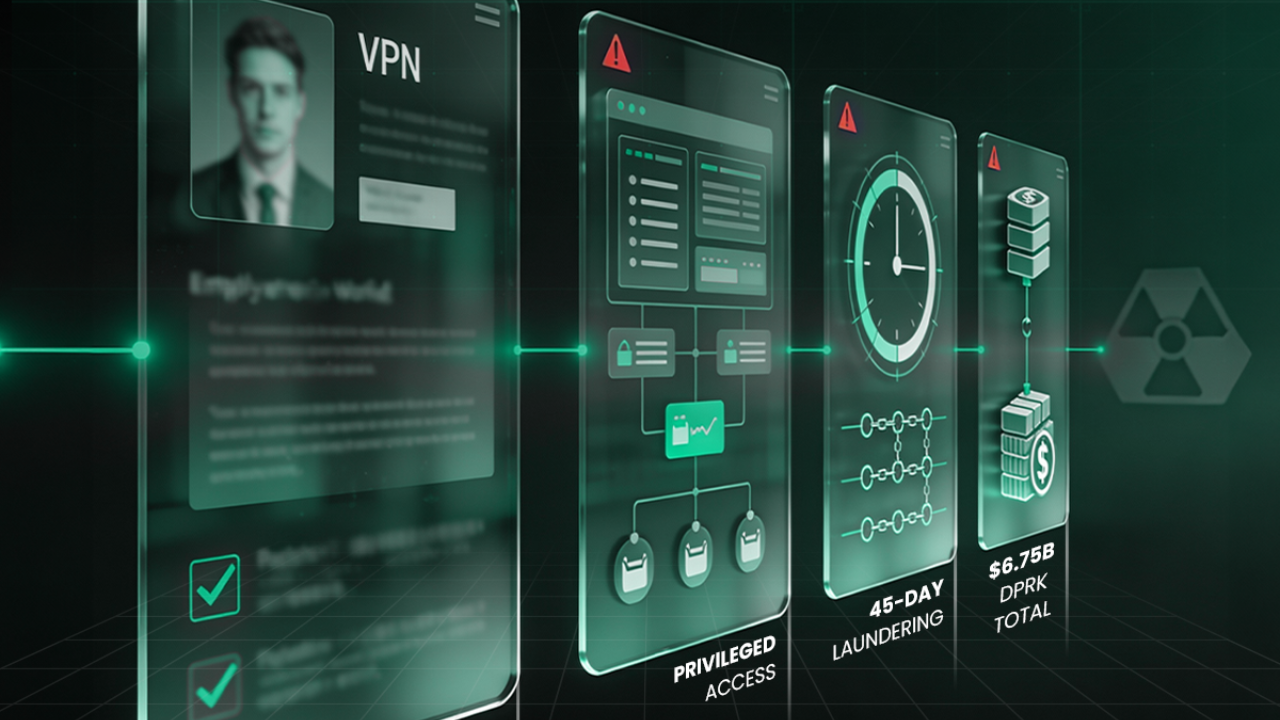
According to Chainalysis, total cryptocurrency stolen by the Democratic People’s Republic of Korea (DPRK) since 2022 now stands at $6.75 billion. The largest single incident this year, the $1.5 billion Bybit breach, would rank among the biggest financial thefts in modern history in any asset class. The difference is that this theft occurred entirely on-chain, in full view, and at machine speed.
What emerges from the data is not randomness, but repeatability. Crypto theft has matured into an industrial operation.
From Hacks to Infrastructure
 For years, large crypto breaches were framed as failures of code or isolated security lapses. Chainalysis’ latest report challenges that framing decisively.
The firm documents a consistent operational model used by DPRK-linked groups. It begins not with exploits, but with human infiltration. North Korean IT workers, often using falsified identities, have embedded themselves inside exchanges, infrastructure providers, and development teams. These are not external attackers probing defences. They are authorised insiders with legitimate access.
Once a breach occurs, the laundering phase follows a remarkably predictable pattern. Chainalysis identifies a roughly 45-day laundering window, during which stolen funds are systematically broken into structured chunks and routed through specific bridge protocols and Chinese-language services, including Huione-linked pathways. This is not improvisation. It is logistics.
The significance here is not merely the scale of losses. It is the level of operational discipline. Crypto theft, in this context, is no longer an opportunistic crime. It functions as state-sponsored financial extraction, used to fund sanctioned regimes and strategic programs.
Two Security Crises, Not One
The report also exposes a structural split that many platforms still underestimate.
On one side is mass retail theft. In 2025, Chainalysis recorded over 158,000 personal wallet compromises, nearly triple the previous year, affecting more than 80,000 victims. These incidents are frequent, smaller in value, and driven by social engineering and credential theft.
On the other side are catastrophic institutional breaches. Just three incidents accounted for 69 per cent of all service-level losses. These are rare, devastating, and almost always tied to privileged access rather than smart contract bugs.
Treating these as the same problem leads to ineffective solutions. Consumer education will not stop state-sponsored infiltration. Code audits will not detect an employee who should never have been hired in the first place.
Why This Is a Geopolitical Problem
What makes the North Korea data especially alarming is its geopolitical context. Crypto theft now represents a significant non-sanctioned revenue stream for a nuclear-armed state operating under heavy international restrictions.
This is why recent actions by the U.S. Treasury, sanctions authorities, and law enforcement agencies increasingly focus on infrastructure-level enforcement, rather than individual wallets. It also explains why regulators are shifting their expectations from best-effort compliance to demonstrable prevention.
The message is implicit but clear. Platforms that facilitate the movement of illicit funds, even unintentionally, are no longer just dealing with financial crime risk. They are exposed to national security scrutiny.
The Industry’s Real Vulnerability
Perhaps the most uncomfortable insight from the Chainalysis report is this: the biggest risk vector is no longer unknown attackers. It is trusted participants operating inside permissionless systems without sufficient behavioural controls.
Identity checks alone do not solve this problem. An infiltrator with valid credentials passes KYC effortlessly. What matters is how systems monitor, constrain, and respond to behaviour over time, especially when that behaviour is automated or machine-assisted.
This is why the industry’s conversation is quietly shifting toward pre-transaction controls, continuous monitoring, and programmable enforcement, rather than post-incident forensics. Once stolen funds begin moving, the window for meaningful intervention closes quickly.
The Takeaway
North Korea’s $2 billion crypto haul is not an anomaly. It is a stress test that the industry failed.
Crypto has reached a scale where adversaries with state resources can weaponise its openness. The response cannot be reactive security patches or broader disclaimers. It requires infrastructure designed with the assumption that sophisticated, patient, and well-funded actors are already inside the system.
The lesson from 2025 is simple but sobering.
Platforms must adopt behavioural monitoring now, before 2026 repeats 2025.
This is no longer about protecting users from fraud. It is about protecting the ecosystem from becoming a parallel financial system for sanctioned states.