
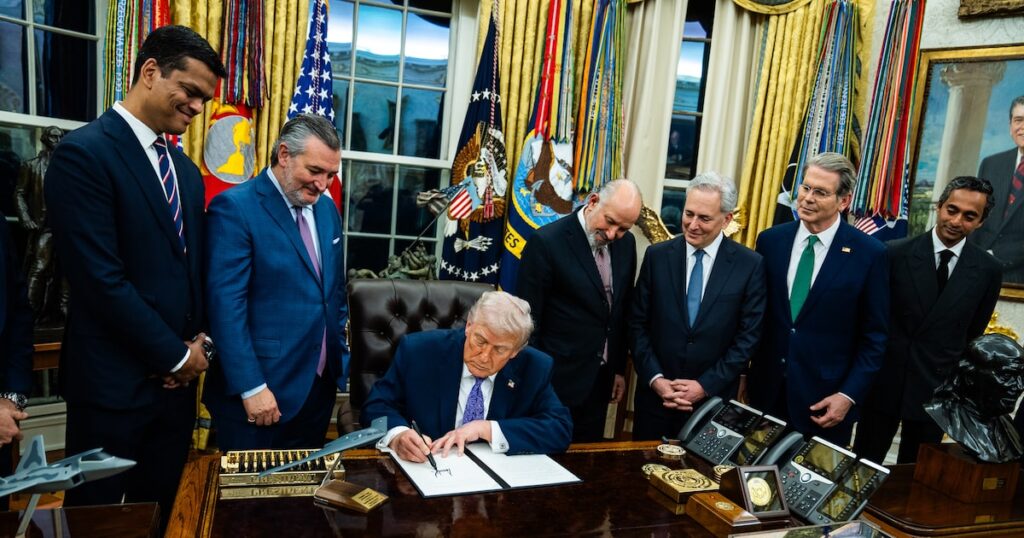
Re: “Congress, not states, should govern AI — Trump’s executive order is a constitutional response to overreach,” by Kevin Frazier, Dec. 18 Opinion.
Frazier presents a well-written and powerful argument to the question of should AI governance be at federal or state level. Obviously he must feel strongly that President Donald Trump’s executive order is well-intended.
However, as I read through his opinions, I became curious as to why certain states argue to the contrary. So, I turned to AI, itself, using Google’s AI mode to ask the same question.
Ah-ha! It seems that there are a lot of good reasons for states retaining considerable say in the laws and rules, especially in the areas “focusing on immediate harms like deepfakes, biometric data privacy, and algorithmic bias.”
I hope that your newspaper will be forthcoming in a little whataboutism on this subject.
L. David McDonald, Heath
Fearful for democracy
Even though it’s cold outside, seeing Tuesday’s cartoon of a redacted U.S. Constitution chilled me to the bone even more. In all my years, I would never have thought I would be concerned for our democracy.
As a former officer in the U.S. Army, I developed a very strong affection for our Constitution and our democracy, and today I am fearful for both. What have we allowed to happen?
Dan Siculan, Royse City
Democrats do more harm
Re: “Texas GOP rooting me out,” by Clayton Devin, Tuesday Letters.
Like Devin, I, too, read with interest the cases for voting values over parties. I consider myself a conservative independent. Like Devin, I vote mostly, but not totally, for Republicans. I don’t care about party labels. I care about what I believe is best for the country.
Unlike Devin, I haven’t given up on the Republicans, because although they sometimes do things I don’t like, the Democrats do far more harm. One of three reasons Devin cites for abandoning the party is redistricting without input from voters. Fair enough. However, look what happened when Joe Biden, the duly appointed Democratic candidate for president, imploded during his debate with President Donald Trump. Suddenly, the Democrats realized Biden would lose.
So what happened? A handful of party power brokers, including Nancy Pelosi and a famous actor, decided Biden had to go. They picked Kamala Harris to replace Biden, without one single vote from the public.
Democrats love to accuse Trump of destroying democracy, yet this was one of the most flagrant acts against democracy in the history of our republic.
So, I’ll continue to vote mostly Republican, though sometimes I hold my nose when doing so.
Daniel Willis, Garland
Density wrong for DART
Re: “Public transportation is key,” by Fran Powell, Dec. 12 Letters.
This letter writer mentioned that Dallas-Fort Worth lacks the large, well-utilized public transit systems of some of the great cities of the world, proposing that the current system be expanded. New York, London and Paris were mentioned as models.
I believe the main reason large transit systems work in those cities and not so much in D-FW is population density and more vibrant city centers. The member cities in DART have a density of about 1,500 people per square kilometer.
London has about 6,000 per square kilometer, New York City about 11,000. Paris has even more than that. At those densities, transport via auto is not really feasible — mass transit is desirable, required and economically attractive.
Another consideration is city center development and daily visits. Downtown Dallas seems to be shrinking, not growing, and there are not enough daily visits to justify a large transit system.
New development is in the suburbs, and their low density does not make large mass transit required, desirable or economically feasible. I believe this is the reason some cities want a smaller DART, more responsive to their need levels and at lower cost.
Bill Pritchard, Farmers Branch
Uninviting pastor petty
Re: “Pastor who backed Pride uninvited to meeting — Keller City Council revokes opening prayer offer, citing recent festival he hosted,” Dec. 20 Metro & Business story.
How small of the Keller City Council to uninvite the priest who leads St. Martin-in-the-Fields Episcopal Church from delivering the invocation at a council meeting, apparently because the church allowed a Pride festival to use a field on its property. How petty, how pitiful, how pathetic.
Bill Lewis, Round Rock
Hiker’s law partner tireless
Re: “Family, friends keep search, hopes alive — SMU professor, attorney disappeared in Georgia a month ago during hike,” Dec. 13 news story.
I am the next-door neighbor to Kathryn “Kate” Morris. I have known Kate for nine years. Over the years, I learned a lot about Kate’s life — growing up losing her biological father at around age 5, having childhood cancer and on into adulthood and the practice of law and her eventual decision to leave Strasburger & Price, LLP, for private practice with Charles Hosch.
Fast forward to Nov. 11, 2025, and at the disappearance of Charles, Kate has triggered an incredible effort that continues today to find and bring Charles home.
Kate has been in Georgia since the early days and the formation of the search and rescue/recovery missions. She did fly home to teach Charles’ Southern Methodist University course, but then she returned to Georgia.
Kate has set up the website, bringcharleshome.com, updates it daily and started a funding account to help repay all the many, many search, rescue and support efforts.
I think everyone walking this earth wants to have just one friend like Kate. She is also very active in our neighborhood, and we co-host a once or twice a year “driveway party” for neighbors.
She would have also been most deserving of consideration for Texan of the Year. I suspect Hosch’s family agrees.
Francis Howard Manning, Dallas/Preston Hollow