
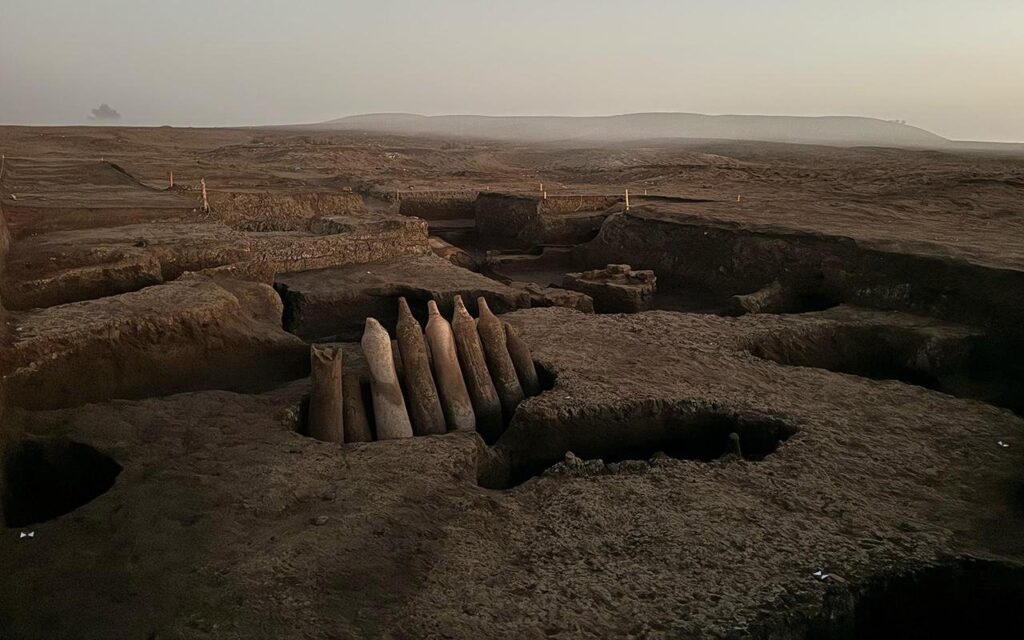
Archaeologists in the western Nile Delta in Egypt have discovered an “extensive industrial complex” from the Late Period and the early Ptolemaic Period, as well as part of a cemetery from the Roman Period. These finds include valuable information related to the economy, daily life, and funerary traditions of this time.
 Excavation site in the western Nile Delta. Credit: Egyptian Ministry of Tourism and Antiquities
These finds were made by a joint Egyptian-Italian archaeological team from the Supreme Council of Antiquities and the University of Padua at the sites of Kom el-Ahmar and Kom Wasit in Beheira Governorate. These new discoveries bring to the foreground the significance of the western Delta as a center of production, trade, and settlement, linked to the Mediterranean world and the hinterland of ancient Alexandria.
Archaeological excavations have uncovered a large industrial building, consisting of at least six rooms, which are well organized for the purpose of production. Two of the rooms were used for fish processing, where archaeologists have recovered nearly 9,700 fish bones. These show that there was mass production of salted fish, which was valuable in antiquity and contributed immensely to long-distance trade. The other rooms were used for the production of metal and stone tools, as well as faience amulets, suggesting a diverse local economy rather than a single specialized activity.
Unfinished figures of limestone and other materials discovered at the site at various stages of manufacture are also indicative of the site being an active workshop area. Imported amphorae and fragments of Greek pottery point to the complex being functional as early as the fifth century BCE, suggesting strong cultural and commercial connections between Egypt and the Greek world.
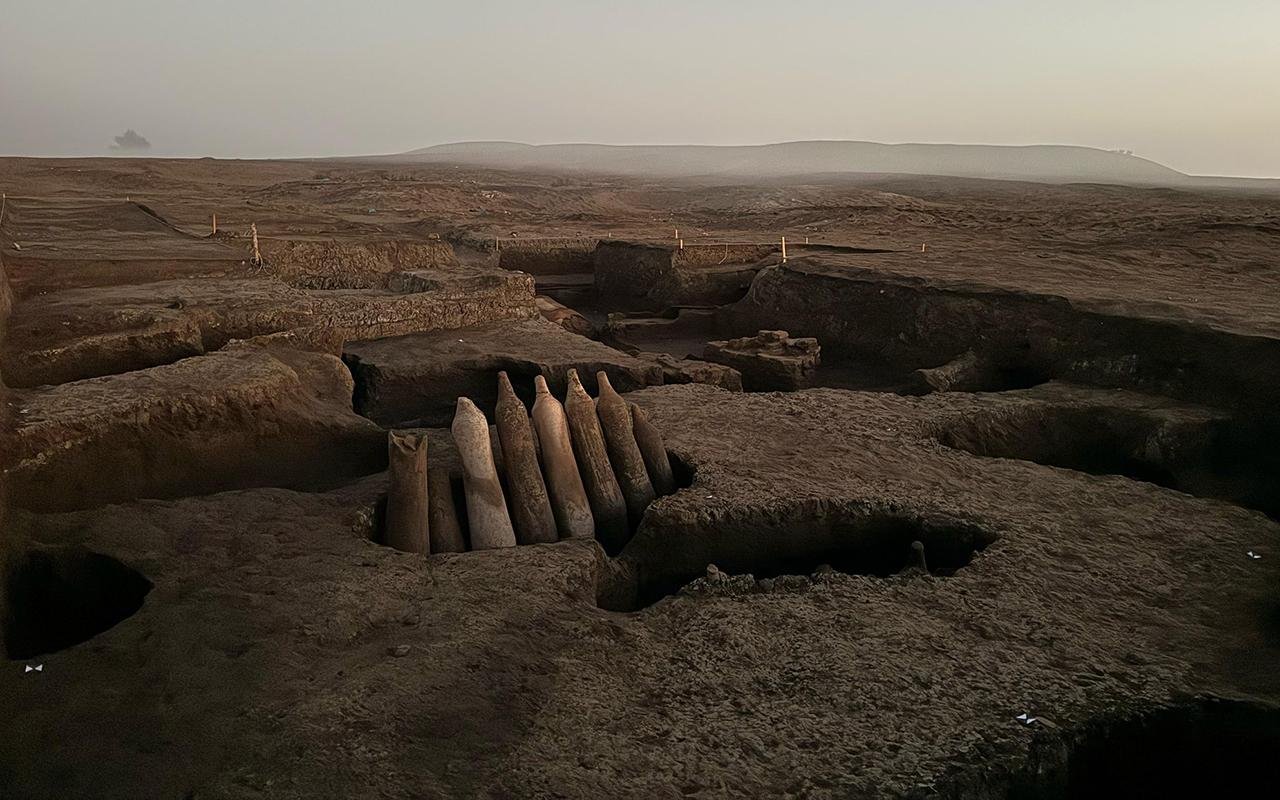
 Findings from the Roman necropolis. Credit: Egyptian Ministry of Tourism and Antiquities
Apart from the industrial finds, the mission excavated a Roman cemetery located nearby. This necropolis contained a variety of burials, including simple in-ground burials, burials in ceramic coffins, and the burial of children inside large amphorae. Such burials give an indication of the varied funerary traditions within the Delta during the Roman Period and provide valuable information regarding the social structures and cultural influences in the Delta.
Bioarchaeological analysis is being undertaken on the remains of 23 individuals, which include men, women, children, and adolescents, and reveals that the people buried at this site lived under relatively good conditions, with no signs of major disease or violence. Ongoing studies aim to obtain information about diet, health, age, and sex, which will help create a detailed picture of life in the western Delta during this period.
Some of the most remarkable discoveries include dozens of fully preserved amphorae and a pair of golden earrings thought to have been owned by a young female. These artifacts have been transferred to the Egyptian Museum in Cairo.
The discoveries represent an exceptional and informative window into industrial production, economy, and burial practices in the western Nile Delta over several archaeological periods, serving to highlight the area’s significance as a hub of human activity and cultural interaction.
More information: Ministry of Tourism and Antiquities