

MINNEAPOLIS — Barry Butt can’t remember the year exactly, but Braeden Cootes was 10 or 11, and that puts it at Christmastime 2017 or 2018.
He remembers the rest vividly. His son, Lincoln, had gathered with a group of friends in their Sherwood Park neighborhood just outside Edmonton for a holiday game of pickup hockey on the backyard rink. Lincoln was a 2003, and on the ice with him were his teammates from Sherwood Park and Braeden’s older brother Sean, a 2005 goalie.
As usual, Braeden, who was two years younger than Sean and four years younger than everyone else, had found his way into the mix.
And Butt says he was “literally the best player on the ice.”
All these years later, Cootes, a 6-foot, 183-pound center, is now a first-round pick of the Vancouver Canucks and playing for Team Canada at the World Juniors. Butt, who has known him since he was little, became his strength and conditioning coach a few years ago. Among his clients are names like Guenther, Guhle, Savoie, Dach and Zellweger.
Cootes was always a little different, even within that group.
Butt’s story from the backyard rink is just one of the many he uses to explain how.
Among them, he’ll tell you about when Cootes joined the 2022-23 Seattle Thunderbirds team that won the WHL title, and he started getting calls from other clients on that team — Colton Dach, Luke Prokop, Dylan Guenther — raving about how good he was at such a young age. “Even then, the older guys gravitated to him, and that doesn’t always happen,” Butt said.
He’ll tell you, too, about the first time he had him in the gym and what an “outstanding” athlete he is — and how Sean, who is currently playing in the AJHL, is actually one of the best athletes he has ever worked with.
Butt was surprised, as he watched Cootes develop, by just how responsible he was on the ice early. But over time, he has realized that that’s just “Cootesy.”
“The biggest thing for me is how well he understands the game,” Butt said. “It’s easy to watch a guy like him and be like ‘Oh yeah, he’s skilled, he’s fast.’ But when you understand the game, you can see that he does too.”
And everyone who has ever been around him has similar stories, and a prediction that comes with it: That at the World Juniors, he was going to find a way to make a difference for Team Canada.
Ask Seattle Thunderbirds head coach Matt O’Dette or general manager Bil LaForge for a Braeden Cootes memory, and they both go to the same one.
Cootes had joined the Thunderbirds late in that 2023 season as a 15-year-old.
Though he didn’t play in their playoff run, he made an immediate impression on his teammates, opening their eyes with his skill, competitiveness in practices, and the way he carried himself.
During some downtime between two of their playoff series, they had a three-on-three tournament. On a loaded team of junior stars who’ve since gone on to play in the NHL, Kevin Korchinski fought to have him on his team. At the time, O’Dette remembers noting to himself that that was interesting, the respect he’d immediately commanded from older players.
Sure enough, Cootes’ team then won the tournament, and according to O’Dette, he was arguably the best player on the ice at 15.
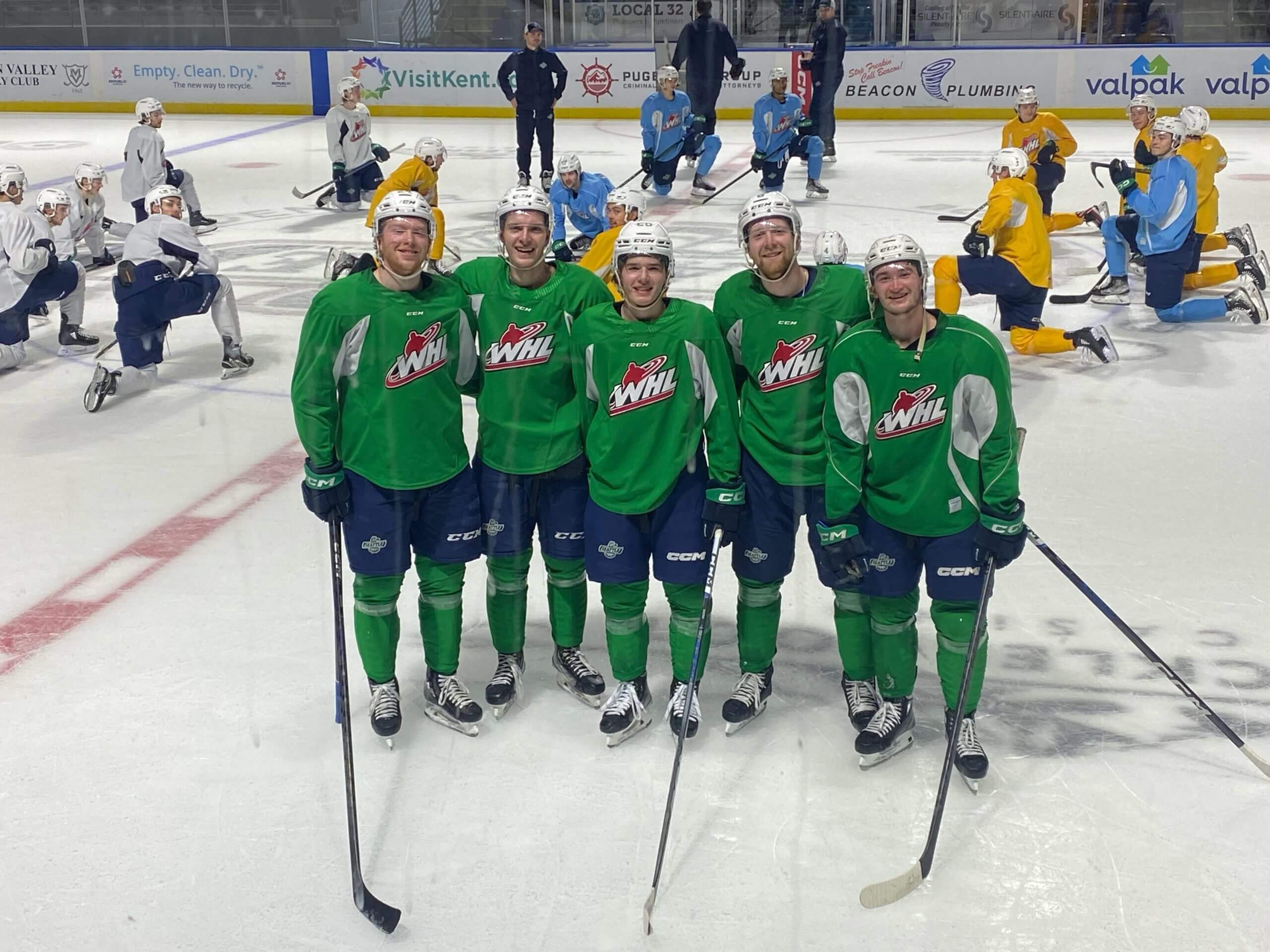
Cootes (center) with his winning three-on-three team. (Courtesy of Matt O’Dette)
He was so impressive in practice every day that spring that the Thunderbirds actually contemplated putting him into the lineup in the Memorial Cup (he was going to play in one game in particular if one of their banged-up veterans didn’t push through).
The following year, in his rookie season at 16, LaForge said the Thunderbirds’ room was already his. Though they don’t like naming a player captain in their draft year, they felt they had to by the time he was 17.
“It was just obvious to us with the way we play and the style that we play that he embodied that,” LaForge said. “He’s just so mature that it didn’t affect him negatively. It just galvanized our team. It was just time. We didn’t make him captain; he did it himself.”
When LaForge drafted him with the 10th pick in his WHL draft year, he traded up to get him, finding he was always the best player in the big games with Sherwood Park.
But even they didn’t fully realize what they had until he arrived and quickly left his mark. He’s “everything you want from a young hockey player, from a role model for the younger and older guys,” according to LaForge.
“He’s just a guy that loves to win and will do anything for the team,” LaForge said. “He does everything the right way. He can play any way. He’s a great penalty killer, he’s excellent on the power play, up by a goal, down by a goal. He’s like a coach’s security blanket.”
Because of all of those things, O’Dette calls coaching Cootes the last few years “a lot of fun.”
“He’s a guy that if you could have 20 of these guys on your team, you’d absolutely sign up for that,” O’Dette said. “He’s just one of those guys that a coach can trust. He’s a very dedicated player. He leads by example. He’s a 200-foot player. He does the intangible things that help a team win.”
O’Dette also thinks, though, that because his intangibles are so high, “sometimes it’s overlooked the amount of skill that he does have.” O’Dette insists he’s also got great vision and playmaking, and a “really good release.”
Entering the World Juniors, he’d registered 23 points and 74 shots on goal in his first 17 games of the season on a now-young Seattle team. In the spring, he captained Canada to an undefeated U18 worlds and led the team in scoring with 12 points in seven games (six goals, six assists).
“He’s got all of the tools that he needs to be an outstanding player at our level and take it to the next level,” O’Dette said.
And while he, Butt and LaForge all said it’s the habits and details that allowed him to start this season in the NHL with the Canucks as an 18-year-old (making him the third-youngest player in Canucks history to debut), O’Dette thinks those other attributes set his ceiling at a Brayden Point, Travis Konecny or Seth Jarvis type of player.
“What makes him so valuable is he’s a versatile player who can fit in up and down the lineup. He can be a top-six player and play with skill guys and against top lines. You could see him fitting in as a third-line center who does all of the little things,” O’Dette said. “He’s just one of those guys that can put you over the edge. He’s a competitive skill guy, not a soft skill guy.”
Before the tournament started, Cootes said he expected to “be a good five-on-five guy and penalty killer” for Canada, knowing his role as an 18-year-old first-timer at U20s was going to be different than the one he played as a first-line center at U18s in April.
But he also said this: “Anytime I come to these events, I usually work my way up the lineup.”
Regardless of his role, O’Dette predicted that Cootes would make a difference for Canada over the course of the tournament.
Cootes got the call from Canada’s general manager, Al Millar, after a game against Spokane. It capped off a whirlwind few months that included gold at U18s, the draft and his NHL debut.
He went into camp set on playing with the same confidence he does in junior and a “Don’t just fit in, fit out” mentality. That didn’t mean it wasn’t daunting when he first walked into a dressing room with names like Hughes, Pettersson and Boeser, but he felt good coming off a busy summer that included skating with an NHL group at the Oilers’ practice facility instead of his previous junior group for the first time, getting out there with Oilers who stuck around in town like Mattias Ekholm and Andrew Mangiapane.
Before all of that, he was also among the top prospects who were heavily recruited by NCAA schools to leave the CHL. LaForge says he’ll always remember the loyalty he showed in staying.
“As much as people kept telling me he was leaving, he would always say ‘Nope, I’m not, don’t worry,’” LaForge said.
Cootes averaged just 8:25 of ice time through Canada’s first three games of the tournament (12th among their 14 forwards), but scored on an NHL-caliber shot against Denmark.
On New Year’s Eve, he played a little more than that at 9:55 but didn’t find the scoresheet in Canada’s 7-4 win over Finland to cap off an undefeated preliminary round. Through four games, he does hold the best faceoff percentage in the tournament at 78.6 percent (11-3).
WHAT A PASS FROM TIJ IGINLA TO BRAEDEN COOTES!
Cootes’ snipe makes it 2-0 Canada! 🇨🇦 #WorldJuniors pic.twitter.com/CD8pGpwt5u
— TSN (@TSN_Sports) December 30, 2025
His World Junior moment, beyond the lone goal against Denmark, hasn’t come yet, though.
But those who know him best think it will.
“He’s so smart and works so hard that whatever role they need him to fulfill, he’ll do it and do it very well. You always want him out there,” LaForge predicted pre-tournament. “We’re really proud of him.”
— With reporting in Niagara Falls, Ontario