
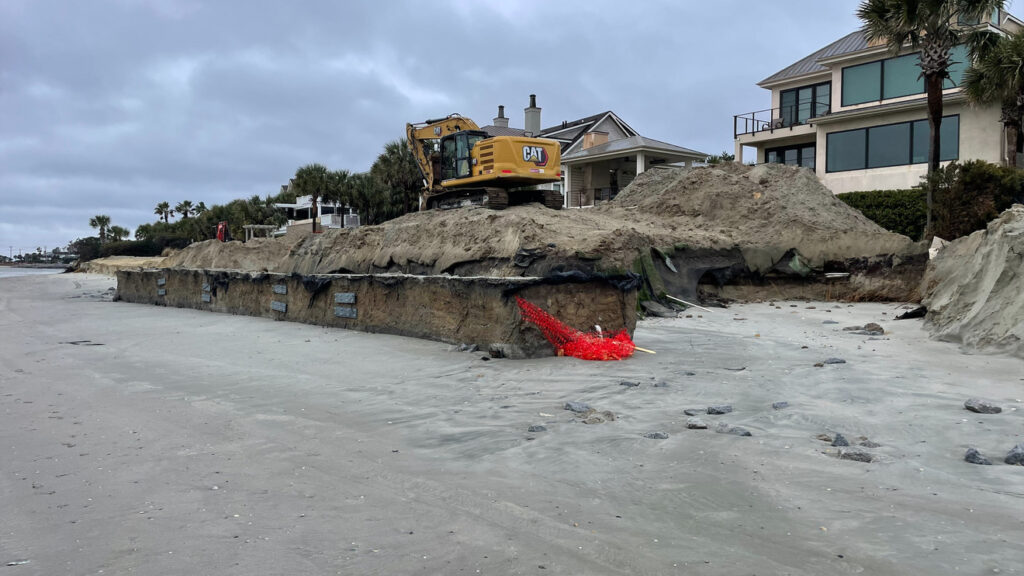
ISLE OF PALMS, S.C. (WCIV) — The legal battle over an allegedly illegal Isle of Palms Seawall reached another turn.
Judge Ralph King Anderson III ruled on Tuesday, Dec. 30, that a seawall, constructed by Isle of Palms property owner Rom Reddy, must be removed. The decision upholds an earlier order from October, which required the dismantling of the seawall. The South Carolina Environmental Law Project and Coastal Conservation League claim that, if left up, the seawall would block public beach access and accelerate erosion.
“This order affirms that illegal seawalls disrupt natural beach dynamics and harm public access,” said Amy Armstrong, the executive director of the South Carolina Environmental Law Project. “South Carolina’s coastline is a precious public asset that must be preserved.”
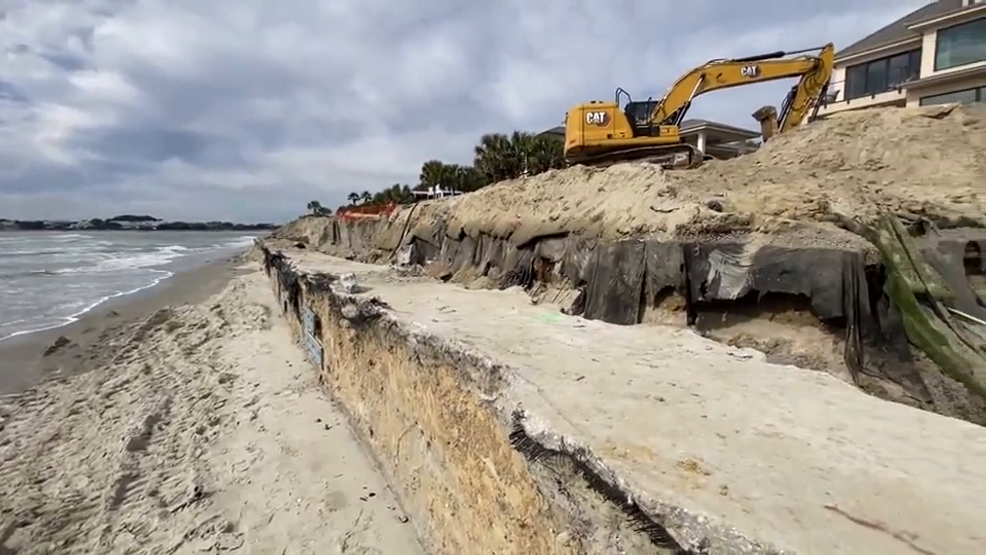
Unauthorized seawall on Isle of Palms sparks DHEC intervention. Pictured Feb. 2, 2024. (WCIV)
The seawall was first constructed in 2023. It has since been the main character in a lengthy legal battle between Reddy and the state.
Reddy, at the time, claimed he was building the wall to protect his property from heavy weather conditions.
“What was happening is the waters were coming in so severely that the soil in my yard was unstable,” Reddy said in early 2024.

The Coastal Conservation League joined the South Carolina Department of Health and Environmental Control in the fight to have the seawall removed. April 3, 2024 (WCIV)
Now, Reddy is looking at a specific timeline and detailed requirements for a Corrective Action Plan for the removal and restoration of the affected beach area.
Judge Anderson’s order mandates that Reddy submit the plan within 60 days, outlining removal methods, schedules, beach stabilization measures and the use of beach-compatible sand for restoration that complies with the South Carolina Department of Natural Resources Marine Turtle Conservation Program.
Removal of the seawall must commence within 90 days of the plan’s approval and be completed within 30 days after, according to court documents. In Reddy’s favor, the judge vacated $289,000 worth of civil penalties and claimed that he did not violate “any permit” or “regulation, standard, or requirement” under the S.C. Coastal Zone Management Act.
However, Judge Anderson did rule that the South Carolina Department of Environmental Services has the authority to order the removal of seawall structures – a portion of the ruling Reddy found disappointing.
“Allowing an agency to have unilateral authority on private property is unconstitutional,” Reddy said in a statement to News 4. “However, the administrative court is prevented by law from ruling on Constitutional issues, which is a travesty.”
As a result of the ruling, Reddy said the Pacific Legal Foundation – a law firm that “defends Americans’ liberties” when threatened by government overreach – is joining the case on his behalf as he plans an appeal.
Environmental protection advocates, on the contrary, are viewing the judge’s decision as a victory for public beach access and coastal ecosystems.
“Illegal seawalls may seem like a solution for individual property protection,” Armstrong said, “but they ultimately lead to a loss of the dry sand beach humans enjoy and wildlife depend on.”
Read the full judge’s order below.