

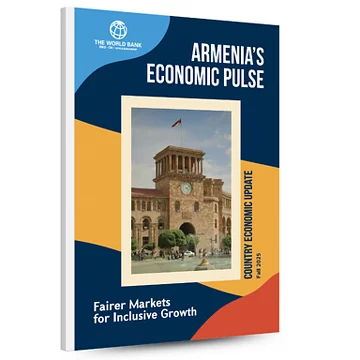
The earlier surge—driven by temporary re-exports and capital inflows linked to Russia’s invasion of Ukraine—has been unwinding since 2024. H1 2025 growth was supported by private consumption, investment, and strong services and construction.
Inflation rose from 1.7% in January to 3.3% in October 2025, mainly due to food. Unemployment increased from 12.4% in 2023 to 13.9% in 2024 amid refugee inflows, before improving to 12.3% in Q2 2025.
DOWNLOAD THE REPORT
The report projects that growth could moderate to 5.2% in 2025 and converge to 4.7% by 2027. Normalizing regional relations and progress with the EU support the outlook, but geopolitical tensions and trade-policy uncertainty weigh on risks.
Delivering on the Government’s ambitions—outlined in the 2021–2026 Five-Year Action Plan and the 2025–2030 Export Strategy—requires a more competitive business environment. Wholesale and retail trade remains central: it contributed about 25% to GDP growth in 2017–2024, accounted for 12% of employment in 2018–2023, and has large consumer relevance, with food representing about 40% of the consumption basket. Yet concentration is high: in food retail, the probability that the four largest firms remain dominant over the next three years is 90% (vs. 60% in peers), indicating weak market dynamism and lagging labor productivity.
Strengthening competition—particularly in wholesale and retail—is therefore critical. Priority actions include: (1) expanding CCPC capacity and digital enforcement tools; (2) enforcing rules to curb unfair retailer–supplier practices and deploying digital-enabled systems to monitor wholesale markets; and (3) refining targeted aspects of the competition framework to support strategic, risk-based enforcement. These measures will improve contestability, support fair pricing, and strengthen equity for low-income households.