
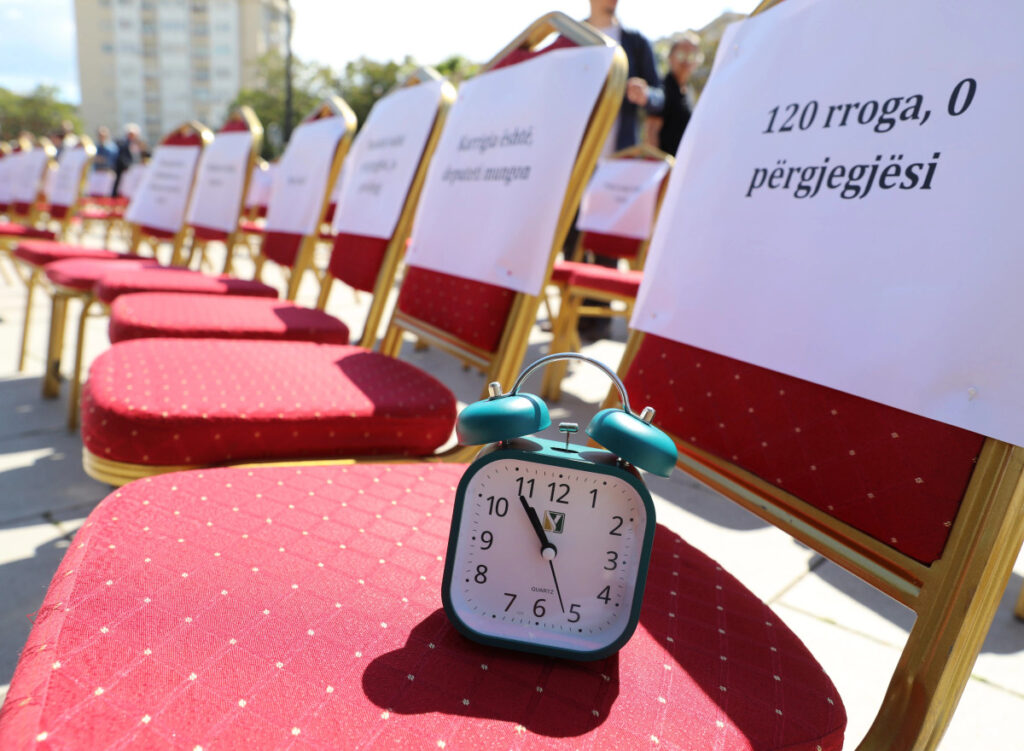
For almost all of 2025, Kosovo was politically blocked, with some institutions dysfunctional and others with limited powers. The consequences of this crisis have been felt particularly in the economy and in the international position of the state.
Kosovo will need time to recover from the consequences of the political crisis that marked the year 2025, experts on political developments estimate.
The lack of will for cooperation between political entities, even after the February 9 elections, left the country without a functional government. The ninth legislature was constituted seven months after the elections, only to be dissolved just 40 days later.
Vullnet Bugaqku, a researcher at the Kosovo Democratic Institute (KDI), says that the past year is considered a failure in terms of legislation, parliamentary oversight and reforms. He mentions the failure to implement the vetting, the non-approval of the Civil Code and laws aimed at reforming the justice system.
“Naturally, this (the institutional blockade vj) causes delays in the implementation of the vetting process in Kosovo. This is a very important process because, as the Venice Commission has emphasized, but also our Constitutional Court itself, Kosovo needs a vetting process that assesses the integrity of the heads of the justice system institutions, in such a way as to pave the way for the performance and accountability assessment of all judges and prosecutors in Kosovo,” he said.
Njomza Arifi, who heads the Group for Political and Legal Studies (GLPS), has also listed the consequences of the blockade in terms of the inability to approve many legislative initiatives.
“In addition to the government with a regular mandate, we do not even have a functional assembly and many legislative initiatives that have been carried over from year to year have already remained blocked or some others have not been launched at all. Important initiatives, such as the Law on Rights at Work, various laws related to the aspect of health rights or healthcare, mental health, the civil code and in parallel with these, various strategic frameworks that have been drafted, but which have remained hostage to approvals by a government with a full mandate or ratification in a functional assembly such as the Anti-Corruption Strategy and many other strategies that are essential for Kosovo,” she said.
Meanwhile, political analyst Seb Bytyqi concluded that the political dramas that Kosovo experienced over the course of a year also have consequences in sensitive areas.
“The postponement of domestic agendas for economic reforms is blocked, for any efforts that should exist to strengthen domestic production or alternative energy, the postponement of domestic public policies. Everything has been suspended and this is more important than, for example, the loss of opportunities for EU funds or similar issues,” he assessed.
List of consequences
The consequences of the institutional blockade do not stop at reforms.
Researcher Bugaqku has also warned of blockades in independent institutions, due to the expiration of the mandate of their members, with particular emphasis on judges in the Constitutional Court, since there is no functional assembly to replace them.
“The mandate of the Ombudsman has expired, a new Ombudsman must be elected. We have two judges missing from the Constitutional Court. Here too, new judges of the Constitutional Court must be elected. We risk that the Constitutional Court will also remain without a quorum because the mandate of several members there will soon expire,” said this KDI researcher.
Beyond the domestic consequences, the political crisis in Kosovo has also had repercussions beyond its borders.
Arifi has concluded that the institutional blockade has weakened the country’s position at a sensitive geopolitical moment, when international attention to the region is increasing.
“The political instability in Kosovo, the lack of a government with full powers, of course also damages the image or credibility of Kosovo towards friends in Kosovo, but also in the international arena. As a result of this crisis, we are risking exploiting two very important momentums: the first is a new administration in the US and the second is a completely new constellation of EU institutions,” says the director of GLPS.
According to Arifi, the institutional crisis prevents Kosovo from using the momentum created for its request to review the status of a candidate country for EU membership, and to benefit from millions of euros from the European Union’s Growth Plan.
“It is hard to believe that now Kosovo will be able to fully benefit from the amount from which Kosovo actually benefits the most per capita from the EU Growth Plan. As we know, we are very late in this regard, precisely as a result of the non-ratification of the agreements in the Kosovo Assembly,” said Arifi.
And according to Bytyqi, the political dramas that Kosovo experienced over the course of a year have also resulted in regression.
“It is a kind of setback because the perspective or perception that Kosovo has already completed the state-building process and is a serious state is being lost. This is a self-inflicted blow in this regard,” said this political analyst.
One of the most sensitive issues that, according to analysts, is directly jeopardized by the institutional blockade of 2025 is the process of Kosovo’s membership in international organizations. The Council of Europe remains in particular focus, membership in which is considered a key step for the international consolidation of the state and the advancement of human rights standards.
“Next year, (EC membership) could potentially be considered if a political consensus regarding this process were reached in Kosovo,” says Arifi.
And according to Bugaqku, Kosovo’s progress towards membership in international organizations is directly linked to the adoption of the Civil Code, a key document that aims to harmonize local legislation with European standards, but which has remained blocked for years.
“This is a very protracted process and Kosovo has been bringing this Civil Code document to the government and parliament for a long time, as a result of the lack of consensus among the deputies. Therefore, it is necessary to have an assembly constituted as soon as possible to approve the Civil Code in such a way that a path is opened, in such a way that Kosovo receives an assessment regarding the fulfillment of standards in respecting freedoms and human rights,” he said.
A little hope
But, high expectations have not been expressed for rapid changes in the new year either.
Those familiar with political developments refer to the time needed by the Central Election Commission to certify the results of the December 28 elections, the procedures for the constitution of the Assembly, the election of the new Government, as well as the constitutional deadline for the end of President Vjosa Osmani’s mandate.
In this context, researcher Bugaqku warns that the country risks losing the first half of the year with institutional procedures alone, not ruling out the possibility that Kosovo will go to elections again, for the fourth time within a short period of time, after the general elections of February 9, the local elections of October 12, and the early elections of December 28.
“We risk ending up in elections again as a result of the fact that there may not be the willingness and political consensus in the Assembly to find an agreement on how to elect the next president of Kosovo. The Constitution clearly states that the procedure for electing the president of Kosovo must be completed 30 days in advance, so if there is not and if this logic of the functioning of these political parties continues, then we will honestly continue next year with this kind of blockades,” he said.
After months of institutional blockade and with the risk that this situation will continue into 2026, analysts warn that the consequences will not only remain at the institutional level, but will be directly reflected in the lives of Kosovo citizens.
For all these months of blockade and the eventual risk of its continuation even during 2026, Bugaqku says that the citizens of Kosovo will suffer the consequences “either in economic terms due to the large increase in inflation” or due to the lack of parliamentary oversight, as a result of which “government departments are no longer playing their role as they have or as they should have, according to the laws in force.”
If, after the early elections on December 28, a new government is not quickly formed, the consequences, according to analyst Bytyqi, will be immediate and potentially more severe.
“If there are other problems with the election of the president, with the budget and with the establishment of all institutions, then the consequences will only be even more severe and will be seen in all aspects, but I hope that politicians will come to their senses,” said Bytyqi.
On the other hand, the GLPS director emphasizes expectations that the new executive will act quickly, especially in relation to Kosovo’s international representation and obligations to the EU.
“Of course, an immediate return to the dialogue table at a high political level is expected, and the second is the ratification of the agreement on the Growth Plan and the implementation of the reform agenda to which we have committed and the opportunity to benefit from the funds dedicated to Kosovo. Meanwhile, internally there are a number of reforms that have stalled and that require immediate attention and that are directly related to, let’s say, what are being called EU fundamentals, such as: the rule of law, public administration, and a number of other reforms in health, education and aspects that are important to us,” said Arifi.
In the absence of a new government, the country continues to be governed by the current leadership, consolidated nearly five years ago. As an incumbent government, it has limited powers, which narrows the space for decision-making and leaves Kosovo awaiting the formation of new functional institutions, following the elections held on December 28.