
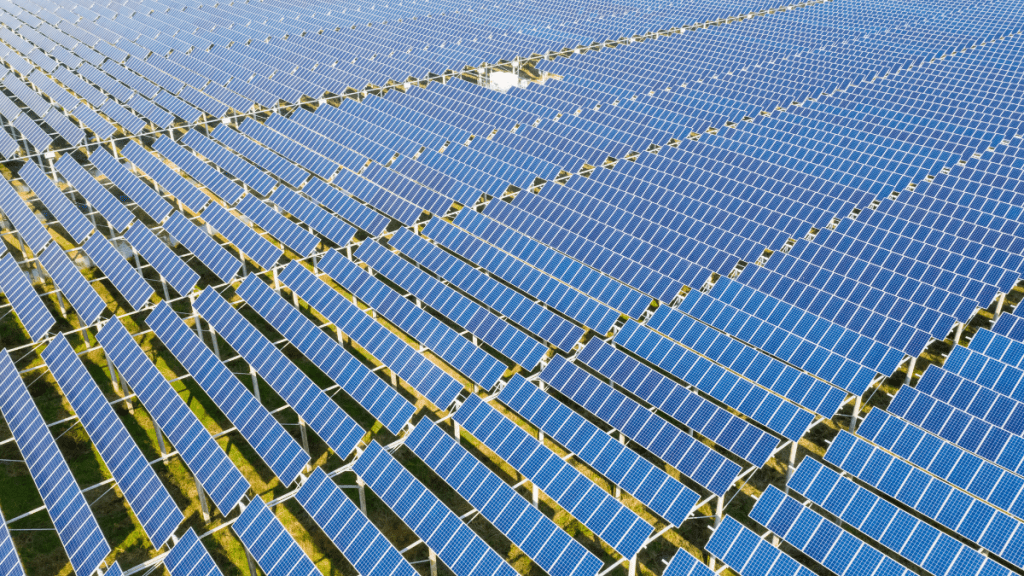
 Representational image. Credit: Canva
Solar power emerged as a major driver of Germany’s electricity mix in 2025, with renewables accounting for 55.9% of net public electricity generation, unchanged from the previous year, according to data from the Fraunhofer Institute for Solar Energy Systems ISE.
Photovoltaics (PV) recorded a sharp rise in output, increasing generation by 21% year-on-year and overtaking lignite for the first time to become Germany’s second-largest source of public net electricity generation, behind wind power. Solar installations generated around 87 terawatt hours (TWh) of electricity in 2025, of which approximately 71 TWh was fed into the public grid, while 16.9 TWh was consumed directly by producers.

Fraunhofer ISE said total solar power generation increased by about 15 TWh compared to 2024, reflecting both capacity additions and higher utilisation. By the end of 2025, Germany’s installed solar capacity reached 116.8 gigawatts (GW) DC, with net additions of around 16.2 GWDC during the year. However, the institute noted that annual solar installations must rise to 22 GW in 2026 to stay on track with national targets.
The strong performance of solar in Germany mirrors a broader European trend. Across the European Union, electricity generation from photovoltaics exceeded coal-fired power generation for the first time in 2025, reaching 275 TWh, compared with 243 TWh from lignite and hard coal combined. Over the past decade, EU solar generation has tripled, while coal-based power has declined by around 60%.
Wind power remained Germany’s largest electricity source, generating 132 TWh in 2025, though output fell 3.2% due to weaker wind conditions. Onshore wind contributed around 106 TWh and offshore wind 26.1 TWh. Despite capacity additions of 4.5 GW onshore and 0.29 GW offshore, wind expansion continued to lag government targets.
Overall, renewable energy sources—including solar, wind, biomass, hydropower and geothermal—produced around 278 TWh in 2025, with 256 TWh supplied to the public grid. While this marked a year-on-year increase of 6 TWh, renewable generation still fell well short of the national target of 346 TWh for the year, mainly due to slower wind expansion and high self-consumption of solar power.
Fraunhofer ISE highlighted that rising solar self-consumption and the increasing use of east-west oriented PV systems have improved grid compatibility but reduced specific yields. Biomass generation rose to 41.1 TWh, while hydropower output declined to 17.8 TWh due to significantly lower rainfall.
The institute also pointed to rapid growth in battery storage, driven by volatile electricity prices and falling battery costs. Large-scale battery storage capacity increased by 60% in 2025 to 3.7 GWh, while total installed battery storage reached nearly 25 GWh, mostly in residential systems. According to Fraunhofer ISE, Germany will require between 100 and 170 GWh of battery storage capacity by 2030 to support a renewable-heavy power system.
Meanwhile, fossil fuel-based electricity generation remained largely stable. Lignite-fired power generation declined, while higher natural gas use offset the reduction. Electricity imports fell in 2025, with Germany recording a net import surplus of 21.9 TWh, down from the previous year, supported by increased domestic gas-fired generation.
Electricity prices on the exchange rose during the year, with the average day-ahead price increasing by nearly 11% to €86.55 per megawatt hour.
Fraunhofer ISE said the data underscores the growing importance of solar power in Germany’s energy transition, while highlighting the need for faster renewable capacity additions, grid-scale storage, and system-level planning to meet future climate and energy targets.
Related
Discover more from SolarQuarter
Subscribe to get the latest posts sent to your email.