
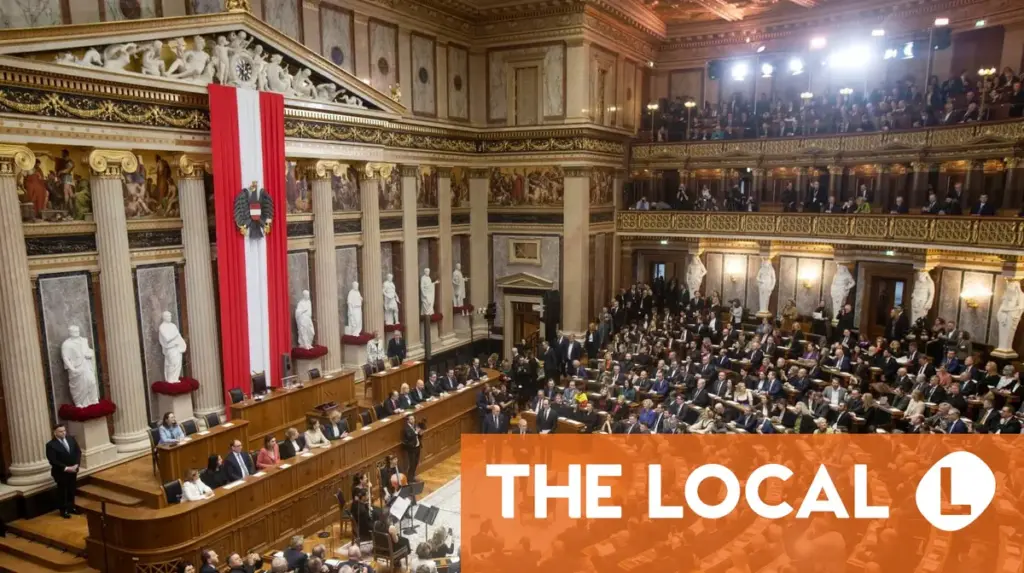
From pay transparency and immigration rules to climate and justice reforms, there will be plenty of new legislation in Austria in 2026 that will affect your daily life.
Austria is heading into 2026 with a packed legislative agenda. After almost a year in office, the coalition of ÖVP, SPÖ, and Neos has already passed dozens of laws, many of them focused on budget consolidation. This year, however, several major reforms are set to move from plans to reality.
They range from migration and labour market rules to justice reform, climate policy and social welfare. Some laws are firmly tied to EU deadlines, while others depend on whether the three governing parties can still find common ground.
Here is an overview of the most important legal changes expected in Austria in 2026, and what they could mean in practice.
New pay transparency rules
By June 2026, Austria must implement the EU’s Pay Transparency Directive, Austrian media reported. This will significantly change how salaries are handled in many workplaces.
Employers will be required to provide clearer information about pay ranges during recruitment. Employees will have the right to compare their pay with that of colleagues performing the same or equivalent work. The burden of proof in discrimination cases will shift, meaning employers must demonstrate that pay differences are justified.
For companies with more than 100 employees, the law goes further. If a gender pay gap of more than five percent is identified for comparable roles, employers will be required to close it within six months.
READ ALSO: KEY POINTS: What changes in Austria in January 2026
Possible changes to compulsory military service
Security policy is another area where decisions are expected in 2026. Against the backdrop of Russia’s war against Ukraine and growing concerns about Europe’s defence capacity, Austria is reassessing its military service model.
Advertisement
A commission set up by the defence ministry is due to present its recommendations in January. A longer period of compulsory military service and mandatory militia exercises are both on the table. A decision on whether to extend the basic service period is expected later in the year.
There are no plans to introduce compulsory service for women, and proposals for a universal civic or resilience year have been explicitly ruled out.
READ ALSO: How does Austria’s mandatory military service work?
Social assistance rules likely to tighten
Around 200,000 people in Austria receive social assistance or minimum income support. For many, 2026 is expected to bring stricter rules.
Vienna has already reduced its minimum income scheme, while other provinces, where social assistance has traditionally been more restrictive, are also tightening conditions. The federal government is working on a reform known as “Social Assistance New”, which aims to harmonise rules nationwide.
The planned reform would introduce stricter conditions for migrants, including waiting periods with reduced benefits, while also placing greater emphasis on support for children. Agreement is required in 2026 for the reform to enter into force in early 2027.
Advertisement
READ ALSO: How Vienna’s €2 billion austerity plan will affect your life
Media funding reform ahead
Media funding is also set for a major overhaul. The government currently spends around €100 million a year on media subsidies, but the culture and media ministry has announced that the system will be fundamentally redesigned.
An expert study is due early in 2026 and will form the basis for new criteria. Given the fragile financial situation of many Austrian media outlets, the outcome could be decisive for their long-term survival.
Climate law and subsidies under pressure
Austria still does not have a comprehensive climate law setting out binding responsibilities and governance structures. The coalition agreement promises such a law, and Neos insist that a clear framework will be adopted in 2026.
A draft presented by the climate ministry in mid-2025 is still under negotiation. It no longer explicitly mentions Austria’s goal of climate neutrality by 2040 and does not include binding sectoral targets for areas such as transport or industry. Instead, the focus is on achieving an overall emissions goal.
Advertisement
Another politically sensitive element is the planned reform of climate-damaging subsidies. These include benefits such as the commuter allowance, tax breaks for company cars and diesel tax advantages. The coalition has agreed on a gradual “ecologisation”, which suggests that cuts will be phased in slowly rather than implemented in one step.
READ ALSO: Why Austria keeps slipping in global climate rankings
Migration and asylum rules tighten further
Migration remains one of the government’s most pressing dossiers, even though asylum applications are currently at their lowest level since early 2020. In November 2025, just over 1,000 asylum applications were filed nationwide.
Despite this, the government continues to argue that Austria is in an exceptional situation. Family reunification for recognised refugees has been suspended for another six months and is set to remain blocked until July 2026.
At the same time, Austria must implement the EU’s new asylum system by summer 2026. The reform foresees faster screening procedures at the EU’s external borders, with a maximum of three days to assess whether someone has a realistic chance of being granted asylum. Applications deemed unlikely are to be processed in accelerated border procedures. To apply these rules, Austria will need new national legislation defining detention, screening and procedural safeguards.
In parallel, the coalition wants to reorganise labour migration. The Red-White-Red Card system is expected to be expanded in 2026, including easier access for apprentices from non-EU countries. A digital one-stop shop is also planned to make applications and document handling easier for skilled workers.
Advertisement
READ ALSO: Why Austria is seeing a sharp drop in asylum applications in 2025
A new federal public prosecutor under debate
One of the most sensitive reforms concerns the justice system. Austria is one of the few EU countries where the justice minister can still issue instructions to public prosecutors, including in politically sensitive cases.
A new federal public prosecutor’s office has been discussed for years as a way to reduce political influence. Previous attempts failed, but the issue is back on the agenda in 2026. SPÖ and Neos are seen as more flexible on design details than the Greens were in the last government, raising concerns among some legal experts that independence could be weakened if compromises go too far.
The key decision for 2026 is whether the coalition agrees on a model closer to the expert proposal developed under the previous justice minister, or on a version that retains stronger political oversight.
Budget pressure continues
Finally, work on the 2027 budget will dominate much of 2026. With deficits still high, the government must decide where to cut spending and which subsidies to reduce.
Advertisement
While structural reforms could save billions in the medium term, political resistance remains strong. In the short term, cuts to funding programmes are likely to be the most visible consequence for residents.
Key vocabulary
die Wehrpflicht – compulsory military service
der Familiennachzug – family reunification for recognised refugees
die Rot-Weiß-Rot-Karte – Austria’s residence and work permit for skilled non-EU workers
das Klimagesetz – a law setting the framework for achieving climate targets
das Budgetdefizit – budget deficit