
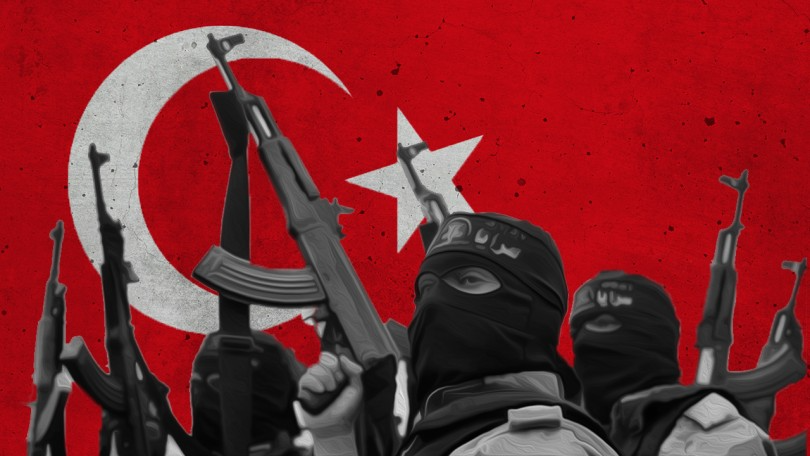
A deadly confrontation unfolded in Türkiye’s Yalova province
during a pre-planned security operation against the ISIS terrorist
organization, resulting in the tragic deaths of three police
officers and injuries to eight others, including one security
guard. The incident occurred in the village of Elmalık,
approximately nine kilometers from Yalova’s city center, when armed
suspects opened fire on law enforcement personnel.
Authorities quickly mobilized Special Operations units from
nearby Bursa, imposed strict security measures, and temporarily
suspended civilian access, electricity, and gas in the area to
contain the threat.
The operation highlights the ongoing challenges Türkiye faces
from ISIS networks, which continue to pose risks not only
domestically but also in the broader regional context.
The incident coincided with a nationwide crackdown, during which
357 ISIS suspects were detained across 21 provinces, including
Istanbul and Ankara, reflecting Ankara’s intensified efforts to
dismantle terrorist cells and prevent further attacks.
Speaking exclusively to Azernews, military
expert Abdullah Aghar offered a comprehensive and stark assessment,
framing the recent developments not merely as counterterrorism
challenges but as part of a wider geopolitical and strategic
design.
The statement ‘If the YPG/PKK weakens, ISIS will strengthen’ is
not moral; it is strategic blackmail.
I don’t know if you are aware, but lately, there has been a
frantic ISIS threat agenda. Operations, raids, detentions, and
arrests are taking place. MIT and internal security units are
working intensely. Clearly, there is unease. On one hand, countries
like Germany are issuing ‘warnings’ for Türkiye. On the other hand,
whispering channels capable of increasing anxiety are operating.
Information that should not be circulating publicly is being spread
through WhatsApp groups.
So what is happening?
Are security units only trying to prevent possible ISIS attacks, or
is this part of a much bigger game?
First, we must look at the regional geopolitical tension from
the Syrian perspective, because the crux of the matter lies there.
In fact, the issue should be framed like this: Türkiye is being
targeted through ISIS because of the impact this will have on the
future of Syria. And this targeting is not limited to the
potentially violent actions of ISIS alone.
The main objective is to suppress, hinder, break resistance,
change perspectives, and force Türkiye to accept defeat and
surrender through this terrorist organization and its
activities.
Why? Because Türkiye:
-
Is the only actor that can undermine the legitimacy claims of
the YPG/PYD. -
Is the only state that rejects the false duality between ISIS
and YPG/PYD/PKK. -
Is the only power offering a unitary interpretation of
Syria.
The extended processes of the March 10 agreement between the
YPG/PKK/SDG and Damascus have also expired. Something will happen.
At best, the YPG/PYD/SDG will be forced to sit at the table with
Damascus. Even this contradicts their so-called
‘autonomous-democratic’ narrative. If they do not sit at the table,
tension on the ground will deepen. Divisions along Arab tribal
lines in Deir ez-Zor may increase, and the vulnerabilities created
by forced conscription, illegal taxation, seizure of oil resources,
and oppression of civilians will become even more visible.
To prevent a possible operation, diplomatic and intelligence
pressure must be exerted on Türkiye. And here is the core point:
the YPG/PKK/PYD, which is experiencing a legitimacy crisis, needs
ISIS again.
In other words, the real dirty actor needs to be washed and
polished with ‘ISIS shampoo’ once more. That is why ISIS is seen as
being free against Türkiye, but controlled against the
YPG/PYD/PKK.
Let’s recall the 2014–2019 model. ISIS was elevated as the
‘absolute evil’ in global public opinion. Chaos deepened. At the
same time, a mythological narrative was created around the YPG/PKK,
particularly through Mount Sinjar. Stories were marketed about PKK
militants ‘saving Yazidis,’ while extortion, exploitation, ethnic
cleansing, child soldier recruitment, and violence against
civilians were ignored. This is how the YPG/PYD/SDG rose to power
through ISIS.
What does ISIS provide today?
-
The moment ISIS appears, immunity for the YPG/PKK/SDG
automatically emerges. -
The phrase ‘Now is not the time, ISIS is here’ circulates both
diplomatically and on the ground. -
It becomes justification for continued US presence: ‘We cannot
withdraw.’ -
Pressure on Türkiye resurfaces: ‘If YPG weakens, ISIS
strengthens.’ -
Damascus is told: ‘YPG/PKK/SDG is indispensable.’
All of this is a strategic operation carried out without firing
a single shot.
So why ISIS again, and why in a limited form?
Because the goal now is not to seize territory or declare a
so-called caliphate. The aim is to create perception, establish
balance, provide immunity to central actors—primarily the
YPG/PKK—and prepare the ground for future interventions. ISIS today
is not the central node of power projection; it is a temporary
shadow node used to obscure the real centers of influence.
Let’s be clear:
-
The YPG/PKK/SDG is the local node being made permanent.
-
ISIS is the temporary node used as an insurance policy.
-
The US is the meta-node defining the existence and boundaries of
both.
Why must Türkiye break this complex early?
Because if these nodes become permanent, the YPG/PKK becomes
untouchable, the US presence becomes irreversible, Türkiye retreats
inward, and strategic erosion begins.
ISIS must be strangled before it solidifies:
-
In prisons like Al-Hol and Al-Roj,
-
In Sunni regions of Iraq,
-
Within compromised security structures,
-
And most importantly, in all layers where it has polluted Islam
and its values.
If ISIS creates prolonged chaos inside Türkiye, new permanent
nodes will emerge. Perceptions will harden, interventions will
follow, and the cost will grow. That is why timing is critical.
ISIS today is a high-voltage, temporary knot used to generate
legitimacy for others. Combating it requires not only armed force
but a cybernetic, strategic approach that dismantles the entire
node architecture behind terrorism.”