
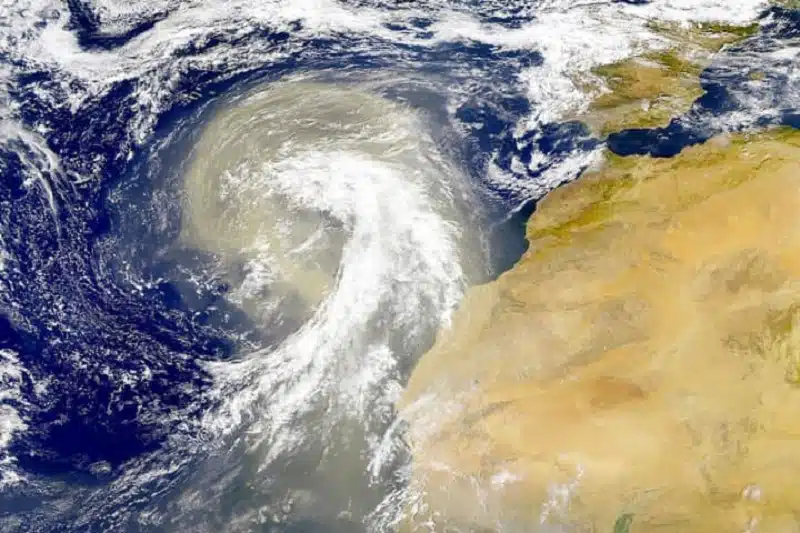
The year 2026 is beginning with abundant rainfall in Morocco, following the unprecedented rains of December 2025, which brought an end to a grueling seven-year drought cycle. However, this low-pressure system calls for heightened vigilance, as it is linked to Storm Francis, a system known for low temperatures, intense short-term rainfall, and strong winds. In this context, the General Directorate of Meteorology (DGM) has issued red and orange alert bulletins across several regions, warning of major weather disturbances.
This is not an isolated phenomenon. The same storm has battered the Iberian Peninsula since last December, as well as the Canary Islands, and has even affected Corsica and parts of France. The phenomenon is also familiar elsewhere, having previously been observed in Ireland and the United Kingdom, where it caused flooding in 2020. Speaking to Yabiladi, Mohamed Said Karrouk, professor at Hassan II University of Casablanca, explained that Storm Francis, named in Portugal, crossed the Azores before moving eastward toward Morocco.
«In Morocco, Storm Francis is caused by cold drops, this part of the cold polar air that reached us in North Africa, fed by another air mass from Siberia. It is therefore a powerful depression. By detaching from the land-sea mass, it entered the more humid and warmer Atlantic air. This shear creates significant disturbances, with strong effects as we have seen in the Canary Islands».
A rain cycle between two drought periods
The storm is now moving toward central Morocco, including Agadir, Essaouira, and surrounding provinces, many of which are currently under high or very high alert. Karrouk notes that he had anticipated this phenomenon as early as September 2025, pointing to La Niña in the Pacific as a key driver.
He explains that La Niña «is behind the other disturbances we have been witnessing since part of the autumn, but also currently and possibly until the beginning of the next spring season», while stressing that this episode is not unprecedented.
In this respect, Prof. Karrouk recalls that «meteorological observations over the years attest to several precedents in Morocco, notably in 1963 and whenever conditions are met to give rise to these effects». He explains that «La Niña weakens the Azores anticyclone, which, in interaction with the Icelandic depression, creates what is known as the negative North Atlantic Oscillation, the positive phase producing opposite effects», such as drought and rainfall shortages.
Karrouk further emphasizes that «we have also experienced these extreme events related to climate change», pointing to a drought–rain return cycle that, he says, «has been a rule for a very long time».
«It is even this cycle that has allowed for the permanent settlement of populations in Morocco, the development of civilization and an economy, thanks to the return of water. Drought is the rule, but the resurgence of water resources remains essential and always follows the lack of rain. We continue to live this rhythm, but with an additional effect: climate change, which accelerates and intensifies evaporation while giving the atmosphere a greater capacity to retain water vapor».
These dynamics mean that «the atmosphere requires a long period to become saturated», he explains. During this evaporation phase, drought sets in and persists «as long as the atmosphere remains large relative to its temperature», delaying the return of rainfall. In this sense, the drought between 2018 and 2025 represents «the full period needed before saturation and precipitation», with La Niña acting as the trigger.
While «the rains are now here», climate change, Karrouk warns, will generate «increasingly extreme phenomena». «Existence evolves through alternation, which itself is becoming more intense».
According to him, the extreme nature of these episodes has «existed for at least the past 10 to 20 years». Historically, he recalls the return of rains in 2006, followed by nationwide flooding, then again in 2009, 2010, and 2011.
Increasingly extreme cycles
Over time, «dams were filled for the first time in their history, especially Al Massira». Karrouk notes that «after the major floods of December 1996 and February 1997, the dam did not exceed a 30% fill rate, while in 2010 it was close to overflowing, requiring the opening of its gates to protect the infrastructure».
In November 2014, Morocco also experienced the Guelmim storm, which caused significant human and material losses. «More recently, in September 2023, West African monsoon flows reached southern Morocco, causing flooding in Tata and Ouarzazate, as well as in southern Algeria and Tunisia», Karrouk recalls.
«What happened last year in Spain’s Valencia region was followed by a similar phenomenon the following September in Tata and Ouarzazate», he adds, placing Storm Francis within a broader regional pattern.
Analyzing the growing frequency of such events, ecologist Omar Zidi, a member of the executive bureau of the Moroccan Coalition for Climate Justice, says these phenomena are becoming less isolated and increasingly tied to global climate dynamics.
Speaking to Yabiladi, Zidi notes that these winter rains are exceptional «due to their abundance over a short period, causing sudden floods, as seen in Safi, where riverbeds long thought dry have reclaimed their natural paths».
He also suggests that Morocco may be moving toward a Mediterranean-type climate, citing IPCC reports that identify the region as a climate hotspot.
«The observation is both global and national. It calls for a readjustment of public policies at the municipal and provincial levels. Strategies exist, and local authorities are required to implement them across their territories».
In this regard, Karrouk stresses the need to «conduct vulnerability studies in Morocco» to assess the impact on each region.
«This means taking stock of the current situation, adapting shelters, preparing to limit damage by protecting lives, but also developing infrastructure and anticipating emergencies—so as to benefit from the positive side of these episodes as well».