
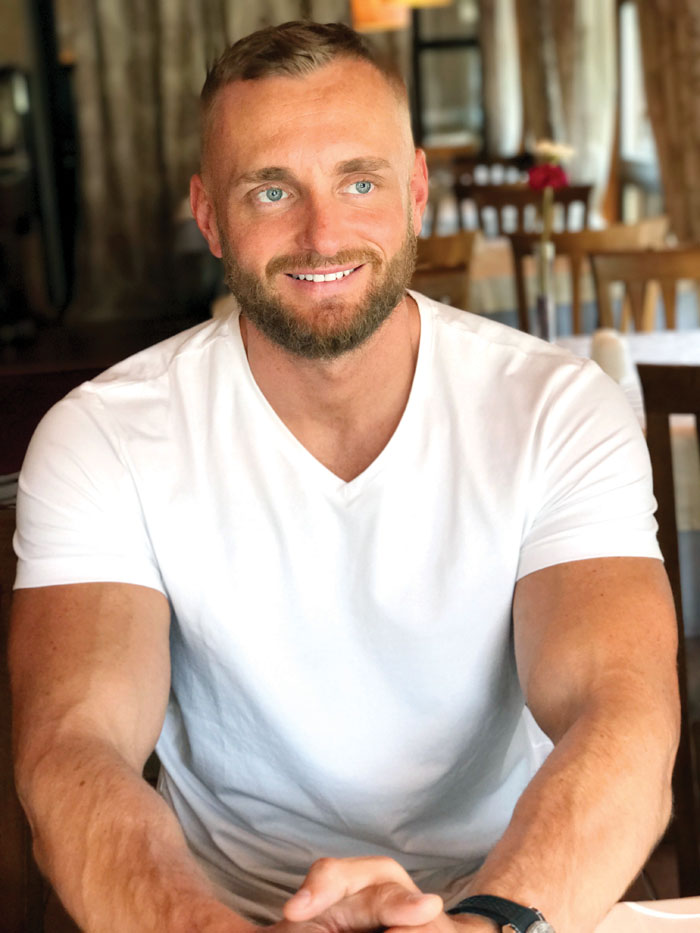
For most people, the Bosnian War was just a moment in time, in a far off place, transmitted into living rooms via news broadcasts. For Adis Ziga, the early 1990s conflict consumed his reality, transpiring right in his own backyard, but it also served as the catalyst for his move to America that brought him to Salisbury.
Late last year, Ziga joined former longtime Salisbury newsmen David Whisenant and Mark Wineka for a book signing event at South Main Book Co. Whisenant was selling copies of his memoir “Chasing the Story.” Wineka had his “Drive Across Town,” chronicling the Crawford House move.
Ziga’s story, “The Empty Chocolate Wrapper: Bosnian War Genocide from the Eye of Innocence,” tells his account of a revoked childhood, lost beneath the terrors of a war he can hardly comprehend but is forced to face during such a pure period of one’s life. Although, with Ziga’s upbeat and positive demeanor, it is hard to tell on the surface that he survived one of the most tragic genocides of last century.
Per Britannica, the conflict was an ethnically rooted war in Bosnia and Herzegovina, which was a former republic of Yugoslavia with a multiethnic population comprising Bosniaks (Bosnian Muslims), Serbs and Croats.
Destabilization in the region and economic uncertainty brought on by the twilight of the Soviet Union unraveled the comfortable village life Ziga documents in his book. Bosniaks comprised he largest ethnic group in Bosnia at the time war breaks out, but that does not protect them from Serb paramilitary forces and the danger that was brewing from just across the border in Serbia.
The first part of the book recounts memories of elders and humorous village moments that encapsulate and showcase the peaceful nature of Žepa, Ziga’s small home on the eastern border of Bosnia and Herzegovina. He cherishes encounters with non-immediate family members and large gatherings of fellow Muslims as he learns about his family’s culture and religion.
In one story, he gets a new denim outfit made complete with a leather belt his uncle produced in his shop just for Ziga.
Those childhood memories were soon swept up in a sea of grief and violence. Co-governing parties of the various nationalities stopped cooperating and after Bosnia and Herzegovina gained independence in 1992, those Serb paramilitary forces began firing on the nation’s capitol, Sarajevo, the same site where Austrian Arch Bishop Franz Ferdinand’s assassination in 1914 sparked World War I. This latest conflict would not consume the globe but it would become the waking reality for those who had to live through it.
Bosnia is surrounded by three countries: Serbia (to the west), Montenegro (to the south and Croatia (to the east and north). Ziga’s eastern home of Žepa placed his people right in the eye of the storm of the conflict, barely separated from Serbia.
Caught in the crosshairs, Zepa becomes the subject of a Serbian siege, which results in the deprivation of comfort for Ziga and his family.
“Imagine Salisbury, war breaks out, you are hearing about a war in Tennessee,” Ziga said. “Villages are burning around us, you are sitting next to the border and know all that separates you is a river from where full-blown war is starting.”
United Nations Peacekeeping forces were deployed to the region.
“They were Ukrainian, but we had to surrender our weapons and they were in charge of protecting us,” Ziga said. “For about 2-3 years, we had been protected by these soldiers, but up to that point you were exposed to grenades, airplanes flying over, water supplies being poisoned.”
His father was a construction worker but was forced into a farming role as the villagers sought any means at all to survive.
“Nothing was coming in and nothing was leaving,” Ziga said. “Towards the end of the war, they started bringing a little bit of supplies, bare minimum, flour oil, sugar, salt. Sometimes we would have airplanes dropping parachutes of supplies.”
A pivotal moment in the narrative is the fall of Žepa in 1995, leading to a harrowing exodus. Ziga describes the painful separation from his father and the dangerous journey to safety, including a terrifying encounter with Serbian soldiers.
“They forced us to walk to a free territory,” Ziga said. “During that stretch, a lot of things took place. (Checkpoint soldiers) demanded things from my mother, valuables, money and gold.”
Ziga was 8 when the war broke out. He witnessed all the atrocities that he saw during the time most children are learning arithmetic. He would immigrate to the United States in 2000.
“Whenever war ended in Bosnia, a lot of refugees, Bosnian men, captured during the war, there was an agreement with Serbia, who did not want them to go back to Bosnia,” Ziga said. “A lot of these men ended up in America. Their families were not here, but they would request their families to follow. It was a safe haven. That is how many Bosnians came here.
“My brother-in-law and sister arrived first, and a few years later, the only way you could bring someone is if you could guarantee you could take care of them, so they don’t have to depend on government assistance.”
Like many Bosnians, Ziga’s sister tried St. Louis, Missouri first, but it proved not to be where the resettled family wanted to stay.
“They thought at that that time, St. Louis was not that great of a place,” Ziga said. “It was a lot of crime. We just escaped the war, can’t go back to that environment.”
So they decided to move to North Carolina.
“Before coming to the United States, you have to go through rigorous interviews with the officials and you had to go through medical exams,” Ziga said. “We were refugees because my home was never rebuilt in the eastern part of Bosnia. That part of my life was not rebuilt. We could not go back. It was destroyed by the war.
“We went through the process. When we arrived, we were given a number. You could apply for social security later on for a green card and eventually citizenship.”
When he came to the United States, Ziga enrolled at Catawba College, and earned a bachelor’s degree in business administration. After graduation, he began his career in the banking industry.
When not writing or working, Ziga enjoys working out, reading, spending time with his family, traveling, collecting old coins and geeking out on history.
Ziga has suffered from episodes of post traumatic stress disorder brought on by his experiences. On New Year’s Eve in 2019, the fireworks in Myrtle Beach, South Carolina, transported him back to his village.
“As I stood there on the beach, a grown man weeping at fireworks, I realized that the scars of war run deeper than I ever imagined,” Ziga writes.
The title owes itself to a small trinket that little Ziga grasped as a child. He fondly remembers how the wrapper brought him joy because it brought back memories of the sweet treat it once held, but it takes on a new meaning in the book as it represented something deeper. One case involves his sister showing him how to fold it and turn it into a book mark. It serves as a reminder to the reader that in the midst of childhood, seemingly discardable items can hold great worth in the eye of an innocent beholder.
Check out Ziga’s book. It is available on Amazon.