
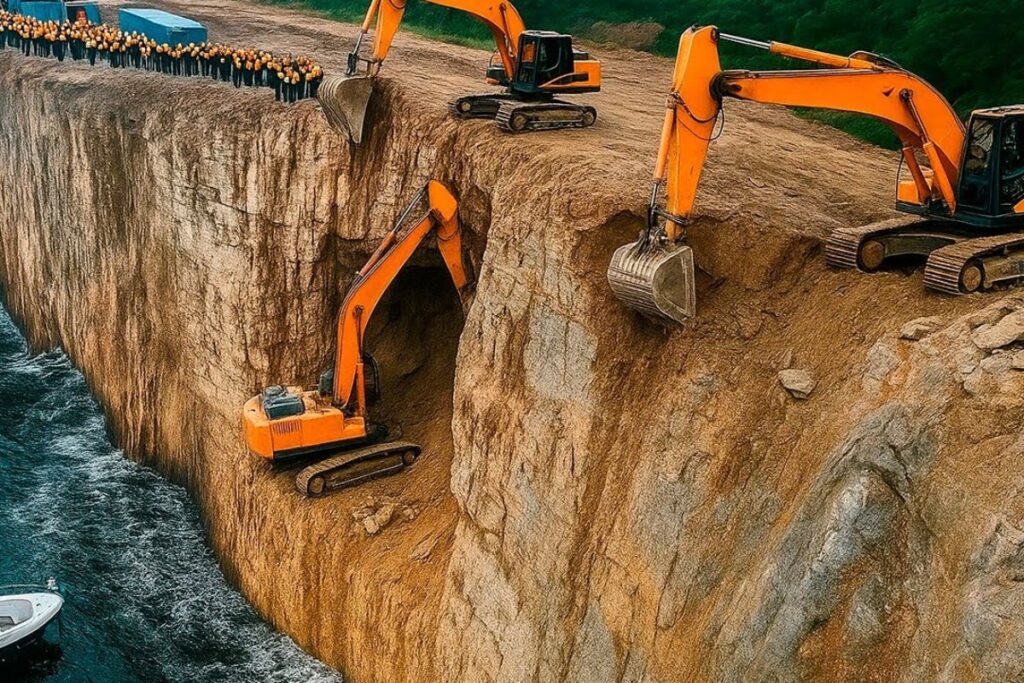
Norway has decided it will no longer obey geography. Faced with a stretch of ocean that crushes ships like toys, the country decided to split a mountain in half, spend almost 1 billion euros, and open the world’s first ship tunnel to hide the sea inside the rock.
The target is the Stad peninsula, a seemingly harmless spot on the map, but which in practice is the point where the North Sea and the Norwegian Sea collide, creating cross waves of up to 30 meters. More than 30 people have died and dozens of serious accidents have already been recorded at this maritime bottleneck, through which ferries, fishing trawlers, and ships that support one of the most important fleets in Europe pass.
Where the sea goes mad and turns the coast into a game of Russian roulette.
On paper, Stad is just a bend in Norway’s rugged coastline. For those who sail, it’s almost a sentence of permanent risk. Here, weather forecasts are often useless, and survival becomes a matter of luck.
It is the exact point where two giant seas meet head-on. The shallow underwater topography amplifies the energy of the waves and creates an extreme scenario: swells up to the size of a ten-story building coming from multiple directions at the same time, crashing against the bow and sides of the hull.
The storms don’t “pass,” they only pause briefly. For more than 100 days a year, the region functions like a war zone.
Norway can’t simply detour. The country exports millions of tons of fish a year, and this area is a vital maritime highway.
Today, many ships wait for windows of just a few hours to attempt the crossing, which can open and close in 30 minutes. Each match is almost a lottery where the winning ticket could cost the lives of an entire crew.
How the world’s first ship tunnel inside a mountain was built.
This is no small hole for cars. The corridor will be approximately 37 meters high and 26 meters wide, enough space for a cruise ship to navigate comfortably, with antennas and superstructure.
To achieve this result, engineers need to remove approximately 3 million cubic meters of rock, the equivalent of hundreds of thousands of dump truck trips. It’s literally dismantling a mountain, piece by piece.
To blow it all up at once would be geological suicide. Therefore, the excavation is done in layers, from top to bottom. First, the roof is removed and the vault is stabilized.
Then, the work descends level by level until it reaches about 12 meters below sea level, slicing a “cake” of granite with dynamite and giant hydraulic excavators.
Brute force, diamond wire, and water under control.
Explosions eliminate volume, but leave scars. Detonated walls become uneven, full of sharp edges and cracks. In a road tunnel, concrete solves the problem.
In a water-filled tunnel, roughness means turbulence, whirlpools, and loss of control for heavy ships.
To avoid this scenario, the Norwegians will combine dynamite with jewelry-making precision. Steel cables coated with industrial diamonds rotate at high speed, cutting through the granite and leaving the walls smooth, reducing water resistance and ensuring a more stable flow.
It’s the brute force of mining combined with the delicacy of a surgical cut on a monumental scale.
Building the tunnel, however, is only half the challenge. The other half is inviting the ocean in without destroying everything. The tunnel will be kept dry during construction, isolated by temporary steel barriers at both ends.
Inside this “cocoon,” teams install lighting, monitoring systems, and all the security infrastructure that will allow the world’s first ship tunnel function as a predictable route through the chaos of the open sea.
Flood the mountain without letting it collapse.
Once the structure is complete, the most delicate hydraulic operation of the entire project begins. You can’t just open the floodgates and let the Atlantic invade the mountain.
Special valves will allow water to enter gradually, balancing the pressure ton by ton until the internal level is exactly the same as the sea level outside.
Only then will the dams be removed, and the mountain will officially become an arm of the ocean.
The lighting was designed as part of the navigation. No spotlights blinding the captain. Continuous LED strips will run the entire length, like a futuristic runway.
In an enclosed environment, where GPS can fail, these colored light lines indicate the safe trajectory and serve as a visual guide for each vessel.
Ship traffic as if it were an airport inside the rock.
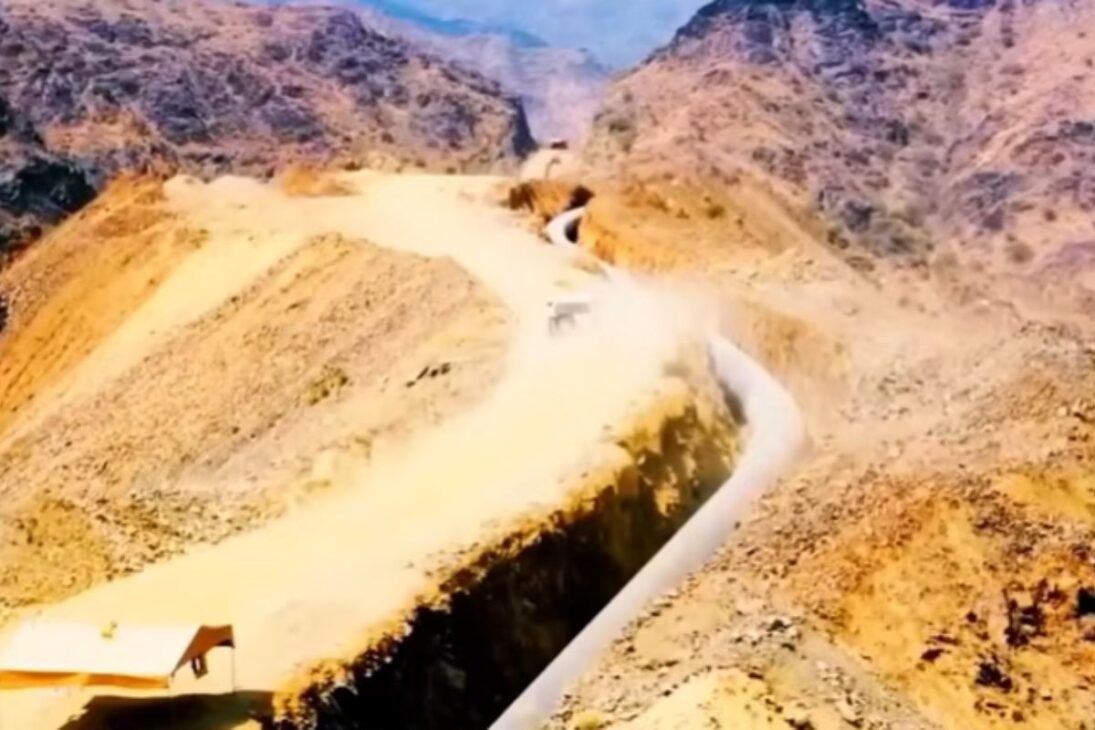
Controlling ships weighing thousands of tons through a stone tunnel requires traffic discipline.
The plan is to operate the flow in an alternating one-way system: for one hour, ships travel north. In the following hour, the direction is reversed and the ships travel south.
Everything will be coordinated by a control center that functions like an airport tower. Radar, thermal sensors, and infrared cameras will monitor every meter of the tunnel. If a ship stops or slows down unexpectedly, the system detects it immediately.
The tunnel entrance itself is a piece of defensive engineering. Instead of a straight cut into the mountain, the mouth will be carved into stepped stone terraces.
These steps break up the energy of the waves before they enter, acting as natural shock absorbers and protecting the interior of the building. world’s first ship tunnel from the direct impacts of the raging sea.
Nearly 1 billion euros, political crisis and strategic decision.
The price of this bold undertaking helps explain why the project became the subject of political dispute. When the tunnel was approved, the estimate was several hundred million euros.
With global inflation, geological complexity, and rising material costs, the budget jumped to almost 1 billion euros, practically double what was projected.
The government even went so far as to freeze the project and question whether it made sense to spend so much money to “gain a few minutes of travel time”.
Parliament, however, saw the bigger picture. This is not about time, but about lives, national security, and logistical stability on Norway’s west coast.
Negotiations with contractors have reopened, seeking cost cuts without sacrificing safety, and a new political breakthrough has become a priority.
The tunnel is gigantic, but not infinite. Very wide supercontainer ships will continue on the outer route, braving the storms. The real target is the coastal vessels, ferries, and cargo ships that keep the Norwegian economy running.
It is estimated that most of the region’s current traffic will be able to use the tunnel, reducing risk, delays, and fuel consumption.
For smaller vessels, the savings in effort and time can be significant, with fewer hours spent battling giant waves.
A country obsessed with tunnels pushes the limit once again.
While in many places such a project would be considered an isolated folly, in Norway it seems simply the next logical step.
The country already has dozens of road tunnels cutting through mountains, including many that pass under the sea. For many Norwegians, Entering the darkness of the rock is as much a part of the routine as going to the market.
The Lærdal Tunnel, for example, is the longest road tunnel in the world, at 24,5 kilometers, and uses caverns illuminated with blue light to keep drivers alert and calm.
The Rogfast project, on the other hand, descends hundreds of meters below sea level and even incorporates underwater roundabouts, as if a small concrete city had been built beneath the ocean.
In this context, the world’s first ship tunnel In Stad, this is not an isolated whim, but yet another chapter in an engineering culture that treats granite like butter and considers the mountain an infrastructure, not a barrier.
When the sea enters the mountain and becomes an attraction.
The rock removed from the peninsula will not be discarded. The millions of cubic meters will serve as raw material to build an entire new district in a neighboring city, with houses, hotels, and businesses built literally on the bowels of the mountain that previously blocked the route.
Furthermore, the project is expected to become a global tourist attraction. An observation platform will allow visitors to see the moment when a large cruise ship stops battling giant waves and calmly enters the Earth’s interior, guided by soft lights, in silence, while the storm continues to rage outside. It is the perfect image of human stubbornness in the face of Europe’s deadliest sea.
Ultimately, the Stad tunnel is more than just a safe passage. It’s a monument to the insistence on not accepting that a single stretch of sea should decide the fate of an entire coastline.
The mountain remains in place, the waves are still out there, but Norway is about to have a concrete, enlightened, and navigable answer to this chaos.
And you, would you risk crossing the world’s first ship tunnel Right in the middle of a 30-meter storm just to experience what it’s like to ride through the sea inside the mountain instead of facing the waves outside?