
Norwegian Prime Minister Jonas Gahr Støre stressed an urgent need during the New Year holidays “to safeguard security” and preserve democracy, even before US President Donald Trump launched a military assault on Venezuela. Støre had already cited the “instability in the world” that’s “directly affecting our lives”and demanding entirely new levels of defense and preparedness.
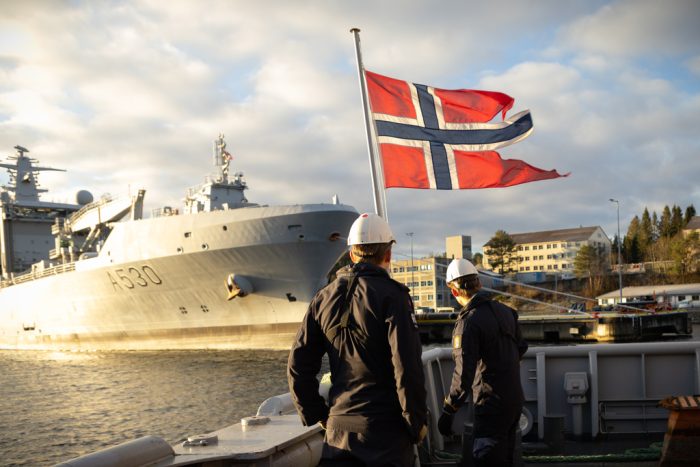 Norway is investing heavily in its defense while also sending more military aid to Ukraine. Russia still poses the biggest threat, not least in the Arctic, while questions rise over the US’ commitment to NATO. PHOTO: Oda Holmefjord/Forsvaret
Støre’s government later criticized Trump’s intervention in Venezuela, claiming that it “lacked democratic legitimacy.” Even though Norway and many other countries have also criticized the Venezuelan government as authoritarian and brutal, the US assault on the country is widely viewed as violating the Rule of Law.
The military attack ordered by US President Donald Trump also further confuses the US’ NATO allies, including Norway, at a time when the alliance is already under pressure. The pressure intensified during the Christmas holidays when Trump repeated his desire for the US to take control over Greenland, which currently is part of the Kingdom of Denmark. It’s one of NATO’s original allies, joining along with the US when the alliance was first formed in 1949.
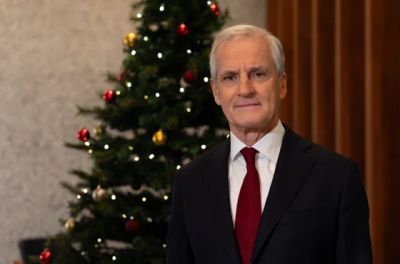 Prime Minister Jonas Gahr Støre opted to deliver his latest annual New Year’s address to the nation not from his residence, as in prior years, but from the newly restored government complex in downtown Oslo. It was bombed by an ultra-right-wing terrorist in 2011, but will soon be ready for government ministries to move back in after 15 years in “temporary” offices. Støre views the complex as a symbol of Norway’s “open democracy” that survived the attack. PHOTO: Gøril Furu / DIO
“When countries (including the US) are erecting tariff barriers, we are confronted with high prices at the local shop and businesses that are vital to our communiuties are dealing with growing uncertainty,” said Støre during his New Year’s address to the nation. He also referred to how “climate change and extreme weather are wreaking havoc” and how Russia, “supported by China, Iran and North Korea, is moving into the fourth year of its brutal war against Ukraine.”
The prime minister referred to how a fifth-grade class at the Isfjorden School in the county of Møre og Romsdal actually sent him a letter asking whether there is a risk of war in Norway.
“I completely understand why they would ask me this,” Støre said. “The world situation has become more serious. There is war in Europe. So yes, we, too, must be prepared for the fact that war could once again come to Norway.”
That’s why there’s been such a military build-up within Norway and why Norway is a major donor to Ukraine, in an effort to help the embattled country keep fending off Russia after its invasion nearly four years ago.
“We are strengthening our Armed Forces, as part of the world’s strongest military alliance and with our northern European Allies in a Europe that is taking greater responsibility for its own security,” Støre said, calling that “both right and necessary.”
Støre noted other threats as well, such as cyber attacks, sabotage and attacks on important infrastructure such as transport arteries, power and water supplies and industrial plants. Surveillance of Norway’s offshore oil and gas installations has already been boosted, while civilians are being urged to prepare for at least a week without electricity, water or being able to buy groceries.
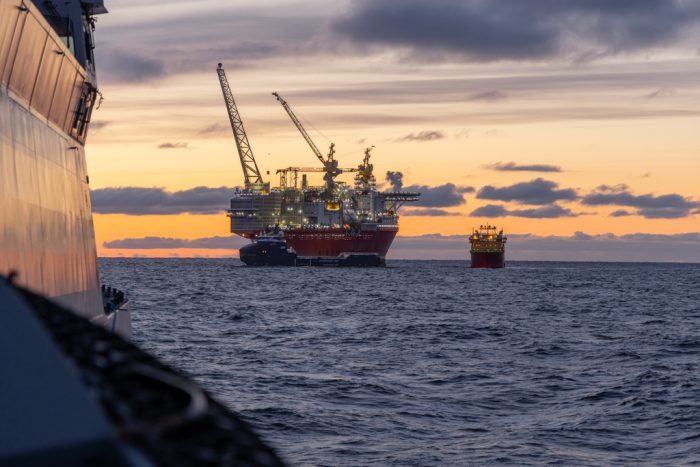 The Norwegian frigate KNM Fridtjof Nansen has been among those on patrol around Norway’s offshore oil and gas installations, here at Goliat in the Barents Sea. PHOTO: Catharina Molland Dale / Forsvaret
Støre stressed that “we, each and every one of us, must do more to defend our security, both using our own resources and in cooperation with other countries.” He noted that there is “broad consensus” in Parliament, from the far right to the far left, on a plan to strengthen the Norwegian Armed Forces, “and on the need to continue to provide substantial, long-term support to Ukraine.”
He noted, however, that despite Russia’s war on its own neighbour (which it still hasn’t won despite four years of trying), the Norwegian government still doesn’t think Russia will cross its border to Norway in the far north.
“Our assessment is that Russia does not see it as in its interests to seek a military confict with Norway, a NATO country,” Støre said. Norway and Russia have been relatively good neighbours for centuries, also during the Soviet era. Støre also stressed again, as he has several times before, that “Norway poses no threat to anyone, and neither does NATO.”
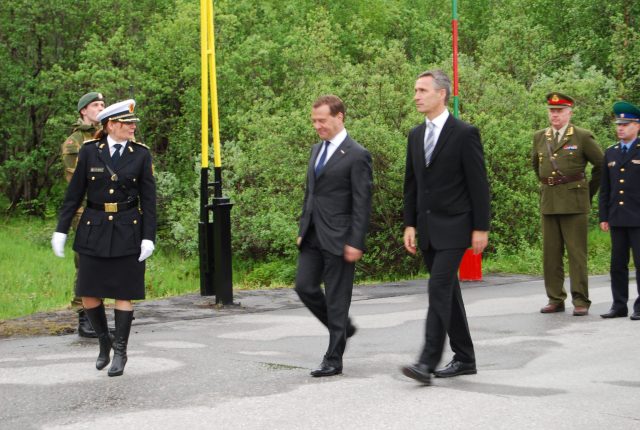 Former Norwegian Prime Minister Jens Stoltenberg strolled over Norway’s border to Russia with its president, Dmitrij Medvedev, in 2013, when relations with Russia were still relatively friendly. That was before Russia invaded Crimea the year after and then all of Ukraine in 2022 and relations froze. Stoltenberg went on to lead NATO for 10 years and is now back in Norway as finance minister. PHOTO: NewsinEnglish.no/Nina Berglund
Others have questioned, though, whether Norway’s defense forces have the stamina to withstand an invasion, and warned that roads and other infrastructure still aren’t sufficient to transport NATO equipment shipped into Norway. Defense expert Ole Christian Emaus wrote in newspaper Aftenposten last fall that the Norwegian Army still lacks personnel and ammunition, that the Air Force still has too few operative hours in the sky and maintenance challenges, that too many Navy ships remain tied up because they lack crew and reserve parts, that the Civil Defense isn’t as spread out as it should be and that Norwegian Special Forces have had to reduce their preparedness as a consequence of inadequate resources.
Støre and defense officials insist that’s being addressed, with budget allocations for the military higher than ever. Billions have been earmarked for both new submarines and missiles, along with ammunition that’s not all being sent to Ukraine. Public opinion polls show a strong willingness among the civilian population to help defend their country, which was known for its resistance forces during World War II.
Many other top politicians have also, like Støre, warned of the need to keep boosting defense, even that “evil forces are on the march,” as the Conservative Party’s Peter Christian Frølich claimed in November. Frølich been personally involved in transporting equipment into Ukraine and been on a campaign to urge all Norwegians to contribute. “The most important preparedness we have (at home) is in our heads and hearts,” he told Aftenposten.
That’s what Støre was also seizing on in his New Year’s address, just weeks after he also appointed his own version of a National Security Adviser. Thomas Boe Hornburg, who has worked with and for Støre since 2016, has been charged with coordinating security and defense issues and strategy among the various ministries, not least defense, justice and preparedness.
“Safeguarding our security is about more than just aircraft and frigates,” Støre said. “What gives us security is people, it’s all of us.” That includes everyday citizens in addition to the military, police and local leaders, he added: “Our security is also provided by the nurses, doctors and all other health personnel who meet us when we are at our most vulnerable, and who treat the injured when every second counts.”
Støre warned that Norway “is not immune to the risks emerging in a more insecure and unpredictable world,” but that “we have a high level of resilience.” Norway is a safe country, he claimed, with a robust economy, a high degree of social equality and a high level of trust between people.
“And we have a vibrant democracy,” he said, noting how voter turnout in last fall’s election was nearly 80 percent. The national mock election in the schools, where students are taught to think critically, also had an 80 percent turnout. “These are not just numbers but proof that we care, that we want to exert our influence and be heard.” Even though there’s wide differences of opinion within Norway, “this does not make us enemies,” Støre said. “Our discussions may be heated, but we can also shake hands or give each other a hug, because we know that what unites us is greater than what divides us.”
NewsinEnglish.no/Nina Berglund