
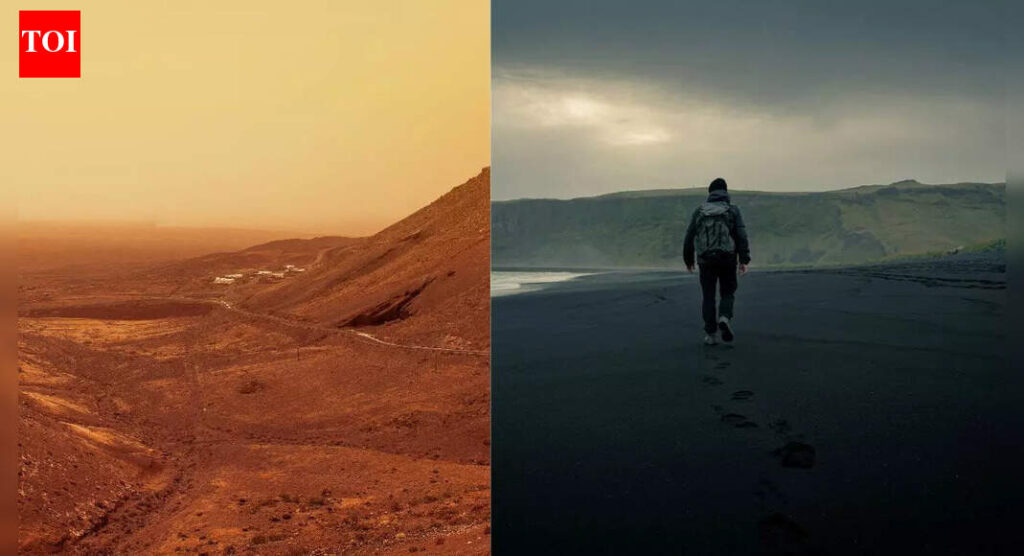

Some places feel borrowed from elsewhere. Iceland is one of them. Walk across its lava fields, and the ground looks unfinished, cracked, dark, and still warm in places. Steam lifts from the earth without warning. Rivers cut through black rock as if they arrived yesterday. Scientists do not go there for scenery alone. They go because the land behaves strangely familiarly. Far away, Mars shows the same scars of fire and water frozen in time. Recent rover images have sharpened that interest. Tiny patterns in Martian rock hint at ancient microbes, the sort of discovery that makes old questions feel urgent again. Before anyone digs on Mars, they dig in Iceland first, slowly, carefully, and with plenty of doubt while waiting for answers to last.
Iceland helps NASA test Mars exploration tools
Mars has always been distant, both physically and scientifically. That distance narrowed a little when NASA announced possible biosignatures in Martian rock. Small spotted marks, almost decorative, appeared in stone that once sat beneath water. On Earth, such shapes usually come from microbes. Nothing is confirmed, but the idea lingers.Rovers like Curiosity have spent years sending back images that look quiet and empty. Flat plains. Layered rocks. Dust without movement. Yet those layers suggest something else. Sediment only settles when water moves. Somewhere in Mars’s past, rivers ran and lakes filled and slowly disappeared.That is where Iceland steps in, not as a copy, but as a reminder.
Extreme environments on Earth guide Mars missions
Iceland is young in geological terms. Volcanoes still shape it. Water still cuts into fresh rock. Basalt lies exposed, dark and heavy, rather than buried and softened by time. In some regions, glaciers and lava sit almost side by side.For planetary scientists, this matters. Ancient Mars was volcanic. It also had flowing water. Iceland shows what happens when the two meet. Mike Thorpe from NASA’s Goddard Space Flight Center once described the comparison as almost direct. Not poetic. Practical.Walk along an Icelandic river canyon, and you can see layers formed by eruptions, then reshaped by water. Mars shows similar layering, only frozen in place for billions of years.
Iceland teaches us about surviving on a hostile planet
Rocks do not speak clearly. They leave hints. Sedimentary layers stack slowly, holding whatever was present at the time. Minerals. Gases. Sometimes traces of life.The challenge is knowing where to look and what to trust. On Mars, tools are limited, and distance adds uncertainty. In Iceland, scientists can take samples by hand. Break rock. Measure gases. Return again.This is where the SWIFT team works. Southwest Iceland Field Team is a plain name for difficult work. Long walks. Cold water. Heavy packs. They collect from riverbeds, lake floors, and hydrothermal vents where heat and chemistry mix in complicated ways.
Carbon clues in Iceland matter for Mars research
Life as we know it leaves carbon behind. Not always neatly. Sometimes it hides in minerals or escapes as gas. But carbon is the starting point.NASA often looks for places on Earth that behave like other worlds. Meteor Crater helps explain the Moon. Greenland ice helps model Europa. Iceland helps frame Mars.Lake Kleifarvatn is one focus. It sits quietly, but below the surface, vents release gases and minerals. Fine sediments settle slowly. The chemistry resembles what scientists think existed on Mars around four billion years ago.Samples from nearby Stóra Laxá contain carbon dioxide rising from lake sediments. That movement matters. On Mars, similar gases may once have moved through water and rock, leaving chemical fingerprints behind.
Could life survive something like this
Iceland is not gentle. Cold water. Shifting ground. Limited nutrients. Yet life persists. Microbes cling to rocks near vents. Organisms adapt without drawing attention.This is not proof of Martian life. It is context. If life finds a way here, under pressure and imbalance, it opens a door. Ancient Mars may not have been welcoming, but it was not empty either.The work continues without certainty. Samples are labelled, tested, and questioned again. Iceland does not provide answers so much as patience. It lets scientists practise reading landscapes that no longer move.Mars remains distant. Iceland stays cold and restless. Between them sits a long pause, filled with rocks, water, and the quiet possibility that life once left marks small enough to almost miss.