
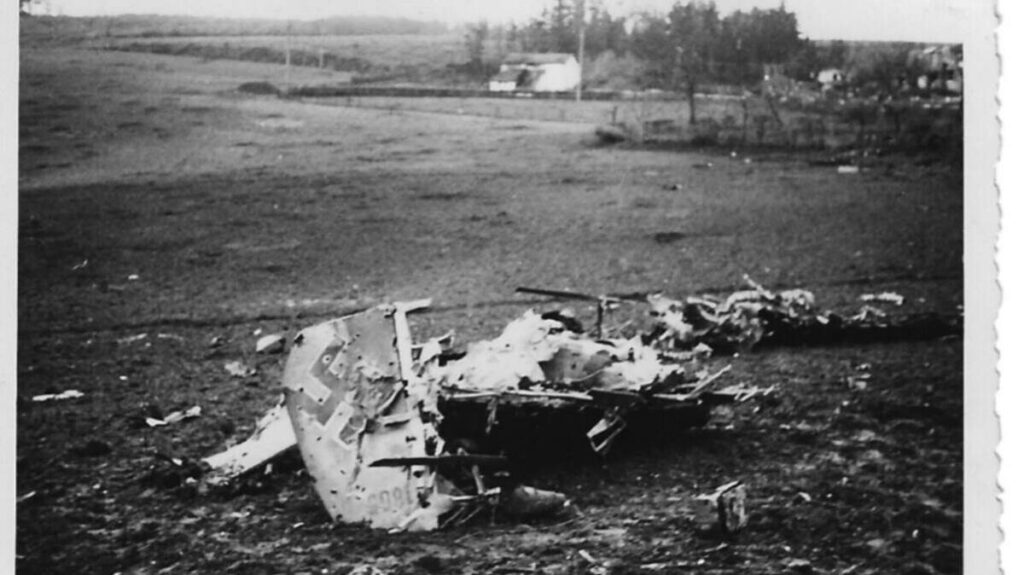
At the end of the Second World War, Luxembourg is littered with the wreckage of military vehicles and aeroplanes. One of them lies on the roadside of the N15 between Pommerloch and Bohey near the Belgian border in Luxembourg’s north-west. Like many other wrecks, it serves as a photo backdrop for families.
Over 50 years later, in the late 1990s, the Luxembourg adjutant major and amateur historian John Derneden came across pictures of the aircraft remains for the first time and identified them as parts of a German Messerschmitt Bf-110, a so-called night fighter.
Adjutant-Major John Derneden has been researching aircraft crashes and emergency landings on Luxembourg soil during the war for three decades © Photo credit: Marc Wilwert/LW-Archiv
On a picture of the right vertical stabiliser, part of the serial number can still be read next to a swastika. It begins with the digits 1805, leading Derneden to suspect that it was a plane with the serial number 180575, which was reported as crashed on New Year’s Eve in 1944.
However, Derneden cannot identify the aircraft without a doubt as another German night fighter crashed just 5.5km away from the site near Tarchamps – and its serial number also begins with the digits 1805.
The factory number is clearly visible on the vertical stabiliser of a Bf-110, which the two children present in front of the destroyed church in Roullingen, near Wiltz © Photo credit: Frank Rockenbrod
Decisive clue after 26 years
In 2004, Derneden received a photo showing two boys standing in front of the bombed church in Roullingen, near Wiltz. Between them they are holding the vertical stabiliser of a Messerschmitt Bf-110, and this time the entire serial number is clearly legible: it is 180575.
However, as far as he knows, no aircraft had crashed near Roullingen. So did this vertical stabiliser belong to the Pommerloch night fighter?
“A little later, I received another photo, which again shows the same left vertical stabiliser,” Derneden said in a written account of his historical sleuthing. He believes it is likely that the tail unit was taken from the Pommerloch crash site – after all, it is made of aluminium and is therefore relatively light.
However, it was not until February 2025 that he held the photo that was crucial for identification in his hands. It was taken in 1946 and shows a family posing by the wreckage of the aircraft in Pommerloch. The plane’s serial number is 180575, as Derneden had suspected.
The Marx family posing at the aircraft wreckage in Pommerloch in 1946. The photo is of particular importance to Derneden, because this time the entire serial number can be recognised on the aircraft © Photo credit: Aloyse Marx
The identity of a corpse
The wreckage belongs to one of the aircraft from Night Fighter Wing 6, which was mainly deployed over Belgium and France on 31 December 1944. “The squadron carried out night fighter missions there, focussing on Bastogne and against railway targets,” wrote Derneden. “In total, four Messerschmitt Bf 110s, seven Junkers Ju 88s and one Heinkel He 219 A […] failed to return in an attempt to intercept Allied bomber formations.”
According to Derneden’s research, one of the aircraft that did not return was the Pommerloch plane. “The pilot was Lt. Günther Richter and did not return on 31 December 1944 after the enemy flight to the Bastogne area,” writes Derneden.
He was the only one of the three crew members to fail the parachute jump, as evidenced by a picture of his badly mutilated body.
Historical reappraisal
Derneden is interested in reassessing history, he said in an interview with the Luxemburger Wort. He has published three books about planes shot down over Luxembourg during WW2.
“A lot was written after the war, but only from an American perspective,” he said. However, it is also important to look at the reports from the other side. For example, German tank crews were sometimes wrongly labelled as SS troops because their uniforms were similar, and German paratroopers were mistaken for Americans because of their different uniforms.
“For some eyewitnesses who didn’t know the whole background, a lot of things got mixed up,” said Derneden. For example, a man once told him that German soldiers had poured petrol on the facades in Ettelbrück before Christmas 1944 and set fire to them. In the meantime, however, it has become clear: “It was the Americans who wanted the Germans out of Ettelbrück and bombed them with incendiary bombs, similar to napalm at the time.”
Wreckage of the Messerschmitt Bf-110, front left engine with part of the propeller © Photo credit: From the collection of Fritz Rasque
A family photo with a sad background
Derneden also has another, more fundamental motivation. “I am driven by the phrase ‘give the body a name’.” Derneden has been identifying aircraft wrecks throughout Luxembourg for the Patton Museum in Ettelbrück for around 44 years – regardless of their nationality.
Decades ago, Derneden and former museum employee Marcel Chevallier – who died in 2013 – visited a farmer together. The farmer had found the papers of a German soldier after the war in an assault gun that had been left behind.
Flying, yes, always! But war, no, never again!
Josef Rickling
German soldier in World War 2
The documents included a driving licence and military service pass as well as family photos showing the soldier with his wife and child.
The former Nazi soldier was still alive at the time “and Marcel Chevallier drove to the man by car to give him back his papers and photos,” Derneden recalled. At the meeting, it turned out that the man’s wife and child had been killed in a bombing raid while he was at war – and that he no longer had any photos of them. Holding the pictures in his hands again after decades was an emotional moment.
Contact with German soldiers
Derneden was also occasionally able to make contact with former Nazi soldiers who were still alive, such as Josef Rickling.
Rickling had been an enthusiastic glider pilot in his youth and therefore decided to serve in the Luftwaffe. He had to make an emergency landing on 23 December 1944 after his plane was shot down in aerial combat over Luxembourg. He was not seriously injured and was able to spend Christmas Day with his family. Afterwards, however, he did not return to the war due to illness.
In an article about Rickling’s fate, Derneden quotes from a letter written by the former airman in 2005: “I’m still ashamed today that I met British airmen who had been shot down and were sitting wounded on the ground in the field hospital in Bitburg and looked at them with indifference and rejection, instead of realising that they had suffered the same fate as me, who had just got off lightly. So once again: Flying, yes, always! But war, no, never again!”
This picture of a field grave was in photos of Bf 110. The Berlé hill can be recognised in the background © Photo credit: From the collection of Fritz Rasque
In the case of Lieutenant Günther Richter, who fell to his death on 31 December 1944, Derneden was able to locate a suspected grave. He discovered a field grave in a garden in an old picture. “You can see the Berlé hill in the background on the right and it is highly likely that the pilot’s remains were buried here,” wrote Derneden.
After the war, the field grave was moved to the military cemetery in Sandweiler by the German burial service. Officially, however, “Lieutenant Günther Richter is still reported missing today,” Derneden said.
Also read:80 years on, George Patton remains a figure of triumph and contradiction
(This story was first published in the Luxemburger Wort. Translated using AI, edited by Cordula Schnuer.)