

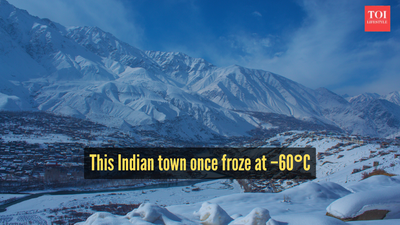
It seems almost unbelievable at first glance. While India is mostly known for scorching summers and tropical beaches, there’s a place where temperatures drop well below freezing. Currently, it’s freezing at around –17°C, and survival here is an act of sheer endurance. This place is Dras, often described as one of the coldest inhabited regions in the world, and undoubtedly the coldest in India.The town, also spelled Drass and officially recognised as Drass by the government, is located in the Kargil district of the Ladakh union territory. Locally, it is called Himababs, Hembabs, or Humas, names derived from its ancient title Hem-babs, meaning ‘snow land.’ The word hem literally means snow, aptly fitting for a region ruled by winter for most of the year.Dras lies along NH 1, between Zoji La and Kargil, earning the moniker ‘Gateway to Ladakh.’ Sitting at an elevation of roughly 10,800 ft (3,300 m), this place is aroud 63 km from Sonmarg, and 58 km from Kargil, making it a vital stopover during the brief summer months.Winters in Dras are more than just cold, they’re more than extreme. It makes for a harsh environment, with average winter temperatures around -20°C, pushing the limits of human endurance. At such high altitudes, thin air prevents the body from retaining warmth, while freezing winds drain heat almost instantly. Experts note that these extreme conditions keep the human body under constant strain, turning even the simplest daily actions into feats of endurance.Dras owes its bitter cold to geography. Surrounded by towering mountains, it remains cut off from warm air masses. Meteorologists explain that these natural barriers trap dense, cold air within the basin, keeping temperatures low for months on end. This isolation, as a result, effectively turns Dras into a natural cold trap every winter.Interesting to note is that its reputation for freezing cold gained global attention in 1995, when temperatures here reportedly dropped to –60°C. Such readings are exceptionally rare outside polar zones, placing Dras on par with Siberia’s frostiest settlements.In the case of heavy snowfall, life becomes even harder. Roads remain blocked for several weeks or months, disconnecting Dras from the remaining area of Ladakh. The people get prepared in advance by stocking up food, fuel, and other essential commodities, knowing well the possibility of not getting any supplies from outside for several months.Summer brings a brief transformation. In the months of June and August, the climate becomes warm with the opening of roads and the ease of traveling. In this brief period, Dras transforms from the frozen fortress appearance to the picturesque hill station for the trekkers and tourists as they trek through the high altitude routes. In the time frame of a few months, the valley experiences the beauty turn before the onset of winter.Homes in Dras are built for survival, not style. Made from stone and mud, they’re designed to retain heat and withstand nights colder than industrial freezers. The local diet, too, is purely functional, hearty, warm, and high in calories, to help fight constant heat loss.Strategically, Dras holds immense importance. Its rugged terrain and punishing weather played a vital role during the 1999 Kargil conflict, proving that sometimes, the cold itself can be as powerful a force as any weapon.In Dras, winter isn’t just a season, it’s a way of life, redefining what it means to endure.