
Review by Sasho Ognenovski
Theatre art has always needed thematic unification, and a showcase of this kind is one of the ways to open the door to theatre productions that are united under a common theme or coming from a single institution. The Sarajevo Theatre Showcase is an enormous theatrical initiative that not only recognizes the presentation of independent theatre from the region, but also opens up other segments of theatre management and theatre writing as well as theatre criticism. This showcase carries within it the breadth of theatre-making where the theatre performance as an artistic act is not the only thing theatre can offer.
This showcase made great efforts to respond to crucial questions relating to theatre as a synthetic art: where, when, why, and for whom? These seemingly dangerous questions position the theatrical act within a region. They also recognize not only the actors and directors but also producers, critics, and managers. In my opinion, this massive showcase is specific precisely because of these aspects. Its comprehensiveness points not only to theatrical reflections in the region of the former Yugoslavia but also to what reorganizing, rereading, and further positioning of theatrical art means, something especially important for independent productions which are often left to drift on the winds of self-reliance and self-presentation.
For three days, the Sarajevo Showcase (in addition to performances) offered six different programmes: the Theatre Market, a platform curated for theatre projects presented in front of the relevant representatives of the theatre world; the Residency Programme in which young theatre artists from across the region (directors, playwrights, critics) were selected and given the opportunity, during their five-day stay in Sarajevo, to expand their network of interests and develop their reflections in the field of theatre art as well as to present their concepts, ideas, and thoughts; the Atelier Programme, an interesting initiative for young playwrights who, working on their new texts under the mentorship of renowned playwrights such as Biljana Srbljanović and Ivor Martinić, developed their craft.
The Theatre Conversations initiative opened possibilities for developing contacts within existing theatre networks and took place on 13 and 14 September, moderated by significant theatre thinkers such as Ivana Vuković and Åsa Richardsdottir. At the same time, we also saw the Green Laboratory, an interesting programme which, in a conference-like format, brought together theatre thinkers to speak about the essences of contemporary theatre, production practices and audience development. There was also the Industry Presentation which was of particular importance for theatre producers who presented their future projects to theatre professionals from Europe and the rest of the world with a special focus on contemporary social and cultural challenges.
Together with the theatre performances, these programmes pointed to the complexity of producing theatre in a region still moving through transitional waters where both challenges and motivations continue to have their roots in past traumas.
The Sarajevo showcase also offered six interesting theatre projects. These included Suicide as a Social Fact, conceptualized and directed by Ana Janković, performed by Iva Ilinčić and produced by BITEF Theatre from Belgrade, Serbia. It is a play that confronts us with two theatrical expressions: minimalism and cabaret theatre. It explores a social abyss and intimate negligence, where suicide, as the final consequence, opens a reconsideration of life philosophy, glazed with irony that truly makes us reflect: no matter how hard we try to remain cynical about our losses, their impact on the disintegration of our personality is immense.

Suicide as a Social Fact.
Photo credit: Nata Korenovskaia, Nenad Šugić.
Machine was an intriguing theatrical reflection that united two diametrically opposed theatrical forms in a single performance. The piece was directed, choreographed and performed by Bojana Robinson and produced by Institute 0.1 from Ljubljana, Slovenia. It is a monodrama attempting to visualize the relationship between human and machine;
Hinkemann”, a theatre project from the independent theatre group “Golden Yeletz” from Skopje, North Macedonia, is a thrilling dramatic performance based on Ernst Toller’s play. It uses circus elements and post-dramatic expression to tell the story of a man torn by war who tries to reenter the flow of his life.
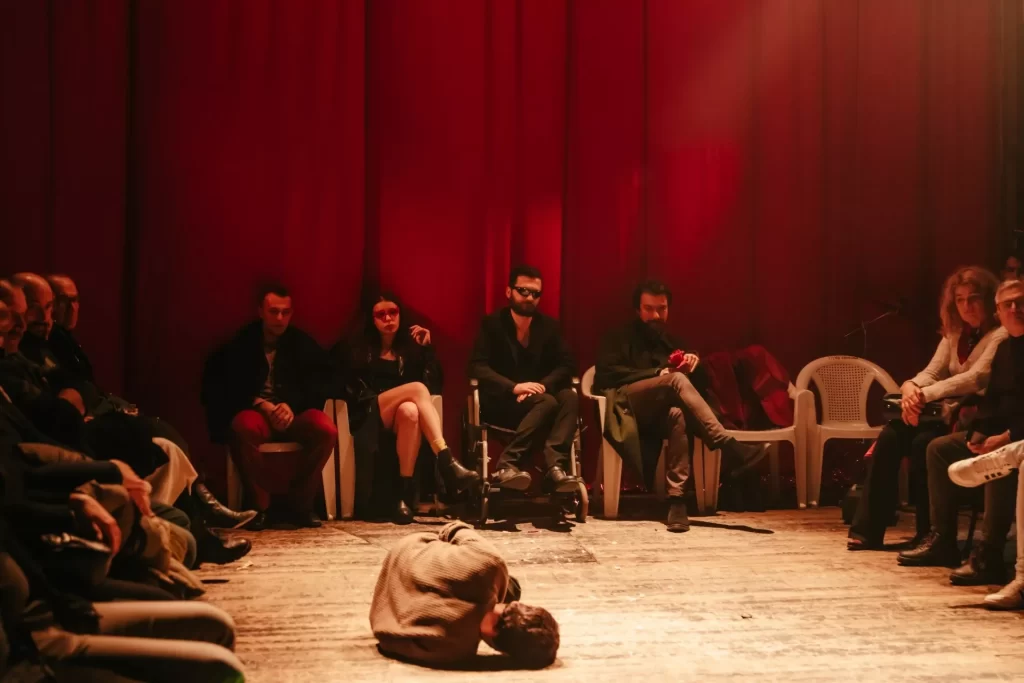
Hinkeman.
Photo credit: Josif Trajkoski.
This Is My Truth, Tell Me Yours, is a stand-up-style monodrama by Jasna Žmak, produced by the Centre for Dramatic Arts Via Negativa, City of Women from Croatia and Slovenia. It is a performance that won the Grand Prix at last year’s BITEF. The work speaks about the articulation of sexual experience in a pleasantly humorous (and ironic) manner, a piece of theatre that may be categorized as a storytelling genre with a slight layering of reflections on inconsistency and indecision.
The Basement (Podroom), was a bold production based on a text by Armin Behrem, directed by Ajla Bešlić and produced by the Sarajevo War Theatre and Realstage from Bosnia and Herzegovina, a play that opens the question of intimate ambivalence where homosexuality and bisexuality appear as phenomena placed under the veil of incomprehensibility within conservative and patriarchal environments.
The production Prishtina. A Premeditated Murder of the Dream, directed by Blerta Neziraj and produced by the Multimedia Centre from Prishtina, Kosovo, was a performance about Rexhep Luci, an architect and one of the fathers of modern Prishtina and modern urban Kosovo, a man who paid with his life for raising his voice against the urban mafia. It is a storytelling theatre piece that speaks openly about the never eradicated corruption in these regions.
The Sarajevo Theatre Showcase demonstrated that independent theatre is of immense importance for the theatrical thinking of these spaces. The six performances that addressed topical regional issues, alongside the six programmes that opened the doors to meaningful networking among theatre artists, made this showcase—already with its first edition—an event of significance for both artists and theatre practitioners.
Institutional theatre has a completely different mode of organization which, in many cases, offers the audience a conventional backdrop, while independent theatre, using its contemporaneous flexibility, becomes the voice of everything that represents deep social, societal, and political problems within the state.
Heartefact, as the organizer of this showcase, revealed the space in which independent theatre can be relevant on multiple levels and become a strong competitor or adjunct to institutional theatre. The networking of artists and the development of all elements of theatre art is a sign of a theatrical era that is yet to come, one that will show artistry, courage and even a spirit of rebellion.