
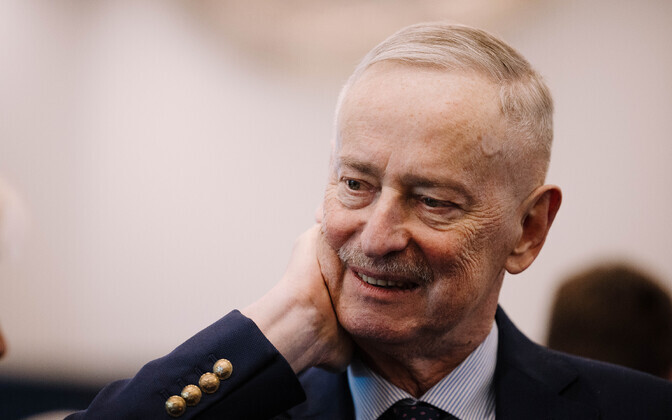
Former European Commission Vice President Siim Kallas said that although relations between the United States and Europe are complicated, it cannot be said that the U.S. is no longer an ally for us.
Kallas commented to ERR on U.S. military intervention in Venezuela, saying that violations of international law are very serious. “We are currently in a time when everyone is thinking about the global order and the security architecture. What was built after the war and affirmed when Estonia regained its independence created a sense of international security, which today is weaker. The breakdown of that international sense of security is a problem no matter how you look at it,” Kallas said.
According to Kallas, the question now is what will happen next in Venezuela. He recalled the U.S. occupation of Iraq in 2003.
“Of course, there’s also the fact that Venezuela is smaller than Iraq. But it has vast forests and in those forests there are all kinds of groups hiding out, armed with plenty of weapons. Will all of this be accepted peacefully? In Iraq, it was harder in the sense that the Islamic world rose up against the United States. It’s hard to say who in Latin America will come to the defense of Maduro and Venezuela. In any case, the question is how the situation will be handled if Trump says he has no intention of sending in ground troops. How will he ensure control over Venezuela or how will Venezuela be transformed into the kind of country the United States wants it to be?” Kallas pondered.
US looking to affirm hegemon role
According to Kallas, the U.S. wants to use its intervention to reinforce its role as a global hegemon.
“Now that it has carried out a military operation, the follow-up questions begin. It needs to cement and legitimize this achievement,” Kallas said.
“In order to gain that legitimacy, the first question is what your own society says. So far, Americans haven’t reacted strongly. The second important question is about allies. How do the United States’ allies respond? To be a global hegemon, you need a broad network of allies. And allies may have very different reactions. We ourselves are wondering whether this worsens our own security situation or not.”
Kallas noted that since Americans have treated the European Union rather dismissively, it would be hard to say today that the EU is an unconditional ally of the United States.
“But then, who else in the Western sphere would be such a powerful and strong ally for the U.S.? The big question is whether actions like this risk isolating it from its allies. The invasion of Iraq, after all, was carried out only after the UN Security Council had made a decision — although in hindsight not everyone takes that decision seriously, it did happen,” Kallas said.
Concern for international law
Speaking about Estonia’s position on U.S. military intervention in Venezuela, Kallas said it largely aligns with that of other European countries, which are concerned about the implications for international law.
“As former prosecutor [Andres] Parmas wrote: when international law is abandoned, it might not seem important at first, but before long, it could become very important. Respecting agreements is a security guarantee that unexpected things won’t happen. In my view, Estonia’s stance has been quite similar to that of Europe overall. No one is mourning Maduro’s departure, but for everyone the big question is: what comes next? It’s one thing to be an outside observer and quite another to be a decision-maker. A decision-maker always has to consider that if you make decision A, you need to know what you’re going to do with B, C, D and F. That’s something every decision-maker in the world has to think about,” Kallas said.
Kallas also raised concerns about how U.S. actions might affect China’s possible plans. “What will China do now? Taiwan? Will America now go and defend Taiwan? By the way, in his New Year’s address, Chinese President Xi said that reunifying Taiwan is on the agenda for this year. What can you say to that? Estonia doesn’t play a role in this big game — we only participate together with others. And with whom? With Europe, of course. That seems to be the prevailing attitude right now.”
The matter of allied relations
ERR asked Kallas whether Estonia should, in this situation, align more closely with Europe or try to maintain its relationship with the United States, especially given that some commentators have suggested the U.S. can no longer be considered an ally to Estonia or Europe.
“Officially, no one is saying that. The Americans are a force and a power in the world — it would be very foolish to shun or ignore them. It was the same issue during my time in office: I emphasized in a speech in Tartu that we inevitably need the United States as our primary security guarantor. Some people in Estonia took issue with that,” Kallas said.
“We must absolutely maintain those relationships. Of course, it’s important that we are members of the European Union. But even for Europe, the United States remains the most important and necessary ally. It’s unthinkable that if we fall out with America, we would then try to make deals with China,” he added.
—