
The confrontation between Armenia’s political leadership and the
Armenian Apostolic Church has moved from quiet tension to open
conflict at a highly sensitive moment. As elections approach, the
dispute has taken on a political dimension that extends far beyond
questions of religious reform. It now touches on state authority,
national identity, and the limits of power in a system that is
undergoing rapid transformation.
The government’s actions toward the church, the opposition, and
key electoral mechanisms point to a broader attempt to redefine the
rules of political competition. What is unfolding is not merely a
conflict between personalities, but a contest over who controls the
pillars of influence in Armenian society, the state, the church,
and the electorate.
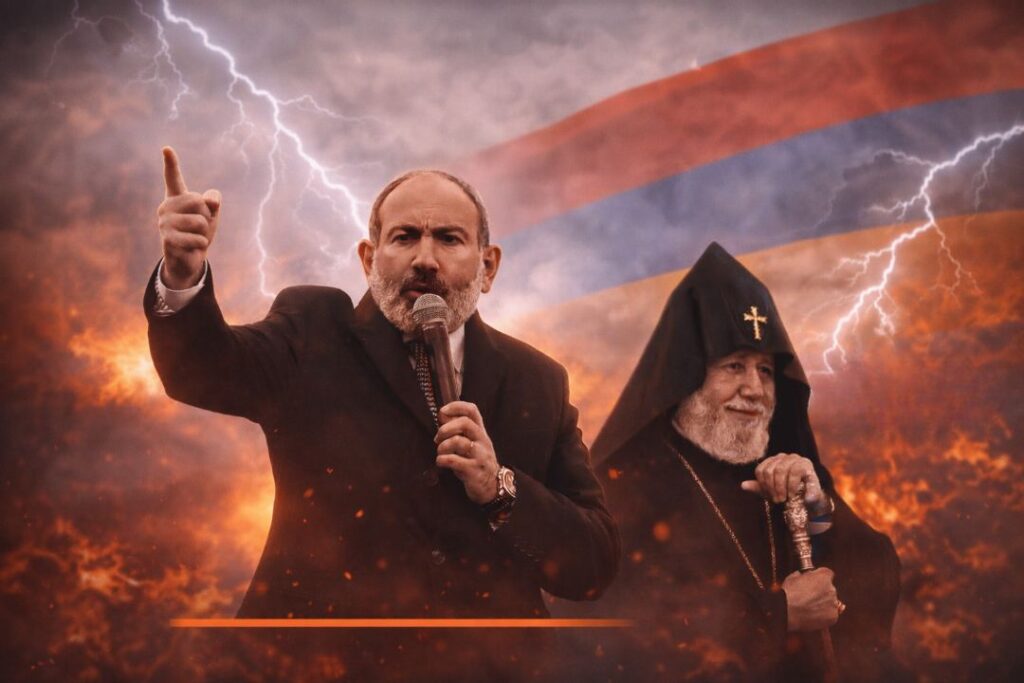
Two powerful camps are increasingly defining the battlefield: on
one side, the architects of a so-called “new Armenia,” rallied
around Prime Minister Nikol Pashinyan; on the other, the
traditional pillars of Armenian political life, where the church
occupies a central, if increasingly contested, role. The
confrontation between these forces is not incidental. It is
structural, deliberate, and unfolding at a moment when
institutional trust is already fragile.
Pashinyan’s strategy appears increasingly focused on pre-emptive
control. His aim is not merely to win elections, but to enter them
with as few unpredictable variables as possible. This logic
explains his parallel moves against political opponents and
institutional rivals. The Homeland Party and its leader, Artur
Vanetsyan, remain a key concern in this context. By tightening
pressure during local elections and keeping Vanetsyan under
constant political and legal scrutiny, Pashinyan is effectively
neutralizing a figure who could otherwise consolidate
anti-government sentiment within the security-minded and
pro-Russian segments of society.
The issue, however, goes beyond ordinary political rivalry.
Allegations that investigations into electoral irregularities are
being selectively funded or facilitated by the ruling camp raise
uncomfortable questions about process integrity. Armenia has seen
this pattern before: revelations of fraud, followed by promises of
reform, followed by new investigations that conveniently reshape
the political field ahead of major votes. Each cycle reinforces
instability rather than resolving it.
Vanetsyan, for his part, has chosen a sharply ideological line
of attack. He openly challenges Armenia’s growing alignment with
the European Union, portraying it as a strategic illusion, while
presenting Russia and the CSTO as Armenia’s only reliable security
anchors. This narrative resonates with constituencies unsettled by
regional uncertainty and skeptical of Western guarantees. Yet, its
effectiveness depends heavily on whether these voices can organize
in an environment where political space is narrowing.
The most explosive front, however, lies elsewhere, within the
Armenian Apostolic Church. The government’s adoption of a
declaration outlining a roadmap for church “reforms,” including the
removal of Catholicos Karekin II, marks an unprecedented
escalation. Formally, the document speaks the language of
transparency, accountability, and institutional renewal.
Politically, it signals the prime minister’s intention to resolve
the church question before the elections, and at almost any
cost.
Reports in Armenian media suggest that Pashinyan is prepared to
apply administrative and security pressure to achieve this outcome
swiftly. The involvement of bishops who oppose the Catholicos, the
alleged monitoring of church services by security agencies, and
instructions to exclude Karekin II’s name from liturgy all point to
a direct state intrusion into ecclesiastical life. Critics argue
this violates the constitutional separation of church and state;
supporters counter that the church itself has long overstepped its
moral and political boundaries.
Here lies the paradox. The church is not acting as a unified
opposition force. Parts of it tacitly accommodate Pashinyan, while
other segments maintain informal links with revanchist and
separatist circles. This dual role is rooted in historical
precedent. During the conflict over Garabagh, elements within the
Armenian Apostolic Church were actively involved in nationalist
mobilization, blessing armed detachments and legitimizing
separatist claims. Such actions not only heightened the threat to
Azerbaijan but also contributed to internal instability within
Armenia itself, leaving a legacy of politicized faith that
continues to shape today’s church–state tensions.
This role weakens its moral authority and turns it into a
contested political instrument rather than a unifying institution.
In this sense, the conflict is not simply about faith or tradition,
is about control over narratives of identity, defeat, and future
direction.
Crucially, this trajectory did not serve Armenia’s long-term
interests. By embedding the church in a project of armed
separatism, spiritual authority became tied to military outcomes.
When those outcomes collapsed, so did much of the church’s moral
standing. Today’s erosion of trust is therefore not accidental; it
is the delayed cost of politicizing faith in the service of
conflict.
Supporters of the prime minister insist that society stands
firmly behind him, at least for now. They argue that Karekin II’s
alleged misconduct has eroded his legitimacy beyond repair and that
the public wants a “cleansing” of the Holy See. If this assessment
holds, Pashinyan’s calculation is clear: breaking the church’s
resistance now will deepen public apathy, demoralize the
opposition, and lower the political cost of re-election.
Externally, this internal struggle intersects with Armenia’s
geopolitical recalibration. The first half of 2026 is expected to
bring intensified Armenia–EU contacts, with visa liberalization
emerging as a key mobilizing promise ahead of the parliamentary
elections. A symbolic or practical breakthrough with Brussels in
late spring could provide Pashinyan with a powerful narrative of
progress. At the same time, both Yerevan and Moscow appear inclined
to keep relations on cautious autopilot until at least spring 2026,
avoiding sharp escalations while the domestic picture settles.
Taken together, these dynamics reveal a familiar Armenian
pattern: elections shaped less by policy debates than by controlled
confrontations, managed crises, and institutional pressure. The
church–state clash, the sidelining of opposition figures, and
recurring investigations into electoral conduct all point to a
system where political stability is pursued through dominance
rather than consensus.
Whether this approach secures long-term legitimacy is another
matter. What is clear is that Armenia is entering the next
elections not merely divided between parties, but fractured between
visions of identity, authority, and alignment. And in that
fractured space, the altar and the ballot have become inseparably
intertwined.