
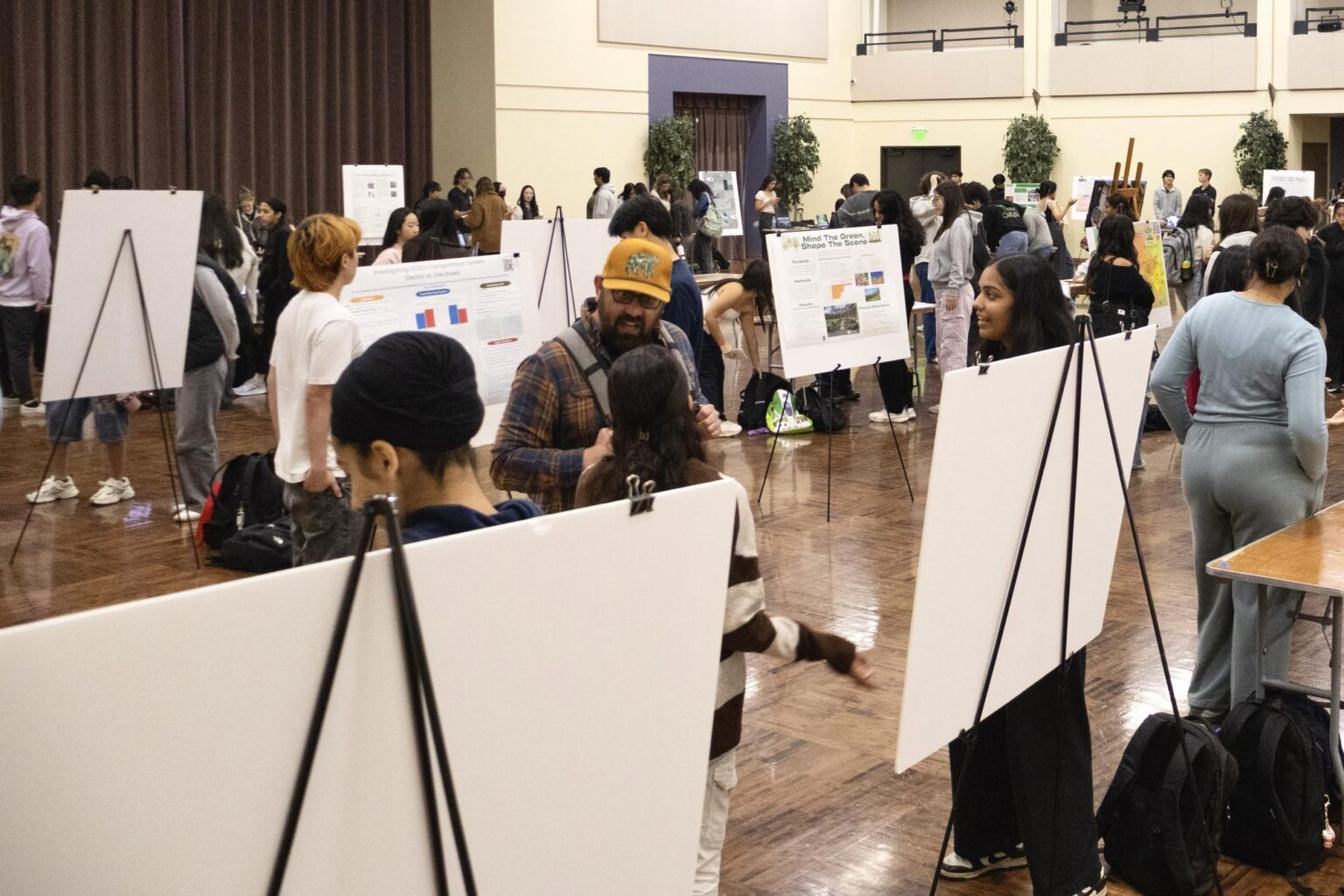
Each quarter, students in Seventh College’s Synthesis 100 class showcase their research projects at the college’s “SYNposium” event, always centering around the college’s theme: “A Changing Planet.” I attended this Fall’s SYNposium event at Price Center Ballroom West to get a deeper look into these students’ projects and passions.
Each section of SYN 100, the final course in Seventh College’s core academic program, focuses on a different climate-related theme, with an emphasis on collaboration and solutions. Unlike many UC San Diego college writing courses, where assignments remain theoretical and confined to the classroom, SYN 100 and the SYNposium event gives students a rare opportunity to share their ideas with a wider audience.
Throughout the two-hour event, over 100 teams answered questions about their projects, discussed ideas, and presented their work to students, staff, faculty, and alumni. Event coordinators invite UCSD community members in related fields to fully realize the real-world impact of the students’ contributions to the ongoing climate crisis conversation.
“The goals of the event are to provide students with the chance to present their work to a real audience beyond their class, learn from peers, and to build the Synthesis community,” said Chloe Thomas, Synthesis events and digital communications coordinator. “The amount of research and possible solutions to climate challenges presented is truly incredible to see all in one space.”
As I circled the room, I stopped to chat with students Aina Huang, Joselyn Li, Minsui Tang, Natalie Cho, Ryan Kuoch, and Shivika Sinha. They introduced me to their project, titled “Museum of Harmony: Healing Yesterday, Connecting Tomorrow,” which explores how art, media, and storytelling can help people imagine more hopeful and harmonious futures.
“We hope to establish connections and mend fractures among humans, the natural environment, and technology,” Tang said.
A virtual museum exhibition, this project shows how Solarpunk art and media can help build unity and understanding for a sustainable future. Solarpunk, they explained, refers to the aesthetic and perspective of a world with clean technology that works in harmony with the natural environment.
Their exhibit included a digital flipbook titled “The Solar Bridge,” which envisions a solar-powered bridge that lights up in various colors in response to human emotions and community interaction. The purpose of this idea is to promote climate-friendly innovation that works to bring communities together — much like the bridge, which glows brighter when its surrounding community spends time together. To bring this concept to life, the team drew the bridge on a poster board, including empty squares to allow attendees to express their feelings by filling in a spot with colors of their choosing — red for anger, blue for sadness, gold for joy, and green for peace.
“I personally enjoyed this experience; it’s definitely something new,” Tang said. “It’s rare to see so much interaction between classmates, and I had the opportunity to get closer to my group mates, which I’m really thankful for.”
Just across from the Museum of Harmony, students Autumn Fischer, Hannah Lam, Isaac Hernandez, Sahej Tiwana used their project to propose solutions for the textile waste produced by fast fashion. Titled “Applique in Action,” the team’s project hosted an upcycling workshop to mend and repurpose clothes students already had by “encouraging UCSD students to use fabric they already have to mend clothes they already have, instead of throwing them away,” Fischer said.
Brianna Nguyen and Maureen Chowdhury’s project, titled “Winds of Change,” aimed to raise awareness about specific communities affected by the fast-fashion industry. The team created a kite made of fabric scraps and materials found in their own homes and in the UCSD Makerspace.
“It was a nice opportunity to be able to explore my creative side and work on a project that I would have never worked on without being in this class and Synthesis program,” Chowdhury said.
Nguyen explained that they divided the surface of the kite into four different regions representing areas of Oaxaca, Mexico; Vietnam; Bangladesh; and Ghana, where the consequences of fast fashion are most prominent.
Just a couple of steps from this kite was the project “Mapping AI,” created by students Angelina Mai, Fiona Shaw, Sarah Sun, and Serim Jang, which focused on the environmental impact of data centers. For them, what began as an effort to raise awareness about data center resource usage evolved into a critique of the lack of transparency tech companies provide regarding their environmental impact.
“Our original goal was to create a map that showed resource usage such as freshwater use, electricity use, and CO2 emissions by data centers with a focus on AI data centers,” Shaw said. “But during research, we realized that data centers do not publicly distinguish which are AI and which are not, and there also isn’t any data for how many resources data centers consume — because there aren’t currently any regulations for whether or not data centers have to report their resource usage.”
The team created a fabric map of California in applique that displayed grouped locations of data centers’ electricity usage by county, and a magnified visual detail that zooms in on the noise pollution generated around data centers.
Every team I spoke to conveyed their shared purpose to fight the climate crisis, and attendees actively engaged with the students in conversation and reflected on the projects’ broader implications for the future of sustainable innovation.
“It’s really cool to be able to share our findings and frustrations about something so relevant that affects all of us,” Shaw said. “To me, it means being part of a fulfilling learning and teaching environment — where everyone is interested in making a change for the world and learning more about the environment together.”