
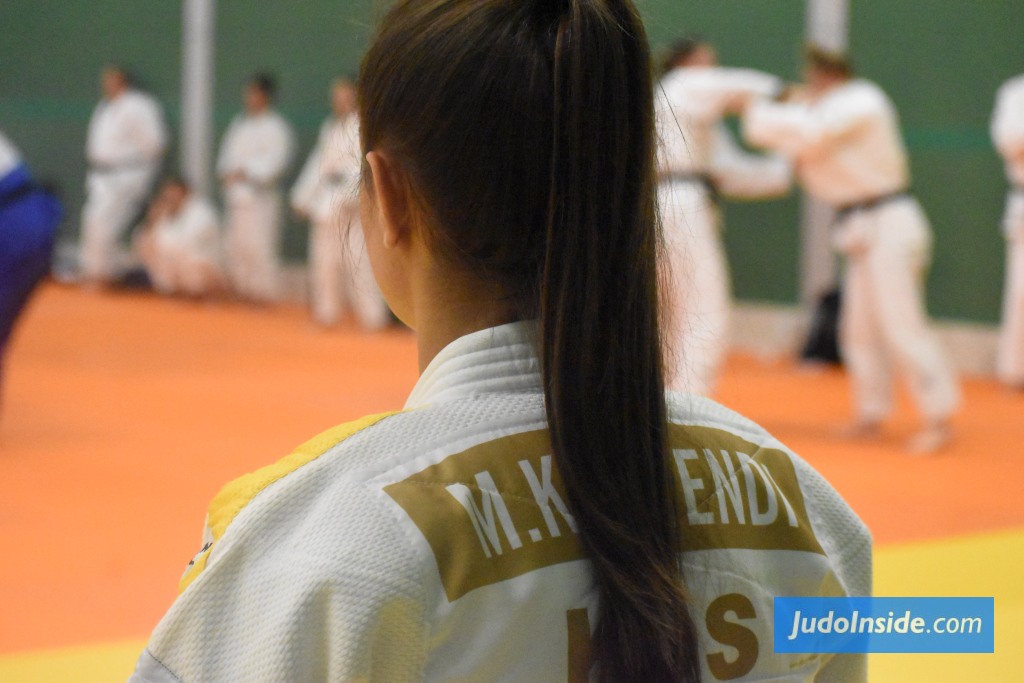
Kosovo is a tiny nation of about 1.8 million people but yet is has produced three Olympic Champions, which is a remarkable story matched only by Slovenia, another small country of about 2.1 million people which has also produced three Olympic champions.
Kelmendi
Kosovo’s ascendancy as a judo powerhouse began with Majlinda Kelmendi, who was the first Kosovo player to break through at the international level. Kelmendi’s first big success was actually her first IJF World Tour event, the 2010 Tunis Grand Prix where she won a gold medal. She would eventually go on to get a whopping 18 IJF World Tour gold medals by the time she retired.
At the European Championships, Kelmendi managed to get a bronze in 2013 and was able to secure a gold the following year, in 2014. She would go on to get three more European golds.
Kelmendi became World Champion in 2013 and in 2014. This was the period when she was at her peak. But in 2015 she sustained several injuries and only returned to competition in September that year in the Bratislava European Cup, which she won. She suffered a rare defeat in the Abu Dhabi Grand Slam in November, to Erika Miranda (BRA).
Kelmendi’s first Olympics was in 2012 where she represented Albania. It was a disaster. She lost her second-round match against Christianne Legentil of Mauritius, who countered her for ippon. But by 2016, there was no stopping her from getting the Olympic gold, although her semifinal match against triple World Champion Misato Nakamura was a really close one.
Gjakova
Nora Gjakova, who is a year younger than Kelmendi, had her first big success in 2012 at the Abu Dhabi Grand Slam where she got a bronze. It wouldn’t be until 2017 though before she got her first IJF World Tour gold. She would go on to win a total of eight IJF golds.
At the Europeans, she got bronze in 2015 and by 2018, was the European Champion.
In 2021, Gjakova peaked at just the right time. In the run-up to the Olympics, she got a bronze in the IJF World Masters in January, a bronze in the Europeans in April, and a bronze in the World Championships in June. But just the very next month, she shined at the Olympics and won gold.
Krasniqi
Distria Krasniqi is the youngest of the three and is the only one still competing (Gjakova recently announced her retirement). While Kelmendi got her first IJF World Tour medal in 2010 and Gjakova in 2012, Krasniqi got her first, a bronze medal, in 2014 at the Dusseldorf Grand Prix. She would get her first IJF gold the following year, in 2015, and would go on to eventually bag 17 IJF gold medals. Given that she is still competing, it is likely she will surpass Kelmendi’s 18 golds.
For the Europeans, she got her first medal (a silver) in 2018. Kelmendi got a European bronze in 2013 while Gjakova also got a European bronze in 2015. Krasniqi would eventually win three European golds. Unlike Kelmendi, she has never won a World title but has two World bronzes (the first in 2019, then in 2022) and a silver (in 2025).
At the Olympics, Krasniqi has surpassed both Kelmendi and Gjakova in that she has an Olympic gold (-48kg at Tokyo 2021) and a silver (-52kg at Paris 2024). She is currently ranked No. 1 in the IJF World Ranking and is expected to be one of the top prospects for the 2028 LA Games.