
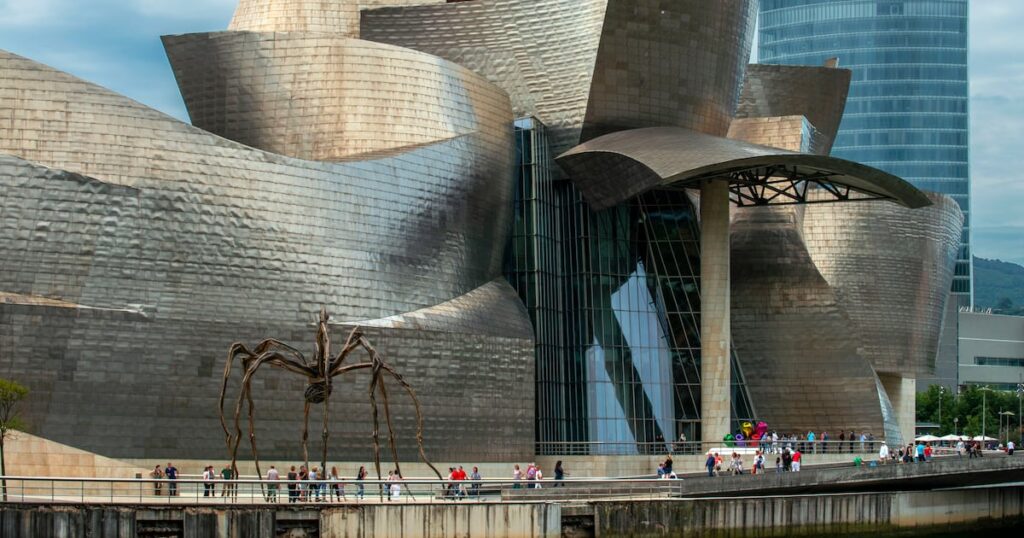
Frank Gehry’s death a month ago marks the end of a career that changed the course of contemporary architecture. Even if you don’t know his name, you will know his buildings: the shimmering Guggenheim Museum in Bilbao that revived an entire city; the Walt Disney Concert Hall in Los Angeles, with its sweeping steel and science fiction curves; the Louis Vuitton Foundation in Paris, a collection of floating shards of glass.
Gehry was the architect who made buildings bend, twist and shimmer in ways that had previously never existed in real life.
What set him apart was not just the clear aesthetic of his work but the mindset behind it. Gehry designed from the deep insides of human instinct, with curiosity, risk, asymmetry and a willingness to be disliked. His buildings refused to apologise for their own presence. Whether one loved or hated them, Gehry forced a confrontation with the idea that architecture is never neutral. Buildings are not just shelters or containers of use; they are arguments about who we are, what we value, and how boldly we imagine a future.
Gehry’s genius was his fearlessness, and with it, accountability. If a building was going to dominate a skyline, it should earn its place there – not through efficiency metrics or planning-approval gymnastics, but through emotional, cultural and civic meaning.
In Ireland, where architecture has long been a modest, landscape-attuned craft, Gehry’s philosophy arrived as both a provocation and an opportunity. It was largely refused. Ireland’s modern architectural culture has historically been wary of such provocation. The country’s great contemporary buildings, from Liam McCormick’s churches to O’Donnell + Tuomey’s civic work, draw their power from intimacy, material honesty and an almost ethical restraint. They hold themselves close to the ground, sitting in contrast to the older architectural inheritance of cathedrals, castles and Georgian grandeur. Ireland in the modern era has preferred quietness to assertion.
[ Frank Gehry: ‘I’m just free to build, now I don’t have to worry about fees’Opens in new window ]
That is not to say Ireland is incapable of ambition. The Giant’s Causeway Visitor Centre, with its basalt geometry folded into landscape, showed that a building on this island could be both daring and deeply rooted. Daniel Libeskind’s Bord Gáis Energy Theatre, angular and crystalline, briefly suggested that Dublin might embrace architectural volume. Even the Criminal Courts of Justice, austere and monumental, demonstrated a willingness to let public architecture carry symbolic weight.
But when the “Bilbao effect” swept through Europe after 1997 – the idea that a single, daring cultural building could revive an entire city – Irish critics debated it with fascination and suspicion. Gehry’s Guggenheim was the catalyst for this belief: a museum so striking it turned a declining industrial port into a global destination almost overnight. It was anomalous, dazzling, undeniably successful. But also, perhaps, un-Irish.
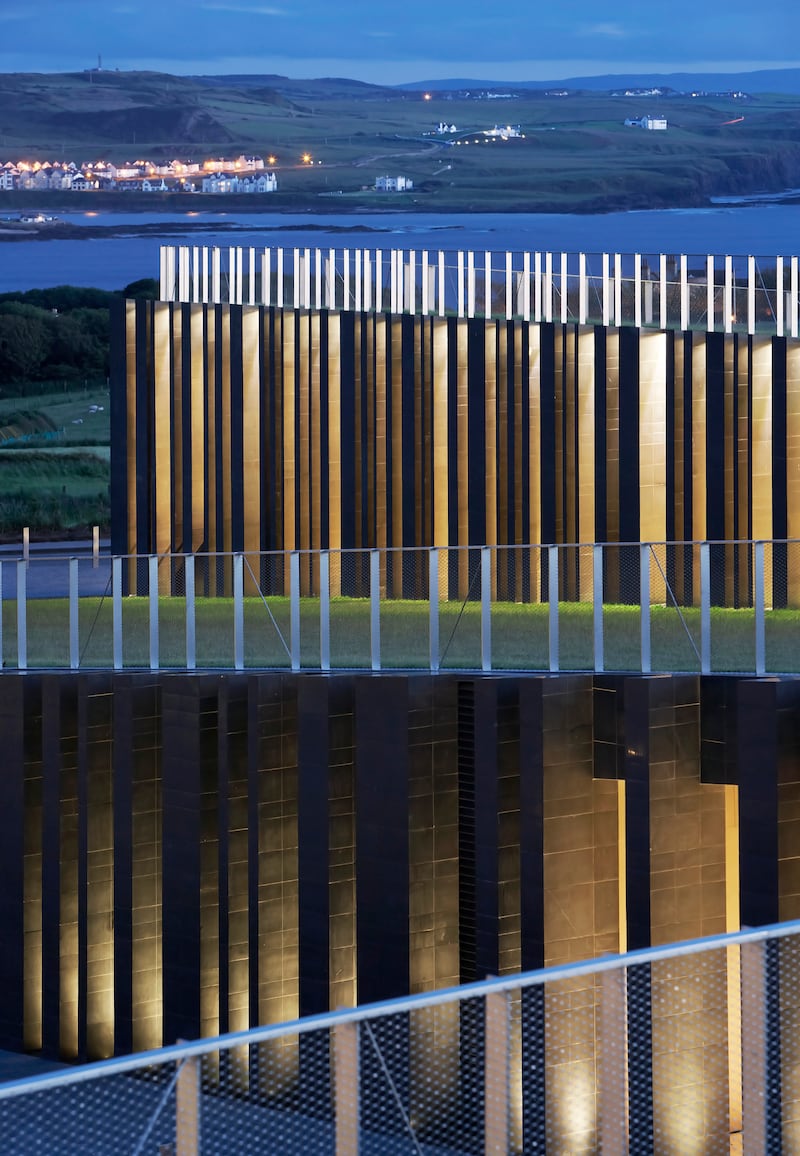
Giant’s Causeway Visitor Centre, Heneghan Peng Architects. Photograph: Hufton+Crow
By the early 2000s, several Irish cities flirted with the idea of a landmark building. Dublin considered cultural mega-projects for the Docklands; Cork, ahead of its 2005 European Capital of Culture year, explored options for a signature arts venue. Internal documents and media commentary repeatedly invoked Bilbao as the precedent. Gehry was, if not formally commissioned, certainly imagined.
But the moment passed, budgets tightened and planning systems bristled. The Irish instinct for architectural modesty reasserted itself, and iconic architecture was deemed too risky, too brash, too incompatible with the national temperament.
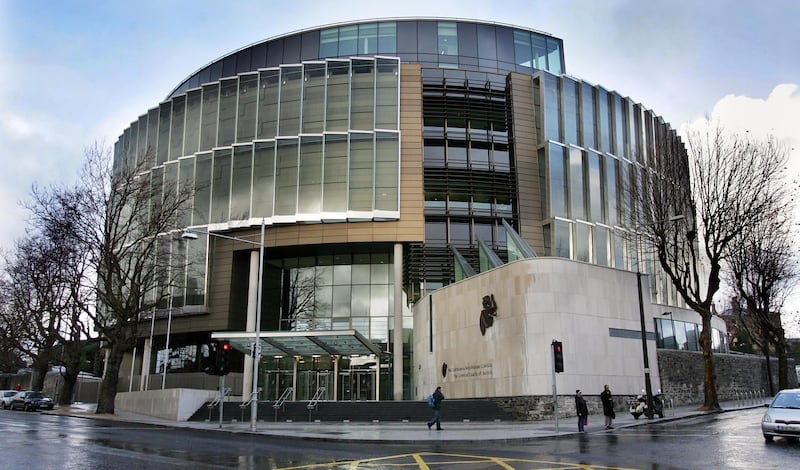
The Criminal Courts of Justice building on Parkgate Street, Dublin. Photograph: Matt Kavanagh/The Irish Times
And yet it feels worth asking: what was lost in that refusal, and is it time to revisit the question?
Ireland today is in a sustained building and planning crisis. We are constructing too little, and what we do build is shaped more by compliance than by vision. Housing emerges from a system optimised for risk avoidance and cost control, not civic ambition. Public projects stall, shrink or arrive in uninspired form. The result is an urban landscape that, despite enormous expenditure and political attention, feels timid, fragmented and uninspired.
You can see this most clearly in the buildings we accept, and the ones we reject. Take St Stephen’s Green Shopping Centre: for all its eccentricity, it is unmistakably itself. Its initial proposed €100 million replacement last year — a smooth, interchangeable facade that could sit in any European city — was rejected by An Coimisiún Pleanála (ACP) on grounds including that it lacked “a strong sense of original aesthetic”. A new design will now be considered.
Or look to the Dublin docklands, once imagined as a showcase of contemporary urban confidence and now a largely uniform field of glass offices and build-to-rent blocks, buildings optimised for tax extraction rather than civic life. Even the National Children’s Hospital, the State’s largest and most troubled public project, has ended up as a vast, technically competent but emotionally flat complex, shaped by years of delays rather than by any visionary architectural intention.
This is not about importing a Gehry building to Ireland, for the era of starchitect monoliths has largely passed, and Gehry himself would bristle at the idea of becoming a formula.
Gehry understood that buildings shape public imagination. Their presence signals what a society believes is worth doing. A daring building does not solve housing shortages or planning bottlenecks, but it can do something subtler: it asserts that public life can be more than functional, while inviting a country to practise fearlessness.
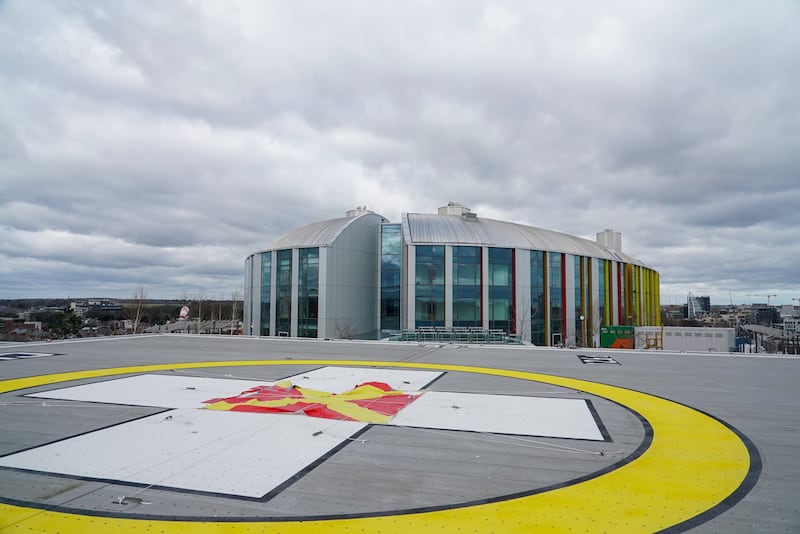
Helipad at the National Children’s Hospital in Dublin. Photograph: Enda O’Dowd
What would it mean for Ireland to recover even a fraction of Gehry’s sensibility? Not his formal vocabulary of the billowing metal and his swooping lines, but the posture behind it – the belief that buildings should matter and that risk has civic value.
In many ways, a Gehry building would have fit beautifully into an Irish context, not because of its showmanship but because of the seriousness with which he treated the emotional life of buildings. Irish culture has always trusted emotion as a creative force; our literature, music and language are built on turning feeling into form. Gehry did the same in architecture.
[ Is Ireland ready for drab Soviet-style apartment blocks?Opens in new window ]
In the early 2000s, when money flowed too easily and cultural confidence was brittle, a titanium-skinned museum on the Liffey might have felt like gaudy overreach. But today, the refusal of architectural ambition reads more as stagnation than as humility. Simply, a country that cannot imagine more than compliance cannot build a future worth living in.
Ireland could use a little of Gehry’s spirit now, a willingness to build with meaning, in architecture and in all public life. Gehry showed that buildings can be instruments of courage. For all our planning laws and procurement rules, the hardest part of building is often simply deciding to try.
Sinéad O’Sullivan is a business economist, formerly at Harvard Business School, where she was head of strategy of the HBS Institute for Strategy