
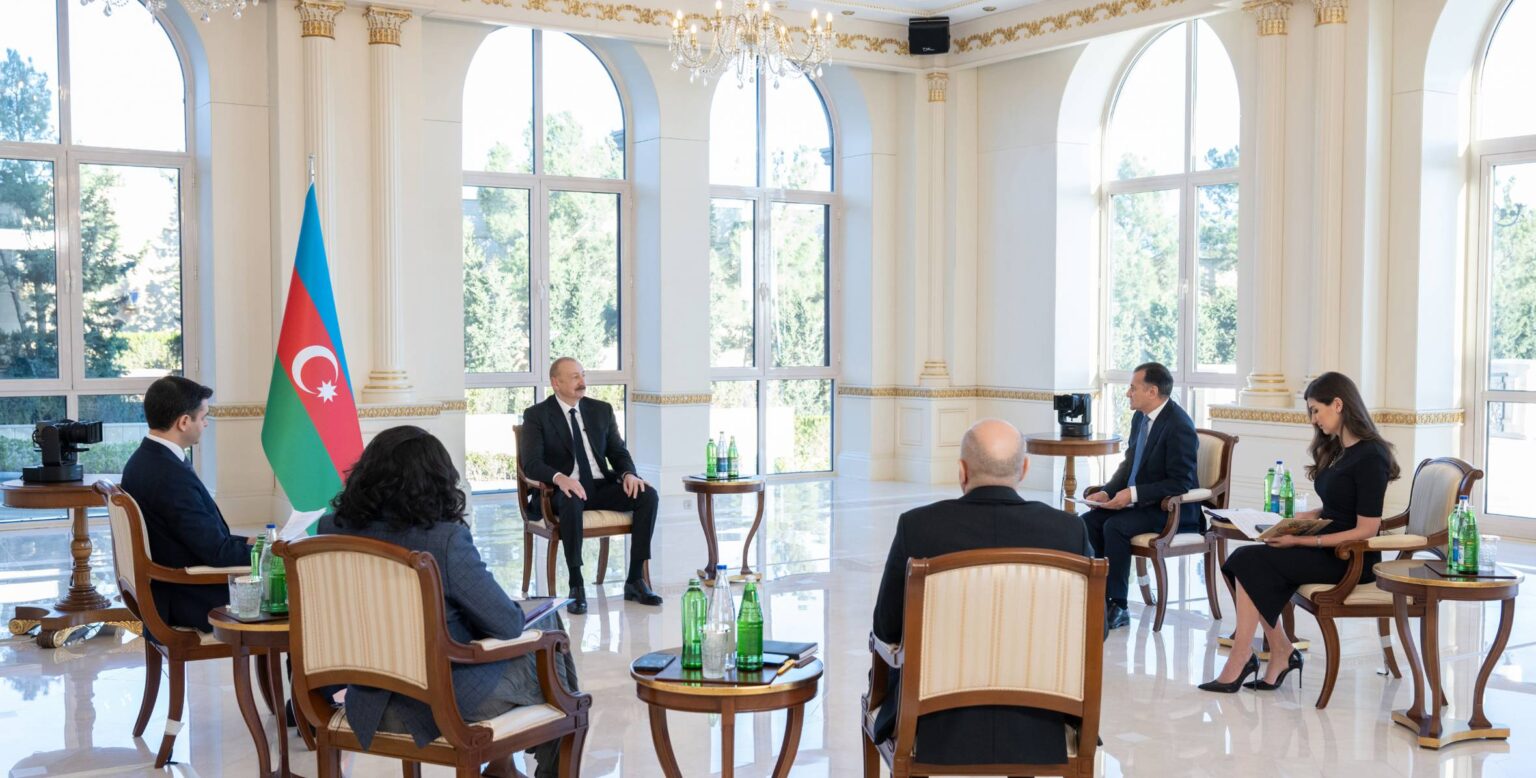
The interview given by President of the Republic of Azerbaijan Ilham Aliyev to the local media in Azerbaijan on 5 January 2026 constitutes a strategic manifesto that clearly reveals how the new global order is perceived and where Azerbaijan positions itself within this order.
Among Aliyev’s remarks, the statement that, in my view, draws the most attention is the following:
“There is no such thing as international law in today’s world.”
This statement may sound harsh. It may even be disturbing for some. But the question we must ask ourselves today is this: Is it wrong?
When we consider the reality of children being bombed before the eyes of the world in Gaza, a population being bombed by their ethnic kin in Ukraine, and the fact that the President of Venezuela was taken from his bed at night, is this statement really wrong? In this context, the real question is actually this: “For whom does international law function? For whom does it have any meaning?” We live in a world where the strong define the law, and the weak have no option other than to seek refuge in it. What Aliyev does is not to embellish this reality with diplomatic courtesy, but to state it as it is.
In my view, this point was also decisive for the Karabakh process experienced by Azerbaijan. For years, the silence surrounding Azerbaijan’s occupied territories in the international arena, the unimplemented UN resolutions, and the silent international actors taught Baku the following lesson: Rights can only be protected by power. In this context, the Azerbaijani people liberated their occupied lands through the power they gained and the bond of brotherhood they established with Türkiye.
The Zangezur Corridor: Not a Road, but a Geopolitical Message
The issue of the Zangezur Corridor, which constitutes the backbone of the interview, is also a result of this perspective. For Aliyev, this corridor is not merely a transportation route connecting mainland Azerbaijan with Nakhchivan. This project is also;
a component that enhances the capacity of East–West trade,
the North–South energy and logistics line, and the Middle Corridor.
In fact, the issue of the Zangezur Corridor is, in Aliyev’s words, “a resolved matter.”
In this context, according to Aliyev, the name of this corridor may change, its formula may change; but its essence will not change. At this point, the message given to Armenia is extremely clear: “Resisting this process means resisting geopolitical reality.” Aliyev’s statement that “avoiding it would be suicide” should be read not as a threat, but as a geopolitical warning.
“The Strong Could Have Stopped It”
Another issue that Aliyev particularly emphasizes in the interview is why Azerbaijan did not use its military power in an unlimited manner during the Second Karabakh War. In this context, Aliyev characterizes Azerbaijan not only as the winning side, but also as a responsible actor that used controlled force. When Aliyev says in the interview, “No one could have stopped us,” he is making a declaration of self-confidence. When he says, “We did not do this because it would have been wrong,” he is drawing a political boundary. This approach reveals Azerbaijan’s claim to being a regional power that now possesses not only military strength, but also political maturity. At the same time, this approach demonstrates that the Azerbaijani Turk has fulfilled the requirements of the Turkic code of warfare.
The Turkic World and Military Reality
One of the most strategic parts of Aliyev’s interview is undoubtedly the messages regarding the Organization of Turkic States. Aliyev clearly states the following: If international law does not function, states must ensure their own security. In this context, while emphasizing the military alliance with brotherly Türkiye, Aliyev puts forward the idea of joint military exercises for the Turkic world. The point that should be noted in Aliyev’s message is this: in the new world, the need for military coordination, deterrence, and a common reflex is openly articulated.
This, in fact, raises the following question:
If Turkic states can act together in areas such as energy, trade, and transportation, why should they not act together on a vital issue such as security?
As a result, as Aliyev also emphasizes, the world is no longer governed by idealistic texts, but by balances of power. Those who want peace must be strong. Those who want to defend the law must first be able to defend themselves.
You may not like this approach; you may even find it harsh. But ignoring this reality in the new world order means that your above-ground and underground resources, along with all your values, become playthings in the hands of the strong. In this context, the main message I take from Aliyev’s interview is: “If you are not strong, being right has no meaning,” because today the world is shaped precisely around this sentence.
Ahmet Sağlam